OpenEvidence and Johns Hopkins Medicine Announce Landmark Collaboration to Design the Future of Medicine and Medical Education in the Age of AI
OpenEvidence and Johns Hopkins Medicine Announce Landmark Collaboration to Design the Future of Medicine and Medical Education in the Age of AI
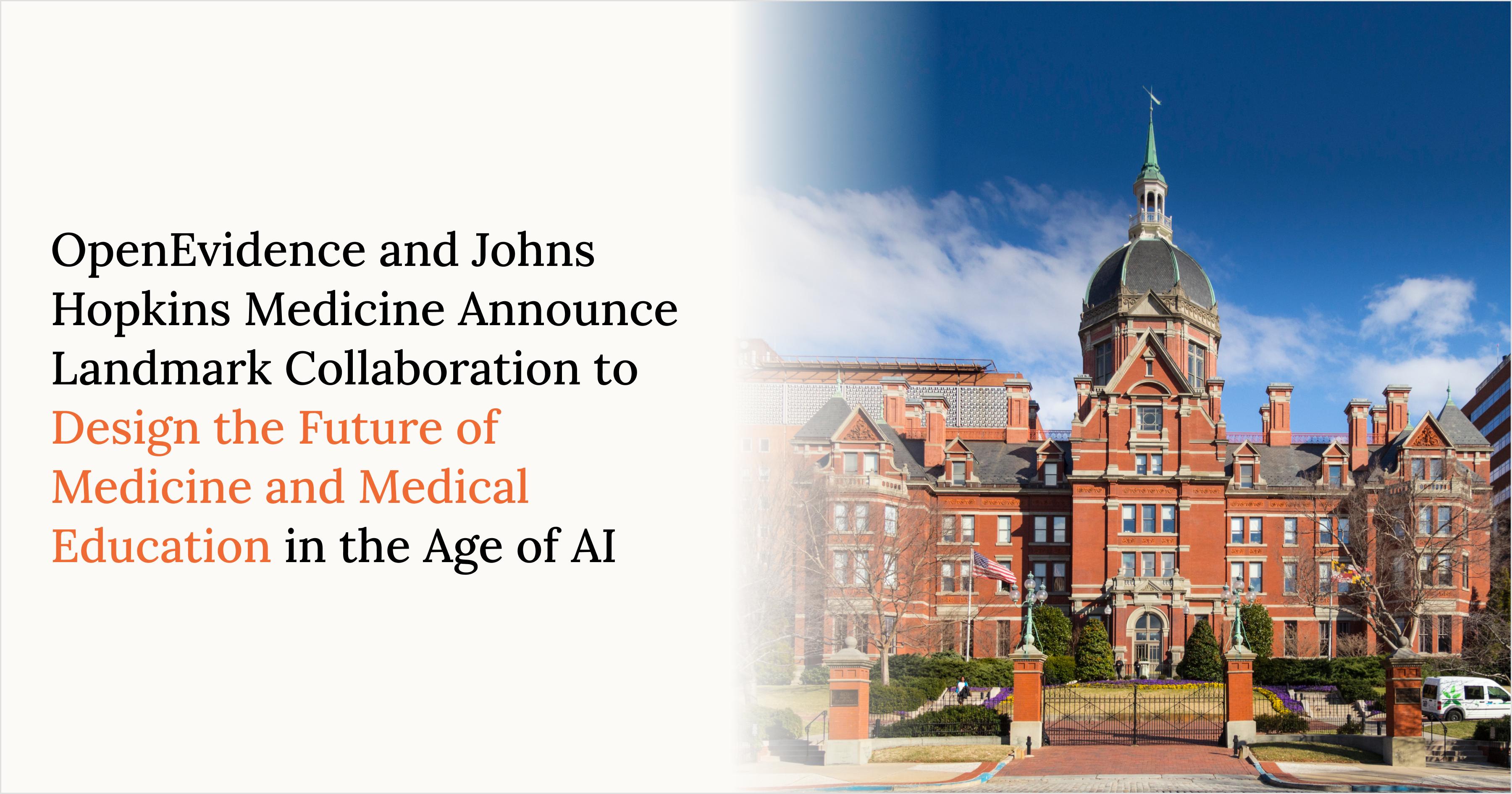
MIAMI & BALTIMORE--(BUSINESS WIRE)--OpenEvidence, the most popular AI for doctors in the United States, today announced a strategic collaboration with Johns Hopkins Medicine (JHM) to reimagine medical education and clinical care in the age of artificial intelligence. The collaboration spans two foundational pillars: preparing the next generation of clinicians for the future in which they will practice and ensuring every patient receives care grounded in the latest, evidence-based clinical guidelines. Ultimately, this is about using AI to serve what has always mattered most – better outcomes for patients.
"Working with OpenEvidence enables us to design and inspire, very deliberately, the model of education and the practice of medicine for this new era." --Sanjay Desai, MD, MACP, Vice Dean for Education, Johns Hopkins Medicine.
Share
The collaboration begins from the shared conviction that the emerging transformation in medicine requires a deliberate reimagination of both education and clinical practice. As AI becomes capable of surfacing and synthesizing the world's medical knowledge in seconds, the role of the clinician shifts toward what cannot be automated: first-principles reasoning, clinical and contextual judgment, and the deeply human work of caring for patients.
Johns Hopkins established the current model of medical education in the United States more than a century ago. OpenEvidence, the most widely adopted medical AI in the United States, has transformed how physicians access and interact with medical knowledge. Together, OpenEvidence and Johns Hopkins will design a medical education model that strengthens foundational principles -- a deep understanding of pathophysiology, evidence-based medicine, clinical reasoning from first principles, and the diagnostic and interpersonal skills at the heart of capable and compassionate care -- while creating novel adaptive AI systems that prepare physicians to lead, and continuously learn, in an AI native environment. Just as Johns Hopkins defined the standard for 20th-century medical training, the two organizations aim to define what rigorous, patient-centered medical education looks like in the AI era.
"Johns Hopkins designed modern medical education around a simple idea: that physicians learn medicine at the bedside, grounded in science and reasoning. The arrival of AI, in many ways, invites us back to the bedside with new tools and capabilities we have yet to fully imagine. Working with OpenEvidence enables us to design and inspire, very deliberately, the model of education and the practice of medicine for this new era," said Sanjay Desai, MD, MACP, Vice Dean for Education, Johns Hopkins Medicine.
"The question in front of medicine is not whether AI will change the physician's role — it is who will define that change, and on what principles," said Travis Zack, MD, PhD, Chief Medical Officer of OpenEvidence. "We believe the future of medicine should be built, not reacted to, and that it must keep patients at the center. There is no institution better suited to build it with than Johns Hopkins, the birthplace of modern medical education."
Together Open Evidence and Johns Hopkins Medicine will also develop human-first AI systems designed to improve care delivery – surfacing and synthesizing the best available evidence in the context of the patient's own medical history and best practices established at Johns Hopkins Medicine. Sophisticated AI will empower clinicians to more quickly reason through that information, contextualize it, and make the best decision for their patient.
“Johns Hopkins clinicians always strive to deliver the best care in the world. This collaboration with OpenEvidence is an opportunity to build on that — giving them tools that make every encounter more informed, more precise, and more attuned to the individual patient in front of them,” said Sara Murray, MD, MAS, Chief Medical Informatics & AI Officer, Johns Hopkins Medicine.
About OpenEvidence
OpenEvidence is the most popular AI for doctors in the United States. According to independent studies, more American physicians use OpenEvidence than all other AI platforms combined. OpenEvidence is trusted by millions of verified U.S. healthcare professionals making high-stakes clinical decisions at the point of care, with evidence that is sourced, cited, and grounded in peer-reviewed medical literature. Founded with the mission to organize and expand the world's collective medical knowledge, OpenEvidence is now used daily, on average, by the majority of physicians in the United States. OpenEvidence is free for all verified U.S. clinicians. Learn more at openevidence.com.
Contacts
OpenEvidence: media@openevidence.com
John Hopkins: jhmedia@jhmi.edu