Thermedical Names Leading Electrophysiologists to Oversee Pivotal Study of SERF Ablation for Ventricular Tachycardia
Thermedical Names Leading Electrophysiologists to Oversee Pivotal Study of SERF Ablation for Ventricular Tachycardia
Independent data safety monitoring board, clinical events committee and arrhythmia core lab draw experts from leading academic medical centers in the U.S. and Canada; David J. Callans, MD, to present early results at VT Symposium 2026 on Oct. 9
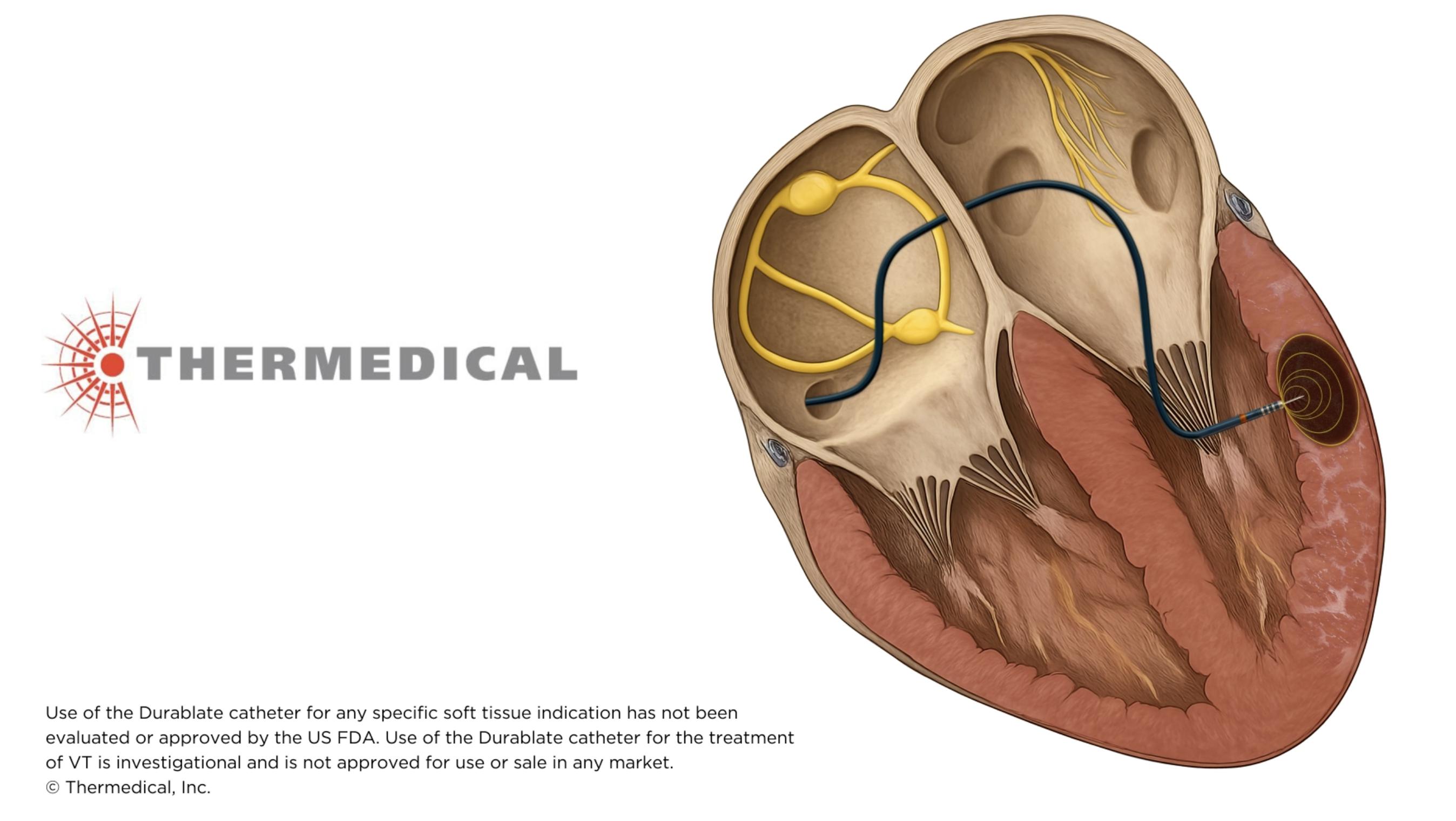
Thermedical® announces members of the independent data safety monitoring board (DSMB), clinical events committee (CEC), and arrhythmia core lab overseeing its pivotal clinical study of the Saline Enhanced Radiofrequency (SERF) Ablation System with the Durablate® Catheter. The nine experts include eight electrophysiologists and a biostatistician from leading academic medical centers in the U.S. and Canada. Early results from the pivotal study will be presented Oct. 9 at VT Symposium 2026 in Brooklyn.
WESTON, Mass.--(BUSINESS WIRE)--Thermedical®, a developer of advanced thermal-ablation technologies, today announced the members of the independent data safety monitoring board (DSMB), clinical events committee (CEC) and arrhythmia core lab overseeing its pivotal clinical study of the Saline Enhanced Radiofrequency (SERF) Ablation System with the Durablate® Catheter. The study is evaluating SERF ablation in patients with ventricular tachycardia (VT) that continues despite medications and prior ablation procedures.
“The patients in this study have VT that keeps coming back after medications and multiple ablations, and they deserve a study run with uncompromising rigor,” said Dr. Michael Curley, inventor of SERF ablation and co-founder and CEO of Thermedical.
Share
The nine experts include eight electrophysiologists and a biostatistician from leading academic medical centers in the U.S. and Canada. Wendy S. Tzou, MD, director of cardiac electrophysiology at the University of Colorado School of Medicine, chairs the DSMB. John Sapp Jr., MD, professor in the Division of Cardiology at Dalhousie University, chairs the CEC and the core lab. Together, the committees will review safety data, adjudicate clinical events and assess arrhythmia outcomes throughout the study.
Early results from the pivotal study will be presented Oct. 9 at VT Symposium 2026 in Brooklyn. David J. Callans, MD, associate director of electrophysiology at the University of Pennsylvania Health System and course director of the symposium, will present “Saline-Enhanced Radiofrequency (SERF) Ablation for VT” during Session IX: Reaching the Unreachable at 5:30 p.m. EDT. The symposium takes place Oct. 9-10 at the New York Marriott at the Brooklyn Bridge. Thermedical is a sponsor of the meeting, and attendees can see SERF technology at the company’s table.
“The patients in this study have VT that keeps coming back after medications and multiple ablations, and they deserve a study run with uncompromising rigor,” said Dr. Michael Curley, inventor of SERF ablation and co-founder and CEO of Thermedical. “These are among the most respected names in electrophysiology and clinical research. Their independent review of every safety event and arrhythmia outcome means the results of this study will stand on their own.”
Data Safety Monitoring Board
The DSMB periodically reviews the study’s safety and effectiveness data. It evaluates the incidence of all adverse events, particularly those of moderate or severe intensity, monitors the quality of safety data and recommends whether the study should be modified or stopped to protect participants. Members are:
- Wendy S. Tzou, MD, FHRS, FACC (chair), professor of medicine and director of cardiac electrophysiology, University of Colorado School of Medicine, Anschutz Medical Campus
- John M. Miller, MD, FACC, FAHA, FHRS, professor of medicine and head of the electrophysiology service, Krannert Cardiovascular Research Center, IU Health
- Henry Huang, MD, FACC, FHRS, director of cardiac electrophysiology, University of Chicago
- George Wells, PhD, biostatistician, Cardiovascular Research Methods Centre, University of Ottawa Heart Institute
Clinical Events Committee
The CEC reviews all reported adverse events and adjudicates the study’s critical safety endpoints. Members are:
- John Sapp Jr., MD, FRCPC, FHRS (chair), professor, Division of Cardiology, Dalhousie University
- Jaimie Manlucu, MD, FRCPC, associate professor of medicine, Division of Cardiology, Schulich School of Medicine & Dentistry, Western University
- Jeanne Poole, MD, FACC, FHRS, professor of medicine, Division of Cardiology, UW Medicine
Arrhythmia Core Lab
The arrhythmia core lab systematically collects, reviews and adjudicates tachyarrhythmia events for study participants throughout the trial. Members are:
- John Sapp Jr., MD, FRCPC, FHRS (chair), professor, Division of Cardiology, Dalhousie University
- Alfred E. Buxton, MD, Ben-Haim Josephson Professor of Medicine, Harvard Medical School, Cardiovascular Division, Beth Israel Deaconess Medical Center
- Andre d’Avila, MD, PhD, director of the cardiac arrhythmia service, Harvard Thorndike Electrophysiology Institute, Beth Israel Deaconess Medical Center and Harvard Medical School
About the SERF-VT Ablation Study
The SERF-VT Ablation Study (ClinicalTrials.gov ID: NCT05337241) is a pivotal clinical study evaluating SERF ablation in patients with VT that recurs despite antiarrhythmic medications and prior catheter ablation. The first patient was treated in December 2025 at the Montreal Heart Institute, and enrollment is ongoing. The study builds on earlier feasibility work and is supported by a $3 million grant from the National Heart, Lung and Blood Institute (R44HL169112).
About SERF Ablation
VT is an abnormally rapid heart rhythm and a leading cause of sudden cardiac death, which kills 325,000 adults in the U.S. every year.1 Many VT circuits lie deep within the heart muscle, beyond the effective reach of conventional ablation tools. SERF ablation delivers radiofrequency energy and heated saline inside the myocardium, so heat is carried into the muscle by saline rather than conducted only from the surface. This gives the electrophysiologist control over the lesion, from as small as conventional RF to transmural when the case requires it. The Durablate catheter is engineered to deliver this energy precisely, with the goal of treating intramural VT substrates that contribute to repeat procedures, implantable cardioverter defibrillator (ICD) shocks and ongoing clinical instability. Earlier studies showed elimination of clinical VT during the procedure and reductions in ICD shocks during follow-up.
SERF ablation for the treatment of VT is investigational and limited by U.S. law to investigational use.
About Thermedical
Thermedical is a privately held medical technology company founded by Michael G. Curley, Ph.D., FHRS, and Patrick S. Hamilton, Ph.D., both alumni of the MIT Hyperthermia Center. Dr. Curley, an engineer with SB, SM and PhD degrees from MIT, is also the inventor of the AcuNav® Diagnostic Ultrasound Catheter, a breakthrough technology that dramatically improved visualization during cardiac ablation procedures and helped to accelerate the growth of the atrial fibrillation ablation market into a major global category. Building on this legacy of innovation, Thermedical develops advanced thermal-ablation technologies to treat ventricular tachycardia and solid tumors. The company is based in Weston, Mass., and is supported by NIH SBIR grants, the Massachusetts Life Sciences Center and venture financing. www.thermedical.co.
1 https://www.webmd.com/heart-disease/sudden-cardiac-death
Contacts
Media Contact:
Amy Cook
amy@amcpublicrelations.net
+1 925-222-5094