Kioxia Announces KIOXIA GP1 Series Super High IOPS SSDs for AI Applications
Kioxia Announces KIOXIA GP1 Series Super High IOPS SSDs for AI Applications
PCIeⓇ 6.0 SSD Achieves 10 Million IOPS Using KIOXIA XL-FLASH™ Flash Memory
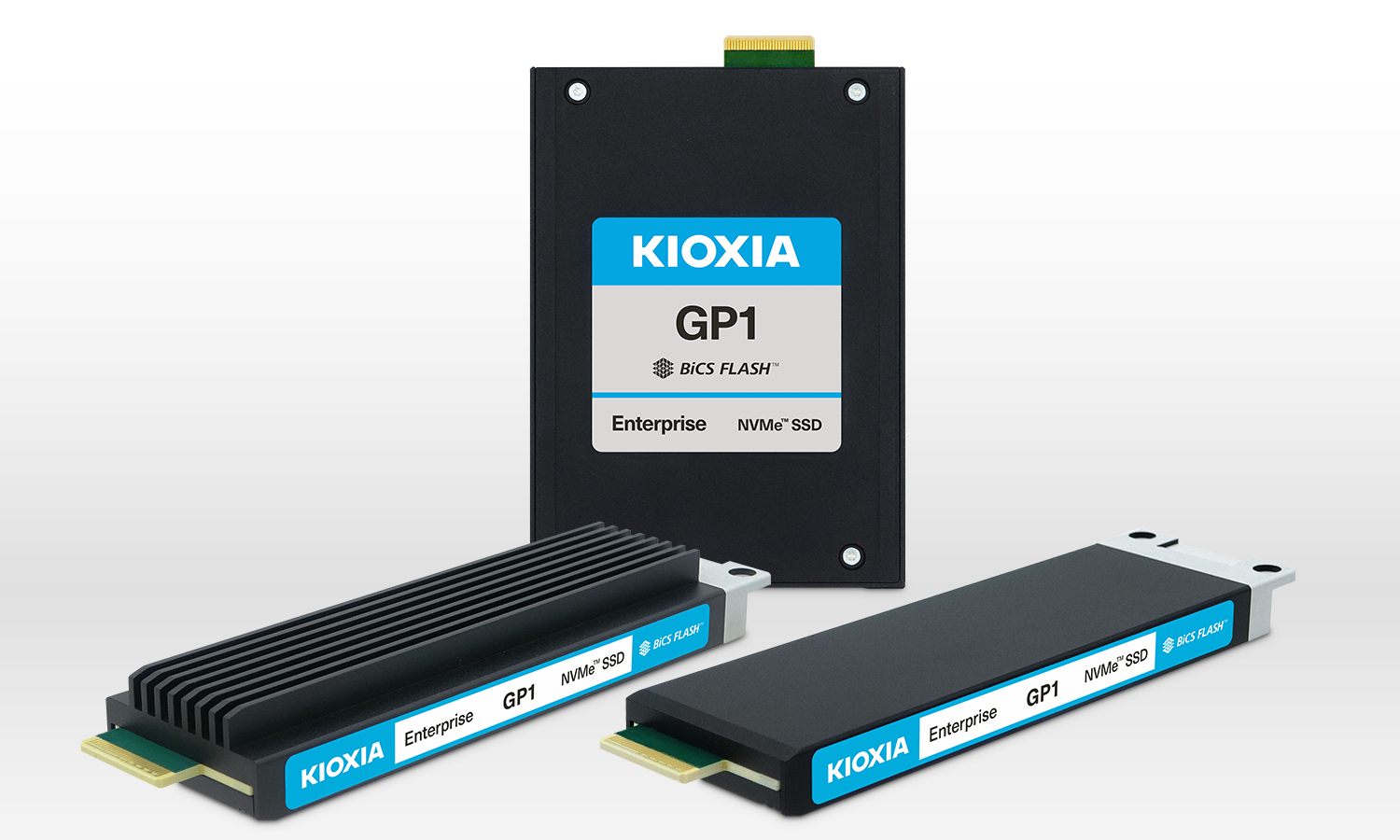
TOKYO--(BUSINESS WIRE)--Kioxia Corporation today announced the KIOXIA GP1 Series PCIe® 6.0 NVMe™ SSDs, the first product in its KIOXIA GP Series of Super High IOPS SSDs optimized for GPU direct access. Building on the KIOXIA GP Series technology introduced earlier this year1, the KIOXIA GP1 Series delivers up to 10 million random read IOPS2 using KIOXIA XL-FLASH™ generation 2 flash memory, enabling flash-based memory extension to help address the growing performance and memory demands of AI infrastructure. Evaluation samples will be available to select customers by the end of 20263. The KIOXIA GP1 Series will be showcased at FMS: the Future of Memory and Storage, taking place August 4 – 6 in Santa Clara, California.
The KIOXIA GP1 Series is designed to support emerging AI storage architectures, which extend High Bandwidth Memory (HBM) as a fast flash memory media-based tier. This approach lets AI systems access larger datasets at a significantly lower cost than adding more HBM4, while improving GPU utilization.
KIOXIA GP1 Series SSDs leverage KIOXIA XL-FLASH generation 2 low-latency, high-performance flash memory to deliver significantly higher IOPS4, finer-grained 512-byte data access, and lower power consumption per I/O compared to conventional TLC-based SSDs. The architecture is designed to scale from today's 10 million random read IOPS to future generations targeting up to 100 million IOPS.
Key features of the KIOXIA GP1 Series include:
- Designed to PCIe® 6.0 and NVMe™ 2.2 specifications
- Utilizes KIOXIA XL-FLASH generation 2 low-latency flash memory
- Up to 10 million random read IOPS at a 512-byte block size2
- Available in E3.S, E1.S 9.5 mm/15mm form factors, with cold-plate liquid cooling capability in E3.S and E1.S 9.5mm form factors (all form factors support traditional air-cooled environments)
- Up to 50 DWPD endurance5
Notes:
1: Kioxia Announces New SSD Model Optimized for AI GPU-Initiated Workloads
(https://www.kioxia.com/en-jp/business/news/2026/20260317-1.html)
2: Read and write speed may vary depending on various factors such as host devices, software (drivers, OS etc.), and read/write conditions.
3: These samples are for the functional check purpose only and the specifications of the samples may differ in mass production.
4: As of July 28, 2026, based on Kioxia survey.
5: DWPD: Drive Writes Per Day. One full drive write per day means the drive can be written and re-written to full capacity once a day every day under the specified workload for the specified lifetime. Actual results may vary due to system configuration, usage and other factors.
Definition of capacity: Kioxia Corporation defines a megabyte (MB) as 1,000,000 bytes, a gigabyte (GB) as 1,000,000,000 bytes and a terabyte (TB) as 1,000,000,000,000 bytes. A computer operating system, however, reports storage capacity using powers of 2 for the definition of 1GB = 2^30 bytes = 1,073,741,824 bytes and 1TB = 2^40 bytes = 1,099,511,627,776 bytes and therefore shows less storage capacity. Available storage capacity (including examples of various media files) will vary based on file size, formatting, settings, software and operating system, and/or pre-installed software applications, or media content. Actual formatted capacity may vary.
NVMe is a registered or unregistered mark of NVM Express, Inc. in the United States and other countries.
PCIe is a registered trademark of PCI-SIG.
Other company names, product names and service names may be trademarks of third-party companies.
About Kioxia
Kioxia is a world leader in memory solutions, dedicated to the development, production and sale of flash memory and solid-state drives (SSDs). In April 2017, its predecessor Toshiba Memory was spun off from Toshiba Corporation, the company that invented NAND flash memory in 1987. Kioxia is committed to uplifting the world with “memory” by offering products, services and systems that create choice for customers and memory-based value for society. Kioxia's innovative 3D flash memory technology, BiCS FLASH™, is shaping the future of storage in high-density applications, including advanced smartphones, PCs, automotive systems, data centers and generative AI systems.
*Information in this document, including product prices and specifications, content of services and contact information, is correct on the date of the announcement but is subject to change without prior notice.
Contacts
Media Inquiries:
Kioxia Corporation
Promotion Management Division
Satoshi Shindo
Tel: +81-3-6478-2404