Feinstein Institutes’ fifth Bioelectronic Medicine Summit spotlights innovation, future of science
Feinstein Institutes’ fifth Bioelectronic Medicine Summit spotlights innovation, future of science
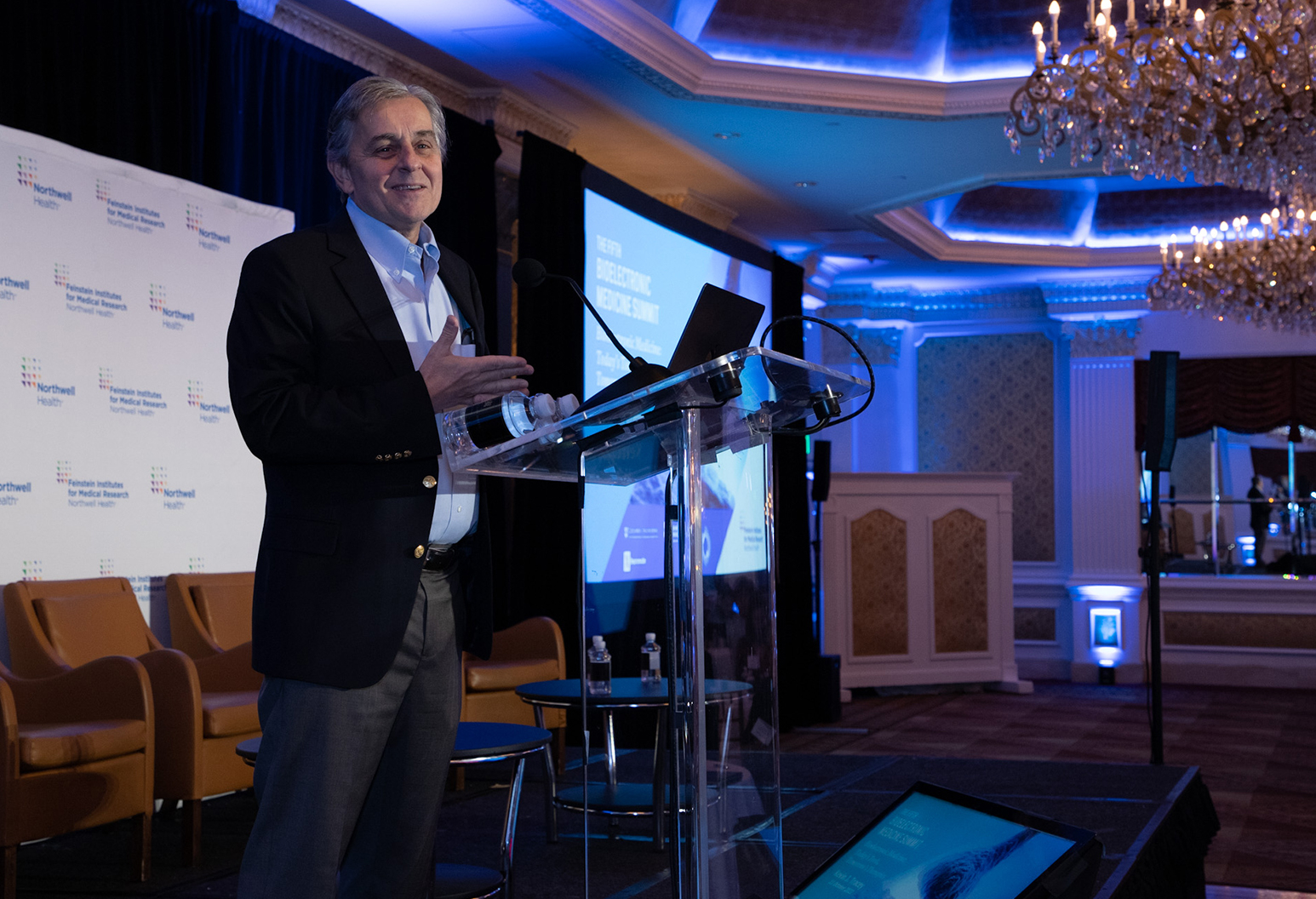
MANHASSET, N.Y.--(BUSINESS WIRE)--Some of the most influential international medical experts, researchers and scientific minds participated in the fifth Bioelectronic Medicine Summit, “Bioelectronic Medicine: Today’s Tools, Tomorrow’s Therapies,” hosted by The Feinstein Institutes for Medical Research. Along with The Columbia University’s School of Engineering and Applied Science, the event was the first in-person Summit since the pandemic, taking place on October 11-12 at the Garden City Hotel in Garden City, New York, where more than 170 people attended.
Bioelectronic medicine combines molecular medicine, neuroscience and biomedical engineering to develop innovative therapies using computer chips and devices instead of drugs to treat a variety of diseases and conditions through stimulation of nerves, including paralysis, arthritis, pulmonary hypertension and inflammatory bowel disease.
“Progress in bioelectronic medicine is accelerating in clinical trials and basic science,” said Kevin J. Tracey, MD, president and CEO of the Feinstein Institutes and Karches Family Distinguished Chair in Medical Research. “This years’ Summit celebrated the collaboration between biomedical engineers, neuroscientists and molecular biologists that is driving the innovative progress for this exciting field.”
Key highlights from the two-day symposium include:
- Robert Gaunt, PhD, University of Pittsburgh, discussed translating brain computer interfaces, the specific needs of patient populations and identifying key technical, regulatory and commercial roadblocks.
- Eric Van Gieson, PhD, Defense Advanced Research Projects Agency, conducted a panel about emerging devices, neural interfaces and developing new technologies.
- Eric Hudak, PhD, National Institutes of Health, discussed how bioelectronic medicine approaches can be used to treat peripheral organ disorders and target complex disorders of immunity, cardiovascular system, metabolism and others.
- Anil Malhotra, MD, co-director of the Institute of Behavioral Science at the Feinstein Institutes, explained how bioelectronic medicine could help treat neuropsychiatric disorders.
- Erika Ross, PhD, R&D Applied Research, described how using digital health data from consumer and clinical devices could inform biomarkers of disease and improve treatment efficacy, device deployment and trial recruitment.
“It is exciting to exchange ideas with some of the smartest people leading the progress in bioelectronic medicine,” said Yousef Al-Abed, PhD, co-chair of the Summit and co-director of the Institute of Bioelectronic Medicine, along with Lopa Mishra, MD. “It is important that collectively, researchers from around the globe continue to share their knowledge and help evolve this promising field of science.”
Some of the key topics discussed included breakthrough research involving the development of bioelectronic therapies for brain disorders, new technologies and interfaces for stimulation, biosensing and the use of data science and machine learning in neural systems.
The Feinstein Institutes, the global scientific home of bioelectronic medicine, continues to invest in bioelectronic medicine. Funded in part by previous state grants, New York State Governor Kathy Hochul recently announced an extra $10 million award to upgrade and create more lab space, recruit new scientists, create new jobs and propel research.
In partnership with BioMed Central, part of Springer Nature, the Feinstein Institutes publishes the journal Bioelectronic Medicine. From biochemistry to mechanical engineering, and a special focus on electrical signaling in the nervous system, the journal is an open-access publication platform that amplifies the impactful global research being done in the growing field of science.
About the Feinstein Institutes
The Feinstein Institutes for Medical Research is the research arm of Northwell Health, the largest health care provider and private employer in New York State. Home to 50 research labs, 3,000 clinical research studies and 5,000 researchers and staff, the Feinstein Institutes raises the standard of medical innovation through its five institutes of behavioral science, bioelectronic medicine, cancer, health innovations and outcomes, and molecular medicine. We make breakthroughs in genetics, oncology, brain research, mental health, autoimmunity, and are the global scientific leader in bioelectronic medicine – a new field of science that has the potential to revolutionize medicine. For more information about how we produce knowledge to cure disease, visit http://feinstein.northwell.edu and follow us on LinkedIn.
Contacts
Julianne Mosher Allen
516-880-4824
jmosherallen@northwell.edu