Feinstein Institutes Technology That Restores Movement and Sensation After Paralysis Featured in Nature Medicine
Feinstein Institutes Technology That Restores Movement and Sensation After Paralysis Featured in Nature Medicine
Three-year clinical trial demonstrates ‘double neural bypass’ system rewires nervous system to enable lasting recovery in severe spinal cord injury
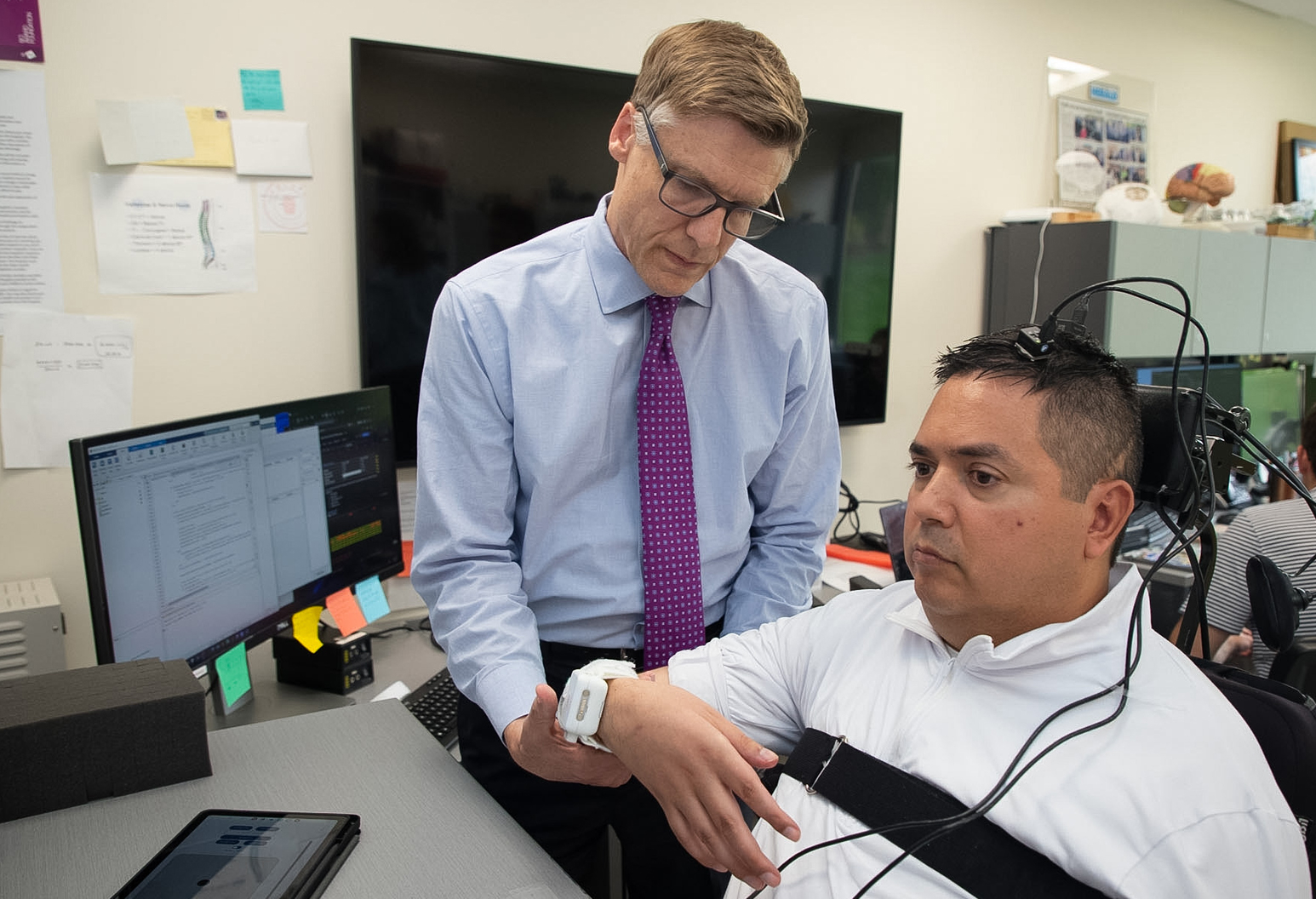
MANHASSET, N.Y.--(BUSINESS WIRE)--Nature Medicine today featured on its cover the findings from The Feinstein Institutes for Medical Research, demonstrating that its “double neural bypass” technology can restore immediate function and promote lasting neurological recovery in complete spinal cord injury.
The study reveals how the novel hybrid brain computer interface (BCI) system combines cutting-edge BCI technology with artificial intelligence (AI) and high-precision electrical stimulation of the spinal cord and brain to achieve what was previously thought impossible: rewiring the nervous system to restore hand function in a person with complete tetraplegia. Over three years of clinical testing, the technology enabled a participant living with quadriplegia, Keith Thomas of Massapequa, NY, not only to feed himself and drink from a cup using his own hand, but also to achieve persistent gains in arm strength and wrist sensation. You can view Mr. Thomas’ remarkable story, showing how he regained the ability to move and feel his previously paralyzed hand – a world’s first.
“This research holds promise for millions of patients, opening up potential for future research and practical clinical applications that could help hundreds of thousands of people living with paralysis. We saw this in action when Keith was able to move and feel again,” said Chad Bouton, PhD, professor in the Institute of Bioelectronic Medicine at the Feinstein Institutes and corresponding author. “This approach is a new way to treat severe paralysis – we’re not just bypassing the injury; we’re actually rewiring the nervous system. Our team of engineers, neurosurgeons and clinical research staff accomplished something that’s never been done before.”
The double neural bypass promotes neuroplasticity - the nervous system’s ability to form new connections and pathways. This dual assistive-therapeutic strategy, developed at the Feinstein Institutes, combining BCI implants with non-invasive wearable stimulation patches worn over the skin to electrically stimulate spinal cord and muscle targets, enabled recovery that persisted for months after stimulation ended, suggesting actual rewiring of damaged neural circuits.
Over 35 weeks of this intervention, Mr. Thomas achieved statistically significant increases of 86 percent in right arm strength and 62 percent in left arm strength. A man who could not lift his hands to his face at the start of the study could now independently scratch his nose and wipe his mouth.
The research team also developed a therapeutic technique called “cortical mirroring” that produced ongoing and durable restoration of tactile sensation. This approach involves recording the patterns of brain activity that occur during imagined touch, then “replaying” those patterns through electrical stimulation of the sensory cortex while simultaneously stimulating the spinal cord and skin. After approximately 25 weeks of the cortical mirroring intervention targeting the right wrist, Mr. Thomas regained the ability to feel touch in an area that had been completely insensate since his injury.
These improvements in strength and sensation persisted for months during the study after the intervention ended. “Remarkably, in a recent follow-up, it was found that these gains were still present after more than two years. This is incredibly encouraging,” said Dr. Bouton.
How the System Works
The study demonstrates the successful integration of five microelectrode arrays surgically implanted in Mr. Thomas’ brain (done after a 15-hour open-skull surgery), 128 channels recording from motor cortex and 96 channels in sensory cortex. Advanced machine learning algorithms decode movement intentions from brain signals with remarkable consistency, achieving up to 84.6 percent accuracy sustained over five months without requiring any retraining.
When Mr. Thomas thinks about moving his hand, AI helps translate those neural signals into precise patterns of electrical stimulation delivered to muscles in his forearm, moving his own paralyzed hand. Simultaneously, force sensors embedded in a custom 3D-printed orthotic device measure pressure during grasping and trigger electrical stimulation patterns in the brain’s sensory cortex, creating the perception of touch in specific locations on the hand.
The system’s precision enables extraordinarily delicate control. Mr. Thomas successfully grasped and lifted hollow, empty eggshells 87 percent of the time without breaking them. Remarkably, he could perform this delicate manipulation while simultaneously holding conversations, demonstrating reduced cognitive burden compared to earlier brain-computer interface systems.
Real-World Impact
The study addresses a critical need for the estimated 15 million people living with spinal cord injury worldwide, more than half of whom have tetraplegia affecting arm and hand function. Individuals with tetraplegia rank restoring hand function as their highest priority – above walking, bowel and bladder. Yet recovery of useful hand function after complete cervical spinal cord injury has remained exceedingly rare.
Mr. Thomas, now 48 years old, sustained his injury in a 2020 pool diving accident that left him with complete C4 sensory and C5 motor tetraplegia. Just 13 months post-injury when he enrolled in the clinical trial, he could not lift his arms to his face, hold objects, or feel any sensation in his hands and wrists. He required complete assistance with all activities of daily living.
“Being able to feel my sister’s hand, to pet my dog and feel her fur – these experiences that the injury took away have been restored,” said Mr. Thomas. “But beyond the study sessions, I can now scratch my face, wipe my eyes independently. The technology has given me back both connection and sense of self.”
The design of the double neural bypass system allows it to be tailored to individual injury patterns and potentially adapted for other neurological conditions, including stroke. The use of transcutaneous spinal cord stimulation reduces surgical burden and associated risks, potentially accelerating clinical translation.
“Dr. Bouton and his team have significantly advanced the fields of bioelectronic medicine and brain-computer interfaces,” said Kevin J. Tracey, MD, president and CEO of the Feinstein Institutes and Karches Family Distinguished Chair in Medical Research. “By combining brain-computer interface technology with high-precision neuromodulation they have opened new therapeutic possibilities for restoring function after injury to the brain and nervous system.”
The technology’s innovative approach and potential impact have earned significant recognition, including being named to TIME Magazine’s Best Inventions Hall of Fame, which recognizes 25 groundbreaking inventions from the past quarter century that have had the most global and societal impact. The double neural bypass was also featured on TIME’s Best Inventions of 2024 list.
Dr. Bouton and team are now further improving the technology and planning expanded clinical trials to test the double neural bypass system in additional participants with varying levels of spinal cord injury and potentially other neurological conditions such as post-stroke movement impairment. Furthermore, the team recently completed another study demonstrating an “interhuman neural bypass” where Mr. Thomas used his brain implant to help another participant with a spinal cord injury move their hand, while he felt sensations in his fingertips when the other participant touched different objects. This interhuman BCI paradigm is exploring shared experiences through brain-body interface technology, true teamwork and cooperative rehabilitation using revolutionary bioelectronic mind-body connections of the future.
For photos and videos of Dr. Bouton, Mr. Thomas and team, click here.
About the Feinstein Institutes
The Feinstein Institutes for Medical Research is the home of the research institutes of Northwell Health, the largest health care provider and private employer in New York State. Encompassing 50+ research labs, 3,000 clinical research studies and 5,000 researchers and staff, the Feinstein Institutes raises the standard of medical innovation through its six institutes of behavioral science, bioelectronic medicine, cancer, health system science, molecular medicine, and translational research. We are the global scientific leader in bioelectronic medicine – an innovative field of science that has the potential to revolutionize medicine. The Feinstein Institutes publishes two open-access, international peer-reviewed journals Molecular Medicine and Bioelectronic Medicine. Through the Elmezzi Graduate School of Molecular Medicine, we offer an accelerated PhD program. For more information about how we produce knowledge to cure disease, visit http://feinstein.northwell.edu and follow us on LinkedIn.
Contacts
Matthew Libassi
631-793-5325
mlibassi@northwell.edu