Bruker Spatial Biology Showcases High Fidelity Spatial Data and Integrated Multi-platform Workflows for Unprecedented Multiomic Insights at AACR 2026
Bruker Spatial Biology Showcases High Fidelity Spatial Data and Integrated Multi-platform Workflows for Unprecedented Multiomic Insights at AACR 2026
Bruker Spatial Biology features new GeoMx-to-CellScape and CellScape-to-CosMx cross-platform workflows and first-of-its-kind 208-plex CellScape XR spatial proteomics datasets
SAN DIEGO--(BUSINESS WIRE)--Bruker Corporation (Nasdaq: BRKR) today announced new updates from Bruker Spatial Biology to be showcased at the 2026 American Association for Cancer Research (AACR) Annual Meeting. At AACR, Bruker Spatial Biology will highlight how its high-fidelity spatial platforms—designed to work together—deliver deeper insights into oncology biology and accelerate translational research.
At AACR 2026, Bruker Spatial Biology will launch new cross‑platform workflows linking GeoMx® DSP to CellScape™ XR and CellScape XR to CosMx® SMI, enabling researchers integrate insights across its spatial biology portfolio—revealing biological relationships that cannot be captured with a single modality alone. Bruker Spatial Biology will also debut new 208‑plex datasets from CellScape XR, highlighting flexible subcellular proteomics for rapid, quantitative spatial phenotyping in oncology applications.
These announcements build upon the major spatial biology milestones Bruker introduced earlier this year at the AGBT General Meeting, where the company demonstrated a portfolio engineered for high-fidelity performance within each omic layer. Together, these advances reflect Bruker Spatial Biology’s long‑standing approach: advancing each platform to be best‑in‑class individually, while consistently being first to demonstrate what is possible when spatial data is captured with unmatched depth, resolution, and fidelity—and connected across biological layers.
PaintScape Now Open for Pre‑Orders with Shipments Expected This Quarter
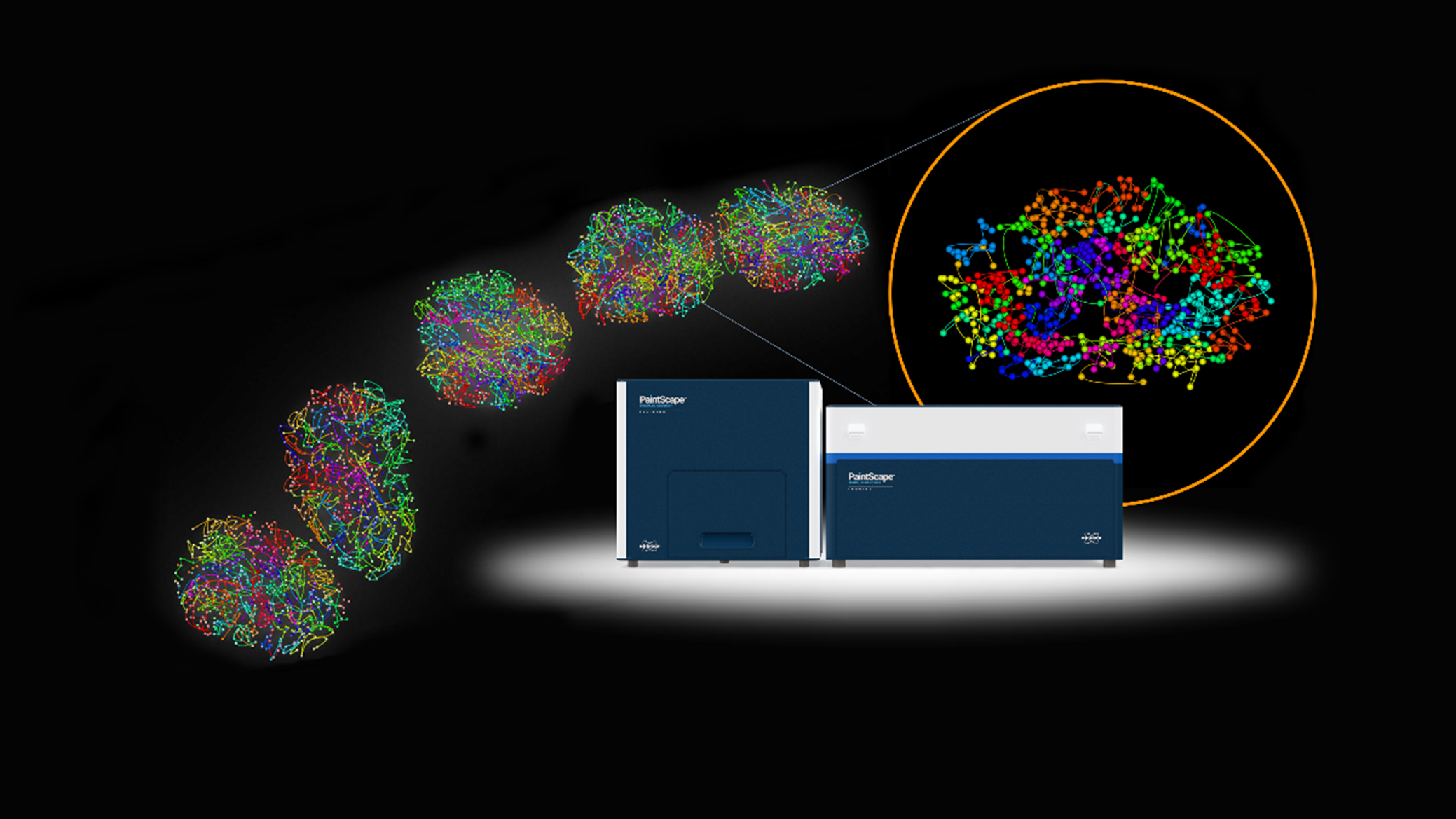
With the PaintScape™ platform, Bruker is the only company enabling high‑precision, multiplexed, direct visualization of the 3D genome in situ in single cells. PaintScape enables researchers to study chromosomal architecture, spatial genome organization, and structural variation directly within intact biological context, opening new avenues for understanding how genome structure influences gene regulation and disease.
Bruker will launch two new panels for the PaintScape platform, including the ChromoPaint™ HuCL PanChromo MPX panel, a 419-plex panel designed for genome wide in situ visualization of chromosomal organization in human cell lines. In addition, Bruker will announce the OncoPaint™ Oncogenic Pathways Panels that will be available later this year, a 1000+-plex modular panel designed to combine genome wide chromosome painting with painting of select cancer pathway associated gene regions in increased genomic resolution.
Commercial shipments of the PaintScape platform are expected to begin later this quarter.
Introducing CellScape XR, the Highest Performing Spatial Proteomics Ecosystem Delivering Best-in-Class Data Fidelity, Robustness and Flexibility
The CellScape XR launch at AGBT represents Bruker’s next-generation advancement in spatial proteomics and introduces what is now the highest fidelity spatial proteomics platform, designed to deliver best‑in‑class data quality, robustness, and assay flexibility.
At AACR, Bruker Spatial Biology will showcase new 208‑plex spatial proteomics datasets, in collaboration with Niclas Blessin at University Medical Center Schleswig-Holstein (UKSH). This assay was pathology reviewed across 12 distinct neoplastic and non-neoplastic human FFPE tissue samples demonstrating the robustness of the CellScape XR protocol. These capabilities enable deeper interrogation of tumor biology, immune contexture, and signaling heterogeneity, and form a critical bridge between discovery‑scale profiling and translational research, at a scale and rigor required for clinical applications.
Bruker is accepting pre-orders for the CellScape XR, with commercial shipments expected this summer.
CosMx SMI Showcases and Extends Complete Spatial Biology Approach
Bruker has consistently been first to define what is possible with the CosMx SMI platform setting multiple best-in-class benchmarks—including both AI multimodal and 3D segmentation, subcellular spatial imaging of the human whole transcriptome (WTX), and same-cell multiomics (WTX and 64+ proteins). At AACR, Bruker Spatial Biology will showcase how these high fidelity, high sensitivity capabilities are expanding further—extending subcellular spatial imaging of the mouse whole transcriptome and highlighting emerging applications for studying human disease, such as T‑cell receptor (TCR) and miRNA imaging.
The AtoMx® SIP builds on the unparalleled data richness of CosMx SMI to accelerate study‑level insight generation and biological interpretation. At AACR, Bruker Spatial Biology will reinforce a new spatial discovery workflow with AtoMx SIP, enabling rapid, image‑based exploration of single‑cell and subcellular whole transcriptome datasets through pre‑calculated spatial insights and streamlined data exports designed for conversational large language model (LLM) workflows. Applying LLMs to the comprehensive, high fidelity spatial data generated by CosMx SMI enables richer, higher quality outputs than are possible with lower resolution or lower content approaches, delivering a more interactive and intuitive experience for biological discovery. In addition, Bruker Spatial Biology will showcase new 3D AI‑based cell segmentation models that extend its best‑in‑class definition of single‑cell boundaries, improving RNA transcript assignment in tissue and addressing long standing limitations of segmentation approaches that fail to account for overlapping cells.
Bruker is accepting pre-orders for the Mouse CosMx WTX.
GeoMx Discovery Multiomics Platform Showcases Unmatched Spatial Biomarker Discovery at Scale with Whole Transcriptome and 1200+ Protein Targets
With GeoMx DSP, Bruker was the first to establish spatial biology at discovery scale and has continued to lead by demonstrating what is possible from discovery through translational research and clinically oriented applications. GeoMx DSP was first to enable high‑plex, same‑slide whole transcriptome and protein multiomics, and later to demonstrate spatial proteomic profiling of more than 1,200 antibodies on tissue with the Discovery Proteome Atlas. At AACR, Bruker Spatial Biology will showcase how GeoMx DSP is the only spatial platform to now simultaneously connect RNA pathway, protein, and post-translational modification (PTMs) across different layers of biology. The breadth of this spatial multiomics data is now informing researchers of biological pathways that are both transcriptionally active and driving functional response. GeoMx DSP further anchors large cohort biomarker and signature discovery and now connects seamlessly to downstream validation and spatial phenotyping workflows with CellScape XR on the same tissue section.
In addition to its spatial biology portfolio, Bruker will present complementary solutions including the nCounter® Analysis System for bulk multiomics and the Beacon® Platform, including Beacon Discovery, supporting downstream translational workflows and functional live single‑cell biology.
Join Bruker at AACR 2026
Bruker will share more details on these innovations at the AACR General Meeting in their spotlight theater on Monday, April 20 titled “Resolving Cancer Across Its Biological Layers with Single-Cell and Spatial Biology”. Demonstrations of the entire suite of Bruker Spatial Biology platforms including PaintScape, CellScape XR, CosMx SMI, GeoMx DSP and nCounter Analysis platform in addition to the Beacon Discovery will showcase the transformative potential of these technologies.
For more information, please visit www.brukerspatialbiology.com.
About Bruker Corporation – Leader of the Post-Genomic Era
Bruker is enabling scientists and engineers to make breakthrough post-genomic discoveries and develop new applications that improve the quality of human life. Bruker’s high-performance scientific instruments and high value analytical and diagnostic solutions enable scientists to explore life and materials at molecular, cellular, and microscopic levels. In close cooperation with our customers, Bruker is enabling innovation, improved productivity, and customer success in post-genomic life science molecular and cell biology research, in applied and biopharma applications, in microscopy and nanoanalysis, as well as in industrial and cleantech research, and next-gen semiconductor metrology in support of AI. Bruker offers differentiated, high-value life science and diagnostics systems and solutions in preclinical imaging, clinical phenomics research, proteomics and multiomics, spatial and single-cell biology, functional structural and condensate biology, as well as in clinical microbiology and molecular diagnostics. For more information, please visit www.bruker.com.
Contacts
Investor Contact:
Joe Kostka
Director, Investor Relations
Bruker Corporation
T: +1 (978) 313-5800
E: Investor.Relations@bruker.com
Media Contact:
Johnny Lyssand, PhD
Senior Director, Downstream Marketing
Bruker Spatial Biology
T: +1 (206) 790-2843
E: john.lyssand@bruker.com