NTHU Uses Big Data to Counter Coronavirus
NTHU Uses Big Data to Counter Coronavirus
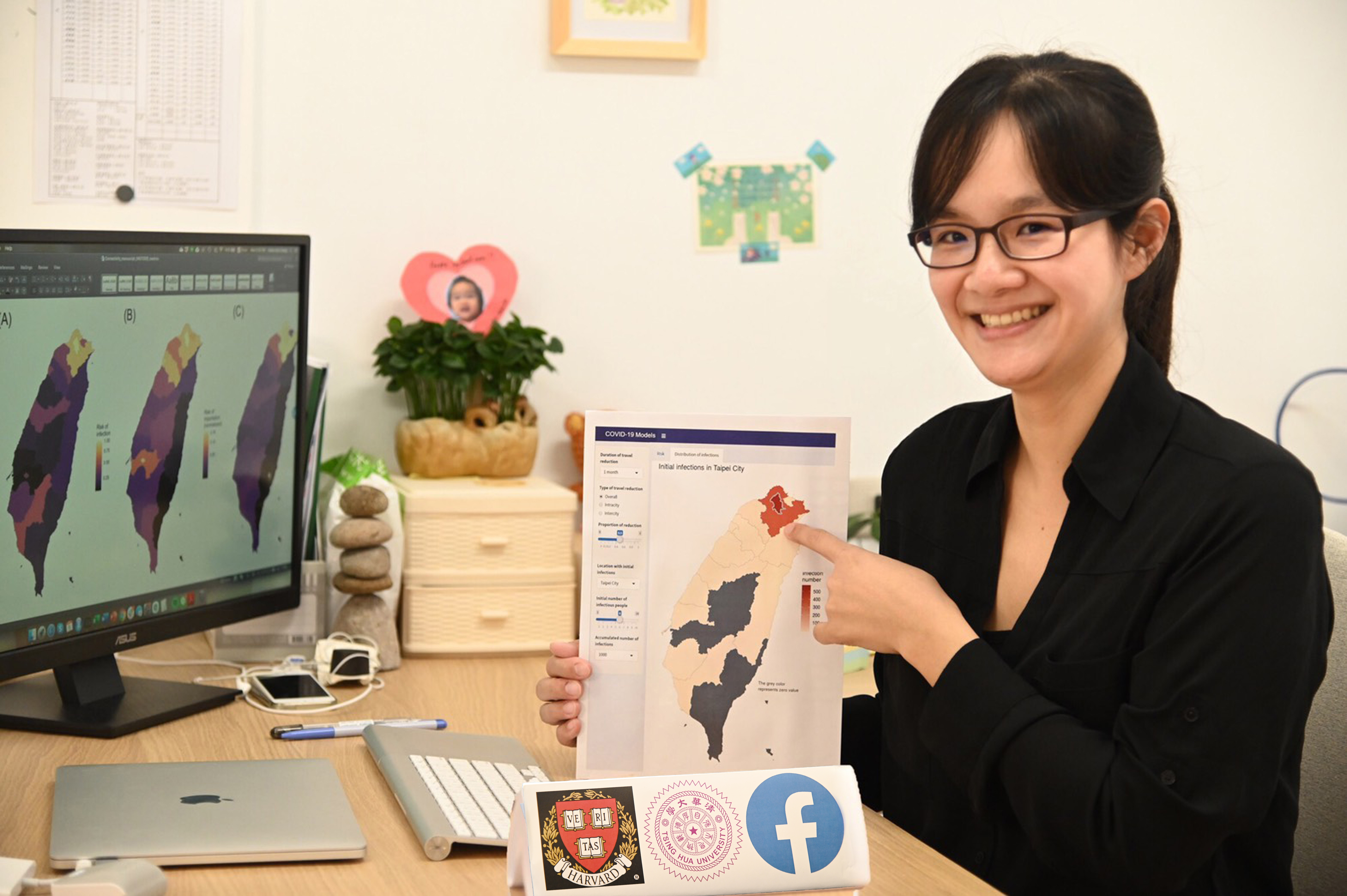
HSINCHU, Taiwan--(BUSINESS WIRE)--National Tsing Hua University (NTHU) has recently begun to collaborate with Facebook and Harvard University in using big data to study the potential spread of coronavirus in Taiwan. This international collaboration is being led by Assistant Professor Hsiao-Han Chang of the Institute of Bioinformatics and Structural Biology at NTHU. The preliminary results indicate that the risk of local transmission is higher than long-distance transmission between counties and cities. Chang’s advice for the upcoming holiday is to stay at home and to avoid crowds.
Based on the results of another study she has recently conducted using mathematical modeling to assess the impact of wearing face masks, Chang strongly supports the Central Epidemic Command Center’s (CECC) decision to set up a system for distributing masks, since it prevents the hoarding of an item important for limiting the spread of the epidemic.
Using Facebook’s big data on the movement of people
At the end of January Facebook, the world's largest social media platform—began providing movement data for a joint study by NTHU and Harvard University's School of Public Health on the spread of coronavirus. The data includes estimates of the number of people moving among cities.
High-risk crowding
Chang's research team also found that local movement plays a more important role in the potential spread of coronavirus than long-distance movement. This runs counter to the widespread perception that distance traveled is the most important risk factor; what matters most is actually the number of people contacted and the length of time one is in close contact with them. Thus visiting crowded places near one’s home may not be safer than traveling to popular tourist attractions. For Chang, one rather concerning finding of the study was that, despite the repeated warnings issued by the CECC since the beginning of the outbreak, travel in Taiwan has continued nearly unabated.
The team has also used mathematical modeling to simulate the impact of wearing masks. According to Chang, there is a clear correlation between the widespread and correct use of masks and lower infection numbers. Millions of masks are being produced and distributed daily in Taiwan, and this is one of the reasons the nation has been able to ride out the pandemic relatively unscathed.
Priority distribution of masks
A study by Chang and Colin Worby, a computational biologist at the Broad Institute of MIT and Harvard, shows that the proper use of masks by the majority of people reduces both the numbers of infections and deaths significantly.
They also found that when masks are limited, giving priority to high-risk groups helps to reduce the overall infections and deaths. Chang said that at the beginning of the epidemic the CECC commandeered the mask factories in Taiwan and set up a mask distribution system to prevent panic buying and hoarding—two key measures which have helped the nation stay ahead of the curve.
Contacts
Holly Hsueh
NTHU
(886)3-516-2006
hoyu@mx.nthu.edu.tw