Northwell Health Converts BiPAP Machines Into Ventilators for Hospitalized COVID-19 Patients, Uses 3D Printed Adapter
Northwell Health Converts BiPAP Machines Into Ventilators for Hospitalized COVID-19 Patients, Uses 3D Printed Adapter
To prepare for potential surge of coronavirus patients in need of ventilators, doctors and engineers designed 3D printed adaptor for use with common breathing machine
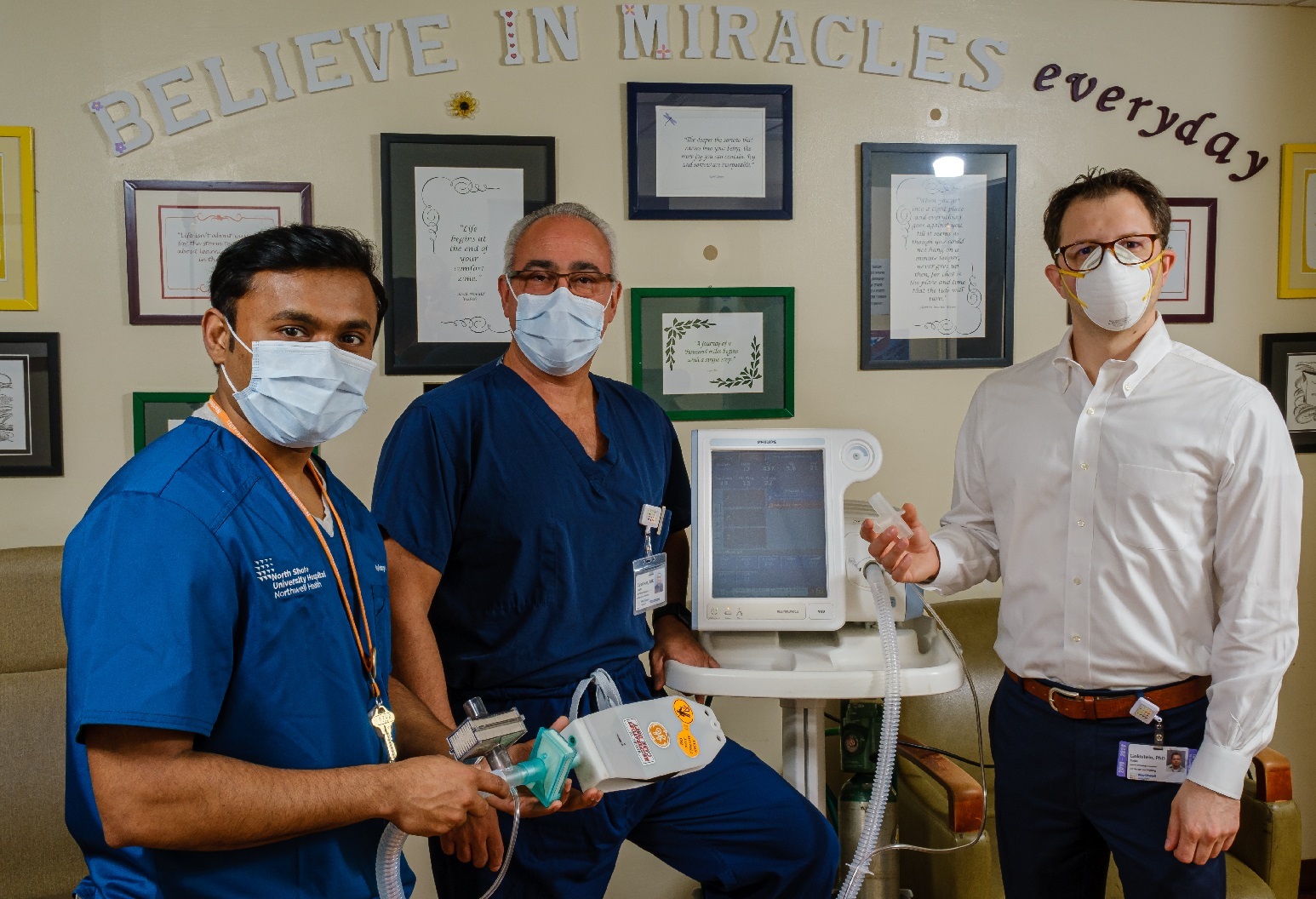
NEW HYDE PARK, N.Y.--(BUSINESS WIRE)--In preparation for potential patient surge and shortage of critical mechanical ventilators for hospitalized COVID-19 patients, a Northwell Health physician, a respiratory therapist, and a 3D printing bioengineer have successfully designed the protocol to turn the more common bi-level positive airway pressure (BiPAP) machine into a functional invasive mechanical ventilator, through a 3D printed adaptor they also designed to aid in the conversion.
BiPAP is one type of PAP, or positive airway pressure, non-invasive machine that is commonly used to maintain a consistent breathing pattern at night or during symptom flare-ups in people with sleep apnea, congestive heart failure or chronic obstructive pulmonary disease (COPD), a chronic inflammatory lung disease.
As the health systems nationwide brace themselves for a potential increase in COVID-19 patients and New York Governor Andrew Cuomo calls for an increased supply of ventilators for hospitals statewide, a team led by Hugh Cassiere, MD, medical director for respiratory therapy services at North Shore University Hospital (NSUH) and Stanley John, NSUH’s director of respiratory therapy, developed a method to convert the non-invasive Philips Respironics V60 BiPAP machine into a pressure controlled ventilator for both patients with and without COVID-19 induced lung disease.
“Our hospitals are at the US epicenter of the coronavirus epidemic, and some of our COVID-19 patients require intensive care unit therapy and mechanical ventilators within minutes of being hospitalized,” said Dr. Cassiere. One sleepless night, Dr. Cassiere thought of the fleet of unused BiPAP machines in the hospitals. “I knew we could develop a way to repurpose and convert these machines to save hundreds of lives.”
Currently, Northwell Health has an adequate supply of ventilators for its patients, and the health system is continually trying to obtain more ventilators to prepare for a likely surge. And while there are plans in place to handle a surge in patient volume, Northwell Health has a good supply of BiPAP machines across its 23 hospitals, and if faced with a surge when ventilators numbers do get low, it would be helpful to use these machines.
The key component to converting the BiPAP machine is a small, plastic T-piece adapter. Because of COVID-19 related supply change shortages, Dr. Cassiere and Stanley John collaborated with Northwell Health’s 3D Design and Innovation department, and together they designed and 3D printed a T-piece in a matter of days.
“We were able to imitate the design of the T-piece adapter and print the plastic-resin piece with our 3D printers,” said Todd Goldstein, PhD, director of 3D Design and Innovation at Northwell Health. “If the need arises, we would be able to print 150 adaptors in 24-hours.”
In an effort to help other hospital systems across the nation, Northwell Health will share the new protocols to convert the BiPAP machine as well as share the T-adapter 3D print design online.
Drs. Cassiere, Goldstein, and Stanley John successfully tested the conversion of the BiPAP machine using the standard, non-3D printed adaptor for both COVID-19 and non-COVID-19 patients. They have also tested the 3D printed T-adaptor and have ramped up production to adopt the 3D printed adaptor clinically in the coming days.
In addition to the T-piece adaptor, modifications to the BiPAP machine include the addition of two high-efficiency particulate air (HEPA) filters at both ends of the oxygen hose to alleviate fears of spreading the virus. They are also recommending using a blind reservoir connected to the last HEPA filter in the circuit.
Last week, Northwell Health, with collaborators at the University of South Florida (USF) and Formlabs, a leading 3D printing company, announced they produced and tested a 3D printed nasal swab to address emergency shortages that hospitals and health care teams may face as testing for COVID-19 increases.
To view and download a video of the doctors using these modifications, as well as video of the printing process, please click here.
About Northwell Health
Northwell Health is New York State’s largest health care provider and private employer, with 23 hospitals, about 750 outpatient facilities and more than 13,600 affiliated physicians. We care for over two million people annually in the New York metro area and beyond, thanks to philanthropic support from our communities. Our 70,000 employees – 16,000-plus nurses and 4,000 employed doctors, including members of Northwell Health Physician Partners – are working to change health care for the better. We’re making breakthroughs in medicine at the Feinstein Institutes for Medical Research. We're training the next generation of medical professionals at the visionary Donald and Barbara Zucker School of Medicine at Hofstra/Northwell and the Hofstra Northwell School of Graduate Nursing and Physician Assistant Studies. For information on our more than 100 medical specialties, visit Northwell.edu and follow us @NorthwellHealth on Facebook, Twitter, Instagram and LinkedIn.
Contacts
Matthew Libassi
516-465-8325
mlibassi@northwell.edu