Leveragen Secures Australian Patent for Singularity Platform Advancing Fully Human Single-Domain Antibody Discovery
Leveragen Secures Australian Patent for Singularity Platform Advancing Fully Human Single-Domain Antibody Discovery
A minimalist immune system enables high-fidelity, format-native discovery through high-throughput, sequence-first workflows
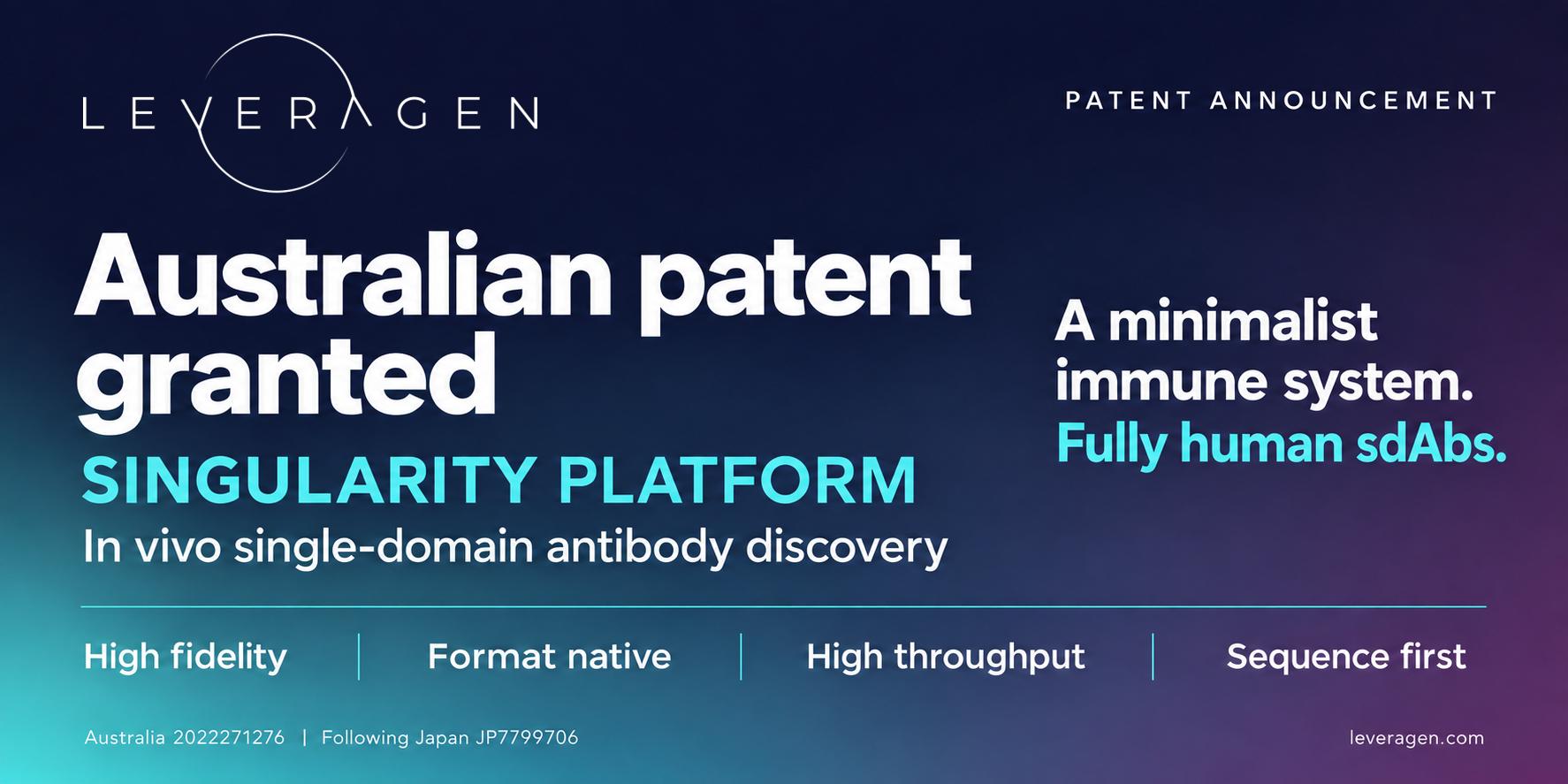
At the center of this approach is Singularity Sapiens: a minimalist humoral immune system dedicated exclusively to heavy-chain-only antibody responses. By eliminating competing conventional antibodies, the model concentrates immune selection on fully human standalone VH binding domains. A broad human V(D)J repertoire integrated precisely at the endogenous mouse immunoglobulin heavy-chain locus provides an in vivo source of fully human sdAbs. The Australian and Japanese grants strengthen Leveragen's patent estate in the Asia-Pacific region. Leveragen offers its platforms and discovery capabilities through licensing, technology access, and service-based partnerships across therapeutics, diagnostics, and animal health.
BOSTON--(BUSINESS WIRE)--Leveragen, Inc., a Boston-based biotechnology company advancing in vivo antibody discovery, today announced the grant of Australian Patent No. 2022271276 on September 3, 2026. Titled "Engineered Non-Human Animals for Producing Antibodies," the patent covers core innovations underlying the Singularity Platform. The grant follows the company's February 25, 2026, announcement of Japan Patent No. JP7799706, extending protection for its proprietary approach to single-domain antibody (sdAb) discovery.
With high-throughput, sequence-first workflows, this design connects biological discovery with next-generation medicines and AI-enabled research.
Share
At the center of this approach is Singularity Sapiens: a minimalist humoral immune system dedicated exclusively to heavy-chain-only antibody responses. By eliminating competing conventional antibodies, the model concentrates immune selection on fully human standalone VH binding domains. A broad human V(D)J repertoire integrated precisely at the endogenous mouse immunoglobulin heavy-chain locus provides an in vivo source of fully human sdAbs.
High fidelity begins with native gene regulation and expression. Unlike conventional transgenic systems that place antibody genes outside their native regulatory context, Singularity preserves physiological control at the endogenous locus. High fidelity also extends to the recovered binder: antibodies can be obtained directly from the engineered immune system in their original selected sequences, without artificial downstream sequence engineering or humanization.
This is format-native discovery. The immune system selects and matures the intended standalone binding domain within a heavy-chain-only architecture from the outset. Clonal selection, somatic hypermutation, and affinity maturation act on the domain in vivo, producing compact building blocks for multispecific antibodies, antibody-payload conjugates, mRNA-encoded medicines, targeted delivery, and cell and gene therapies.
High-throughput discovery extends this biological advantage across diverse candidates. Each sdAb variable-domain sequence encodes a complete binding domain, enabling parallel screening without heavy/light-chain pairing ambiguity. Leveragen's sequence-first workflow uses next-generation sequencing to assess repertoire diversity and clonal expansion, infer lineage relationships, and prioritize candidates for display, binding, functional, and developability assays.
The combination of highly diverse binders and simple single-domain structures also offers a useful foundation for AI modeling and de novo antibody design. Linking immune-selected sequences to experimental measurements can provide biologically grounded data for learning sequence-function relationships and evaluating designed candidates.
"We designed a minimalist immune system with a focused purpose: to discover fully human single-domain binders in vivo," said Dr. Weisheng Chen, Founder and Chief Executive Officer of Leveragen. "High fidelity means preserving native gene regulation and expression, then recovering what the immune system selected without artificial downstream sequence engineering. Combined with high-throughput, sequence-first workflows, that design connects biological discovery with next-generation medicines and AI-enabled approaches."
The Australian patent includes claims directed to specified engineered immunoglobulin-locus architectures, methods for producing the animals, and methods for generating heavy-chain and single-domain antibodies. Certain claims include B-cell mRNA sequencing, clonal-type identification, and phylogenetic analysis.
Beyond Singularity Sapiens, based on human VH domains, the Singularity Suite applies the same design principles to human V-kappa, alpaca VHH, shark VNAR, dog VH, cat VH, and mouse VH scaffolds. Across Leveragen's broader portfolio, the Universality Suite pairs diverse heavy chains with a predefined common light-chain for bispecific and multispecific discovery. The Infinity Suite supports conventional full-length antibodies with paired heavy and light chains.
The Australian and Japanese grants strengthen Leveragen's patent estate in the Asia-Pacific region. Leveragen offers its platforms and discovery capabilities through licensing, technology access, and service-based partnerships across therapeutics, diagnostics, and animal health.
About Leveragen
Leveragen is a Greater Boston biotechnology company developing in vivo antibody discovery platforms and sequence-first workflows. Its Singularity, Universality, and Infinity suites match immune-system architecture to single-domain, common light-chain, and conventional antibody formats, respectively.
Leveragen integrates precise genome engineering, native immune regulation, in vivo selection and maturation, and repertoire analysis to support discovery partnerships with pharmaceutical and biotechnology companies worldwide. For more information, please visit www.leveragen.com.
Contacts
Media
media@leveragen.com