Rambus Enables Next-Generation AI and Data Center Platforms with DDR5 9600 Server RDIMM Chipset
Rambus Enables Next-Generation AI and Data Center Platforms with DDR5 9600 Server RDIMM Chipset
DDR5 9600 RDIMM chipset addresses rising memory performance and power management demands driven by AI and data-intensive workloads on advanced CPU-based servers
- Introduces new 6th Generation Registering Clock Driver (RCD06) operating at 9600 MT/s, a 20% increase in data rate over prior generation solution
- Offers complete chipset, including RCD06, PMIC5030 power management IC, SPD Hub and Temperature Sensor ICs, to simplify module development and speed time to market
- Enables breakthrough memory bandwidth, capacity and power efficiency for agentic AI, HPC and demanding data center workloads running on advanced CPU-based servers
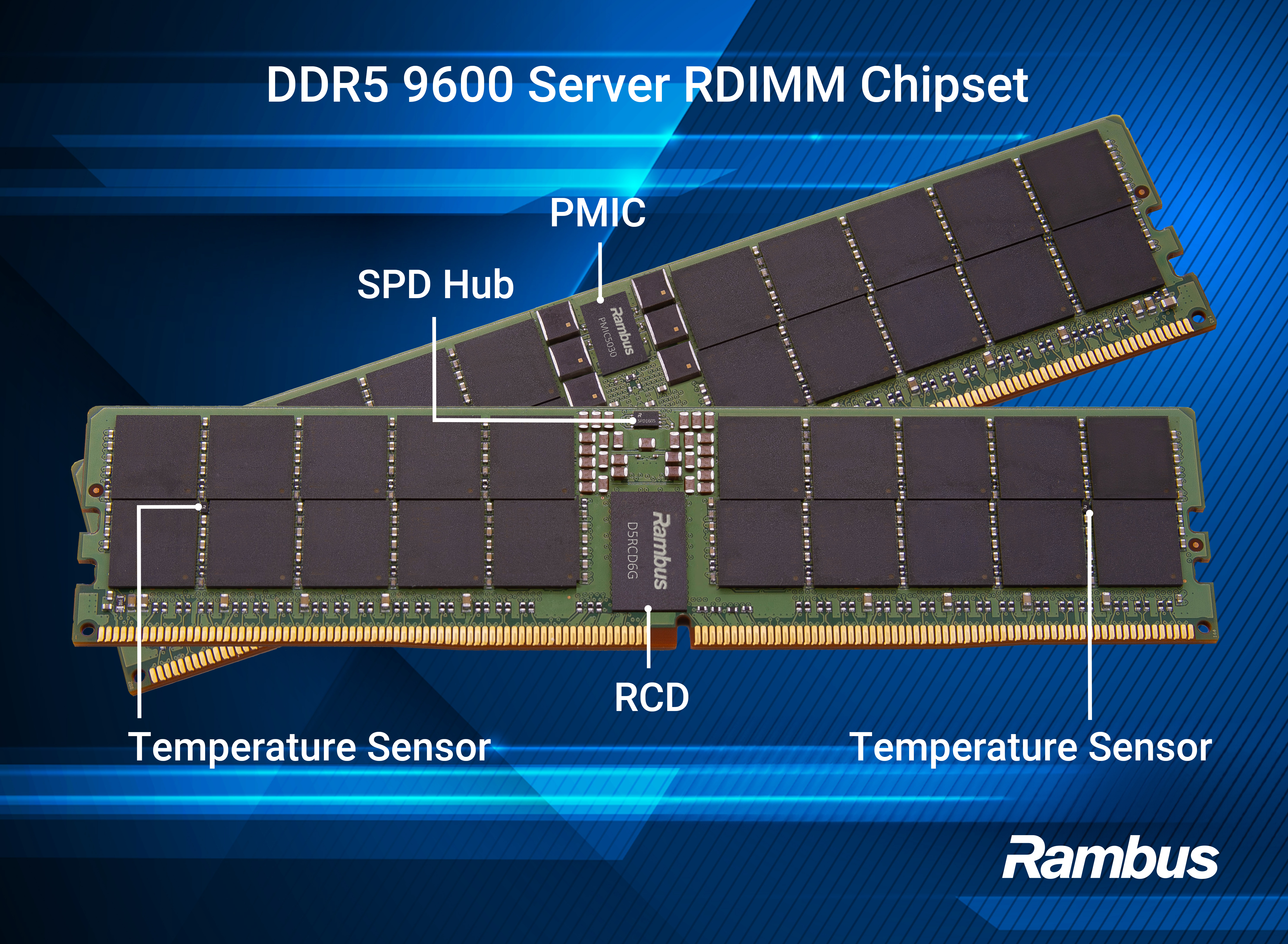
SAN JOSE, Calif.--(BUSINESS WIRE)--Rambus Inc. (NASDAQ: RMBS), a premier chip and silicon IP provider making data faster and safer, today announced its DDR5 9600 Server RDIMM chipset designed to deliver industry-leading memory performance for next-generation data center platforms. Built around the new Rambus 6th Generation Registering Clock Driver (RCD06) with a 20% increase in bandwidth over the prior generation, this complete chipset enables RDIMMs operating at up to 9600 MT/s, unlocking a new level of bandwidth and capacity required by agentic AI, high-performance computing (HPC) and other data-intensive workloads.
The accelerating evolution of AI from model training to large-scale inference and agentic workflows is driving a structural increase in server memory requirements. These workloads are highly iterative and memory-intensive, requiring significantly higher bandwidth and capacity for orchestration and execution. For large language model inference, techniques such as key-value (KV) caching further increase memory capacity and bandwidth requirements by storing and repeatedly accessing contextual data to reduce compute overhead and accelerate token generation. At the same time, CPU platforms are increasing core counts and memory channel density, amplifying demand for faster DIMMs and higher aggregate memory bandwidth. Together, these trends are making memory performance and power delivery critical determinants of overall system throughput. The Rambus DDR5 9600 RDIMM chipset directly addresses these requirements, empowering server makers to build scalable platforms capable of supporting next-generation AI infrastructure.
“The rapidly accelerating adoption of agentic AI and AI inference workloads is driving unprecedented demand for higher memory bandwidth and capacity in the data center,” said Rami Sethi, SVP and general manager of Memory Interface Chips at Rambus. “With our DDR5 9600 RDIMM chipset featuring the new RCD06, Rambus continues to extend its leadership in high-speed memory interface solutions, enabling our customers to deliver the performance and reliability required for next-generation server platforms.”
“As data center architectures evolve to support increasingly complex workloads, memory bandwidth, latency and reliability are becoming critical system-level design considerations,” said Soo Kyoum Kim, associate VP at IDC. “Complete RDIMM chipsets from companies like Rambus address these demands by enabling higher-performance, scalable memory subsystems that can keep pace with next-generation AI and cloud infrastructures.”
The Rambus DDR5 9600 RDIMM chipset is a complete solution designed to support next-generation CPU-based server platforms. In addition to the RCD06, the chipset includes the PMIC5030 power management IC, which delivers efficient, high-current power at low voltage levels to support advanced DDR5 RDIMM configurations. The chipset also includes a Serial Presence Detect (SPD) Hub with an integrated temperature sensor, along with dedicated Temperature Sensor ICs, enabling critical module telemetry, configuration and thermal monitoring functions.
By integrating clocking, control and power management into a cohesive solution, the chipset ensures robust signal and power integrity at high data rates, reducing design complexity for memory module manufacturers and improving overall system reliability. This level of integration is particularly critical as server architectures scale to support higher processor core counts, larger memory capacity and sustained demands of continuously operating AI workloads.
More Information
Learn more about the Rambus DDR5 9600 Server RDIMM chipset at https://www.rambus.com/memory-interface-chips/ddr5-dimm-chipset/.
About Rambus Inc.
Rambus delivers industry-leading chips and silicon IP for the data center and AI infrastructure. With over three decades of advanced semiconductor experience, our products and technologies address the critical bottlenecks between memory and processing to accelerate data-intensive workloads. By enabling greater bandwidth, efficiency and security across next generation computing platforms, we make data faster and safer. For more information, visit rambus.com.
Source: Rambus Inc.
Forward-Looking Statements
Information set forth in this press release, including statements as to Rambus’ outlook and financial estimates and statements as to the expected timing and effects of Rambus products, constitute forward-looking statements within the meaning of the safe harbor provisions of the Private Securities Litigation Reform Act of 1995.
These statements are based on various assumptions and the current expectations of the management of Rambus and may not be accurate because of risks and uncertainties surrounding these assumptions and expectations. Factors listed below, as well as other factors, may cause actual results to differ significantly from these forward-looking statements. There is no guarantee that any of the events anticipated by these forward-looking statements will occur, or what effect they will have on the operations or financial condition of Rambus. Forward-looking statements included herein are made as of the date hereof, and Rambus undertakes no obligation to publicly update or revise any forward-looking statement unless required to do so by federal securities laws.
Major risks, uncertainties and assumptions include, but are not limited to: any statements regarding anticipated operational and financial results; any statements of expectation or belief; other factors described under “Risk Factors” in Rambus’ Annual Report on Form 10-K and Quarterly Reports on Form 10-Q; and any statements of assumptions underlying any of the foregoing. It is not possible to predict or identify all such factors. Consequently, while the list of factors presented here is considered representative, no such list should be considered to be a complete statement of all potential risks and uncertainties.
Contacts
Press Contact
Cori Pasinetti
Rambus Corporate Communications
t: (650) 309-6226
cpasinetti@rambus.com