OpenEvidence Launches Voice Mode: The First Native Speech-to-Speech Medical AI
OpenEvidence Launches Voice Mode: The First Native Speech-to-Speech Medical AI
OpenEvidence becomes the first multimodal medical AI, with a native speech-to-speech interface that delivers hands-free, evidence-backed answers to doctors.
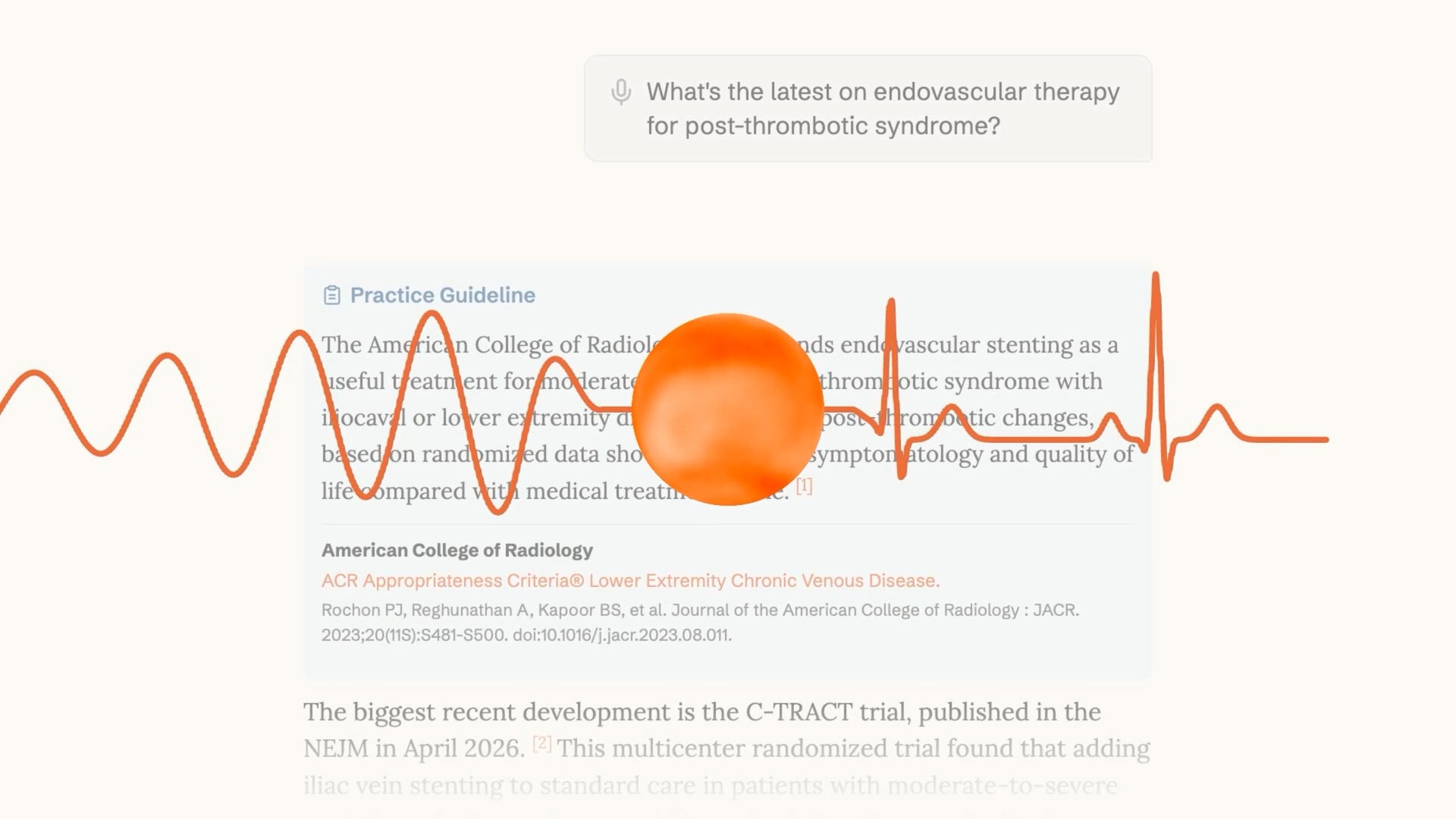
MIAMI--(BUSINESS WIRE)--OpenEvidence, the most widely used medical AI platform among U.S. physicians, today launched Voice Mode, the first native speech-to-speech medical AI interface. With Voice Mode, OpenEvidence becomes the first multimodal medical AI offering a hands-free way for clinicians to ask questions aloud, and hear cited answers read back, on the same peer-reviewed evidence base. The feature is live in the OpenEvidence web and mobile apps and is free for all users.
"Voice Mode gives me the answers I need in those in-between moments.”
Share
Physicians reach for clinical evidence on the go: between rooms, on rounds, walking the corridor outside an OR, charting one-handed during a phone call. Voice Mode is built for those moments. A clinician taps the orange waveform icon, asks a question, and hears a concise spoken answer drawn from the same sources that power OpenEvidence today, including the New England Journal of Medicine, JAMA, Cochrane, and NCCN guidelines.
“There are two sides to building a medical AI — the intelligence and the interface. We've spent years on the intelligence. With Voice Mode, we're advancing the interface to match the everyday reality of practicing medicine,” said Daniel Nadler, Founder and CEO of OpenEvidence.
Every spoken answer comes with the written transcript and underlying references in the same conversation, available the moment the clinician returns to the screen. Clinicians can interrupt mid-answer to redirect or refine the question. In noisy environments, a tap mutes the microphone until they are ready to speak again. For physicians who want voice input without a spoken response, a separate microphone icon dictates the question as text into a standard OpenEvidence search.
Voice runs on the same intelligence as the rest of OpenEvidence. Every spoken answer is drawn from a curated corpus of peer-reviewed literature and read back with the citation chain attached. A clinician can verify any claim by opening the underlying source the moment they are back at a screen. The standard for spoken answers is the standard for written ones.
“When I’m in the ED, I’m never at a workstation when I actually need an answer. I’m gloved, gowned, on the phone or in between patients. Voice Mode gives me the answers I need in those in-between moments,” said Ania Bilski, MD, VP of Clinical AI at OpenEvidence and a practicing emergency medicine physician at UCSF and Kaiser Permanente.
“Voice Mode in the clinic has a higher bar than anywhere else. When you’re talking through a case and thinking out loud, you naturally pause to think and expect the AI to wait. It should just feel like a conversation with a colleague,” said Maya Shah, AI engineer at OpenEvidence.
OpenEvidence now fields more than a million clinical questions a day. Voice opens that flow to the moments when those clinicians are not at a screen. Voice answers are shorter and shaped for listening; the references and the full written form remain in the conversation, so the verification standard is the same as it has always been.
About OpenEvidence
OpenEvidence is the most widely used medical AI platform among U.S. physicians, and is trusted by hundreds of thousands of verified clinicians to make high-stakes clinical decisions at the point of care with answers that are sourced, cited, and grounded in peer-reviewed medical literature. OpenEvidence was founded with the mission to organize and expand the world's collective medical knowledge. Learn more at openevidence.com.
Contacts
OpenEvidence
media@openevidence.com