New Evidence Backs Hologic’s AI-Powered Mammography Technology for Detecting Challenging Cancers
New Evidence Backs Hologic’s AI-Powered Mammography Technology for Detecting Challenging Cancers
Results highlight AI’s potential to aid radiologists in identifying diverse breast cancer subtypes, including invasive lobular cancer
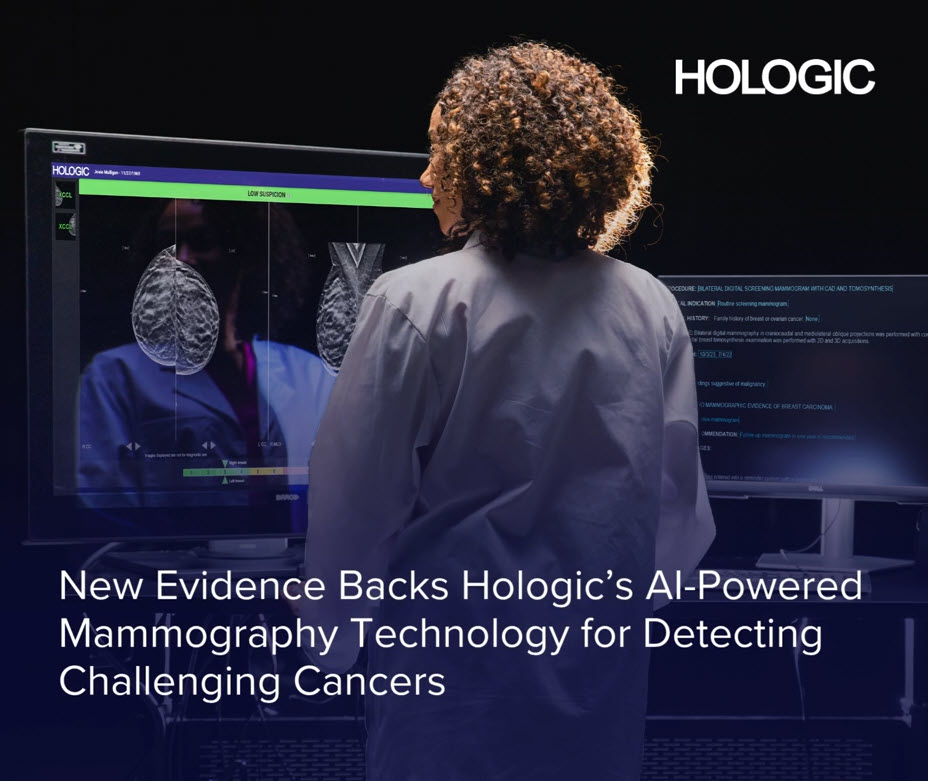
MARLBOROUGH, Mass.--(BUSINESS WIRE)--New research on Hologic’s AI-driven breast cancer detection technologies, including a study focused on invasive lobular cancer, was presented at the Society of Breast Imaging (SBI) Symposium over the weekend in Seattle, Washington.
New research highlights AI’s potential to aid radiologists in identifying diverse breast cancer subtypes, including invasive lobular cancer
Share
“Invasive lobular cancers are more challenging to detect on a mammogram because of their unique characteristics,” said Mark Horvath, President of Breast & Skeletal Health Solutions at Hologic. “In the study, AI maintained high sensitivity for flagging these cancers, including some that had been interpreted as negative at a prior screening. These data add to a growing body of evidence that AI can act as a powerful supportive tool for radiologists as they review the full spectrum of breast cancers.”
In this retrospective, single-center study, researchers at Massachusetts General Hospital in Boston reviewed invasive lobular cancer cases diagnosed over a 10-year period and grouped them into two categories: those detected by a radiologist during a routine screening exam (195 total) and “false negatives” that were diagnosed within a year of a routine screening exam initially interpreted as negative (44 total). Researchers then used Hologic’s Genius AI® Detection solution to retrospectively analyze all 239 cases. In this cohort, the technology identified and correctly localized close to 90% of the confirmed invasive lobular cancers.1
New research suggests that, on average, 1 in 20 women worldwide will be diagnosed with breast cancer in their lifetime and, that if current rates continue, by 2050 there will be 3.2 million new breast cancer cases and 1.1 million breast cancer-related deaths per year.2 About 10-15% of all breast cancers are invasive lobular cancers,3 while ductal cancers that originate in the milk ducts of the breast — such as invasive ductal carcinoma and ductal carcinoma in situ — occur more commonly. Invasive lobular cancer arises in the milk-producing glands (lobules) of the breast and, because of its unique biology and tendency to grow in a linear pattern, it may be more challenging to see on mammography. This may lead to later detection and a more advanced stage at diagnosis.
The AI algorithm also identified 43% of the invasive lobular cancer cases initially interpreted during routine screening as negative.1 Of note, as a retrospective analysis at a single institution, the study did not evaluate how use of AI in real time clinical practice would affect recall rates, biopsy outcomes or patient management.
Also at the Society of Breast Imaging Symposium, Hologic hosted a lunch and learn discussion with breast imaging experts focused on implementation of 3DQuorum® imaging technology, which uses AI to reduce the number of 3D imaging “slices” radiologists need to review without compromising image quality, sensitivity or accuracy.4,5
Study Limitations
The MGH study did not assess false-positive rates, recall rates or biopsy outcomes, and its single-center design may limit generalizability. AI performance was evaluated retrospectively and did not influence real-time radiologist decision-making; therefore, the observed gains represent a theoretical upper bound rather than a measured clinical impact. Additionally, the cohort included only patients with invasive lobular cancer, precluding comparison with other histologic subtypes.
About Genius AI Detection
Hologic’s Genius AI Detection solution is an innovative mammography screening technology designed to locate lesions likely to represent breast cancer. Suspicious areas are highlighted at radiologists’ workstations for concurrent reading to support smart, decisive interpretation. Hologic's deep learning algorithm is fed by the accumulation of a large, diverse patient base, providing rich insight and intelligence. For more information, please visit Genius AI Detection Technology.
About Hologic, Inc.
Hologic, Inc. is a global leader in women’s health dedicated to developing innovative medical technologies that effectively detect, diagnose and treat health conditions and raise the standard of care around the world. To learn more, visit www.hologic.com and connect with us on LinkedIn, Facebook, X, Instagram and YouTube.
Forward-Looking Statements
This news release may contain forward-looking information that involves risks and uncertainties, including statements about the use of Hologic products. There can be no assurance these products will achieve the benefits described herein or that such benefits will be replicated in any particular manner with respect to an individual patient, as the actual effect of the use of the products can only be determined on a case-by-case basis. In addition, there can be no assurance that these products will be commercially successful or achieve any expected level of sales. Hologic expressly disclaims any obligation or undertaking to release publicly any updates or revisions to any such statements presented herein to reflect any change in expectations or any change in events, conditions or circumstances on which any such data or statements are based.
Hologic, The Science of Sure, Genius AI and 3DQuorum are trademarks and/or registered trademarks of Hologic, Inc. and/or its subsidiaries in the United States and/or other countries.
References
1. Lamb LR, Kim H, Do S, Bahl M. Artificial intelligence for the detection of invasive lobular carcinoma on screening digital breast tomosynthesis. Oral presentation, Society of Breast Imaging Symposium, Seattle, WA, April 2026.
2. Kim J, Harper A, McCormack V, et al. Global patterns and trends in breast cancer incidence and mortality across 185 countries. Nature Medicine. 2025;31(4). doi:https://doi.org/10.1038/s41591-025-03502-3.
3. DePolo J. Invasive Lobular Carcinoma (ILC). www.breastcancer.org. https://www.breastcancer.org/types/invasive-lobular-carcinoma.
4. Report: CSR-00116.
5. FDA Submission: P080003/S008.
Contacts
Media Contact:
Bridget Perry
Senior Director, Corporate Communications
(+1) 508.263.8654
bridget.perry@hologic.com