Atia Vision Announces Durable 36-Month Results from First-in-Human Study of their Dynamic Shape-Changing OmniVu Intraocular Lens System
Atia Vision Announces Durable 36-Month Results from First-in-Human Study of their Dynamic Shape-Changing OmniVu Intraocular Lens System
- Data demonstrates stable refractive outcomes through three years with dynamic continuous range of vision from far through near
- Mean binocular uncorrected distance visual acuity of 20/16 at 36 months
- 36-month results won Best Paper of Session at the 2026 ASCRS Annual Meeting
CAMPBELL, Calif.--(BUSINESS WIRE)--Atia Vision, Inc., a Shifamed portfolio company, today announced positive 36-month results from its first-in-human (FIH) clinical study of the Atia Vision™ OmniVu Lens System, a modular shape-changing intraocular lens (IOL) designed to restore a continuous, dynamic range of vision following cataract surgery. The data was presented by William F. Wiley, M.D., Medical Director of the Cleveland Eye Clinic, at the 2026 American Society of Cataract and Refractive Surgery (ASCRS) Annual Meeting1 and was awarded Best Paper of Session. The results demonstrate sustained visual and refractive outcomes through 36 months post-implantation, with a favorable and stable safety profile.
The prospective, multicenter, open-label study enrolled 19 subjects (29 eyes), including 10 binocular and 9 monocular implants. Key findings at 36 months include1:
- Stable Refractive Outcomes: Mean manifest refraction spherical equivalent (MRSE) remained within ±0.50 D throughout 36 months of follow-up. Refractive cylinder also demonstrated stability over time.
- Strong Binocular Visual Acuity: At 36 months, mean binocular uncorrected distance visual acuity was -0.11 logMAR (20/16) and mean best-corrected distance visual acuity was -0.17 logMAR (20/12). Mean binocular uncorrected intermediate visual acuity was -0.05 logMAR (20/20) and mean binocular uncorrected near visual acuity was 0.06 logMAR (20/25, J1).
- Continuous Range of Focus: Binocular defocus curve testing demonstrated 20/32 or better vision over approximately 5.0 D of continuous defocus.
- Favorable Safety Profile: Across all eyes and all study visits, only one YAG capsulotomy procedure was performed. No lens exchanges or refractive enhancements were required.
- Monofocal-Level Contrast Sensitivity: Early contrast sensitivity results from a sub-study at six months showed monocular mesopic performance comparable to published monofocal IOL literature, a notable finding for a presbyopia-correcting lens delivering full range of vision.
“Surgeons have long had to accept trade-offs with presbyopia-correcting lenses. Unpredictable effective lens position, routine YAG capsulotomy, and compromised visual quality have simply been the cost of offering patients a range of vision. These 36-month data tell a very different story,” said William F. Wiley, M.D., Medical Director of the Cleveland Eye Clinic. “Continuous focus from far to near, stable lens position, and remarkably low YAG rates sustained over three years is exactly what we need to see. This could be a real turning point for premium cataract surgery.”
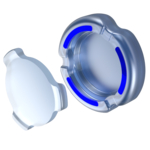
The OmniVu Lens System features a two-component modular design: a fluid-filled, shape-changing base intended to respond to the eye’s natural accommodative mechanism to provide dynamic focusing, and a front optic that aims to reliably meet each patient’s refractive prescription. The capsular bag-filling design is engineered to preserve a more natural physiologic shape of the eye, which is intended to promote stable lens position and minimize posterior capsule opacification (PCO) formation.
“These 36-month results reinforce what we set out to prove, that patients should not have to choose between continuous range of vision and long-term stability,” said Mariam Maghribi, President and CEO of Atia Vision. “We challenged long-held assumptions about lens design, and the durability of these outcomes validates that approach. Our team is energized by this milestone, and we remain focused on delivering a lens that gives surgeons the confidence and patients the quality of vision they deserve.”
The Atia Vision™ OmniVu Lens System has received Investigational Device Exemption (IDE) approval from the U.S. Food and Drug Administration to begin a U.S. feasibility clinical study.
About Atia Vision, Inc.
Atia Vision is developing a modular presbyopia-correcting intraocular lens to address the full range of vision for patients with cataracts and presbyopia. The accommodating lens technology is designed to provide superior visual outcomes with an excellent safety profile and be uniquely customizable to address patients’ evolving vision needs. Founded in 2014, Atia Vision’s technology originated from the Shifamed portfolio, a Silicon Valley-based medical innovation hub. For more information, visit www.atiavision.com.
About Shifamed LLC
Founded by serial entrepreneur Amr Salahieh, Shifamed LLC is a highly specialized medical innovation hub focused on developing advanced solutions that accelerate time to market, reduce risk, increase impact, and forge a path toward a world where patients are able to lead longer, healthier lives. To learn more about Shifamed, please visit www.shifamed.com.
The Atia Vision™ Lens System is an investigational device and is not approved for sale in any market.
References:
1. Wiley WF. Durability of Visual and Refractive Outcomes with a Modular Shape-Changing IOL. Presented at: ASCRS 2026 Annual Meeting.
Contacts
Media Contact:
Amy Phillips
Email: amy.phillips@launchlabpartners.com