Bruker Announces Orders for NIH- and NSF-Funded NMR Systems from New York Structural Biology Center, University of Delaware and Northwestern University
Bruker Announces Orders for NIH- and NSF-Funded NMR Systems from New York Structural Biology Center, University of Delaware and Northwestern University
BILLERICA, Mass.--(BUSINESS WIRE)--Bruker Corporation (Nasdaq: BRKR) today announced new orders for advanced Nuclear Magnetic Resonance (NMR) instrumentation from the New York Structural Biology Center (NYSBC), the University of Delaware and Northwestern University. Supported by the National Institutes of Health (NIH) and the National Science Foundation (NSF), these high-performance systems will enable leading research teams to pursue breakthroughs across a wide range of scientific research, drug discovery and disease biology disciplines.
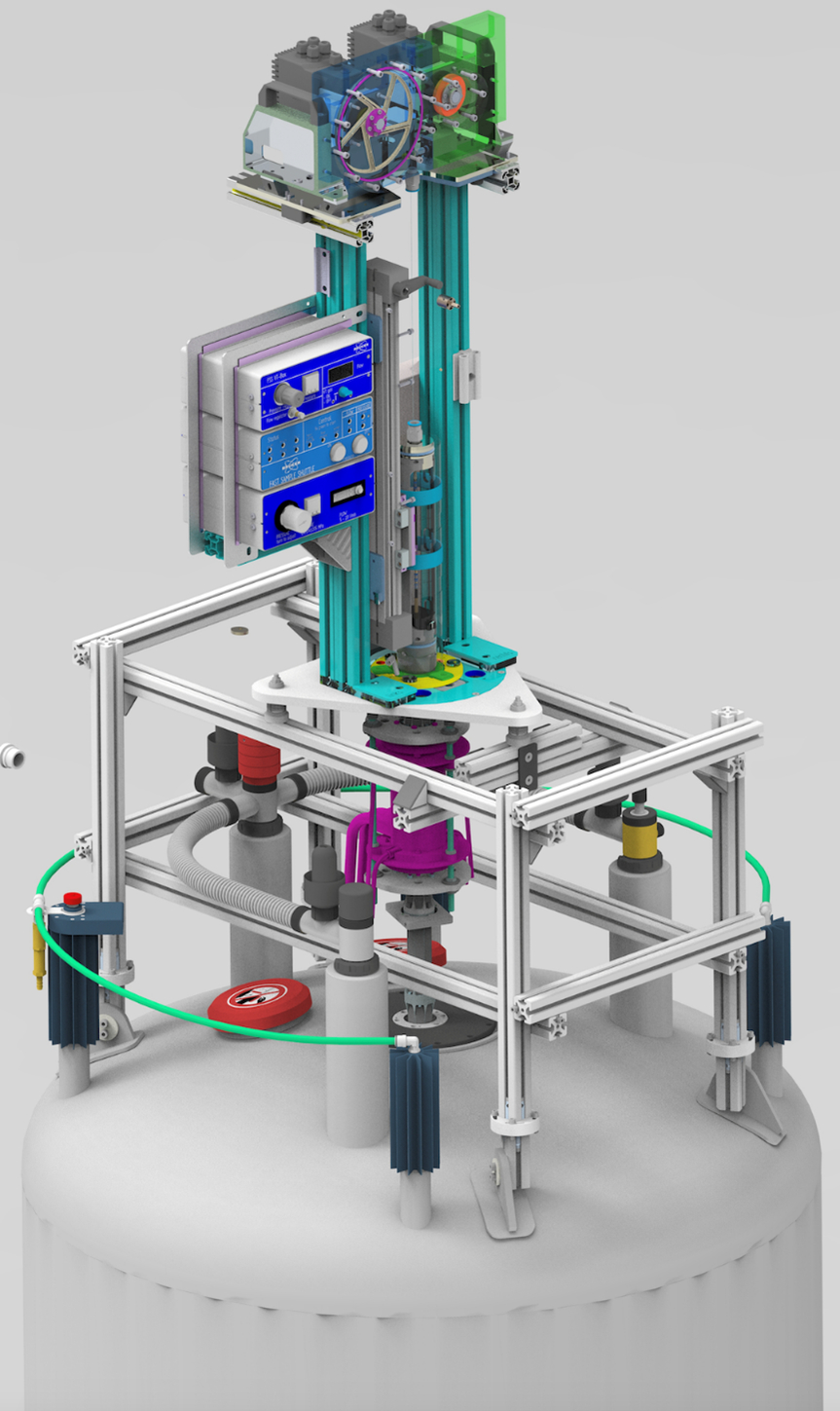
The New York Structural Biology Center (NYSBC) ordered an NIH-funded Multifield NMR Relaxometry System. This advanced relaxometry system will be the first in North America and serves a consortium of nine research institutions in New York State as well as the national community through the NIH-funded Center on Macromolecular Dynamics by NMR spectroscopy. The system consists of a fast NMR sample shuttle system, a magnetic tunnel, and an electromagnetic field cycling coil (FCC), all mounted on a 700 MHz superconducting NMR magnet.
“This novel NMR Relaxometry system is a technological breakthrough that enables for the very first time measurements of spin-lattice relaxation rate constants for 1H, 15N, 13C and other spins in biological macromolecules, including proteins and nucleic acids, over the range of magnetic fields from 100 µT to 16.4 T,” said Arthur G. Palmer, Professor of Biochemistry and Molecular Biophysics at Columbia University and Director of NMR Spectroscopy at NYSBC. “Critically, this instrumentation opens new time regimes for elucidating dynamics of these molecules and enables research ranging from understanding fundamental biological processes in normal and pathological states to discovery of potential new drugs for treatment of cancer and other diseases”.
At the University of Delaware, the Department of Chemistry and Biochemistry has ordered a 600 MHz Dynamic Nuclear Polarization (DNP) NMR spectrometer, funded by the NSF Major Research Instrumentation (MRI) program. This instrument will serve over 25 research groups at the University of Delaware and 12 collaborating institutions, supporting projects that range from understanding the molecular basis of disease to developing new materials and sustainable technologies. The new spectrometer’s enhanced sensitivity will enable investigations of complex biological and engineered systems, including intact cells, protein assemblies, polymers, pharmaceutical formulations, and catalysts.
“This new DNP NMR system will open up avenues of discovery for us not possible with our existing instrumentation,” said Professor Tatyana Polenova, Department of Chemistry and Biochemistry, University of Delaware. “It will impact multiple fields, from structural biology to materials science, and provide training opportunities for students and collaborators. We are grateful for the support of the NSF MRI program, which makes this leap in research capability possible.”
At Northwestern University, the Integrated Molecular Structure Education and Research Center (IMSERC) recently ordered an 800 MHz NMR spectrometer. The instrument will benefit over 15 NIH-funded research groups and the broader Chicago research community, including the Chicago Biomedical Consortium. Key research applications include high-resolution biomolecular NMR for drug discovery, protein-ligand interactions, neurodegenerative disease research, regenerative medicine, and advanced materials development.
“I expect our new 800 MHz NMR spectrometer to transform our ability to conduct high-resolution biomolecular studies and accelerate discoveries in drug development, neurodegenerative disease, and regenerative medicine,” said Dr. Joshua Ziarek, Associate Professor, Department of Pharmacology at the Northwestern University Feinberg School of Medicine. “By making state-of-the-art NMR accessible locally, we are positioning Northwestern as a regional hub for high-field NMR and supporting the next generation of scientific leaders.”
The aggregate value of these three federally funded NMR orders is approximately $10 million, and they are expected to be delivered and installed next year in 2026.
About Bruker Corporation – Leader of the Post-Genomic Era (Nasdaq: BRKR)
Bruker is enabling scientists and engineers to make breakthrough post-genomic discoveries and develop new applications that improve the quality of human life. Bruker’s high-performance scientific instruments and high value analytical and diagnostic solutions enable scientists to explore life and materials at molecular, cellular, and microscopic levels. In close cooperation with our customers, Bruker is enabling innovation, improved productivity, and customer success in post-genomic life science molecular and cell biology research, in applied and biopharma applications, in microscopy and nanoanalysis, as well as in industrial and cleantech research, and next-gen semiconductor metrology in support of AI. Bruker offers differentiated, high-value life science and diagnostics systems and solutions in preclinical imaging, clinical phenomics research, proteomics and multiomics, spatial and single-cell biology, functional structural and condensate biology, as well as in clinical microbiology and molecular diagnostics. For more information, please visit www.bruker.com.
Contacts
Investor Contact:
Joe Kostka
Director - Investor Relations
Bruker Corporation
T: +1 978 313-5800
E: Investor.Relations@bruker.com
Media Contact:
Markus Ziegler
Sr. Director and Head of Group Marketing
Bruker BioSpin
T: +49 172 3733531
E: pr@bruker.com