VDE Americas and RETC Introduce Solar Panel Hail Resiliency Curve Test
VDE Americas and RETC Introduce Solar Panel Hail Resiliency Curve Test
VDE’s rigorous testing protocol measures solar panel resiliency against real-world hailstorm conditions to better defend critical power infrastructure against catastrophic severe convective storm damage.
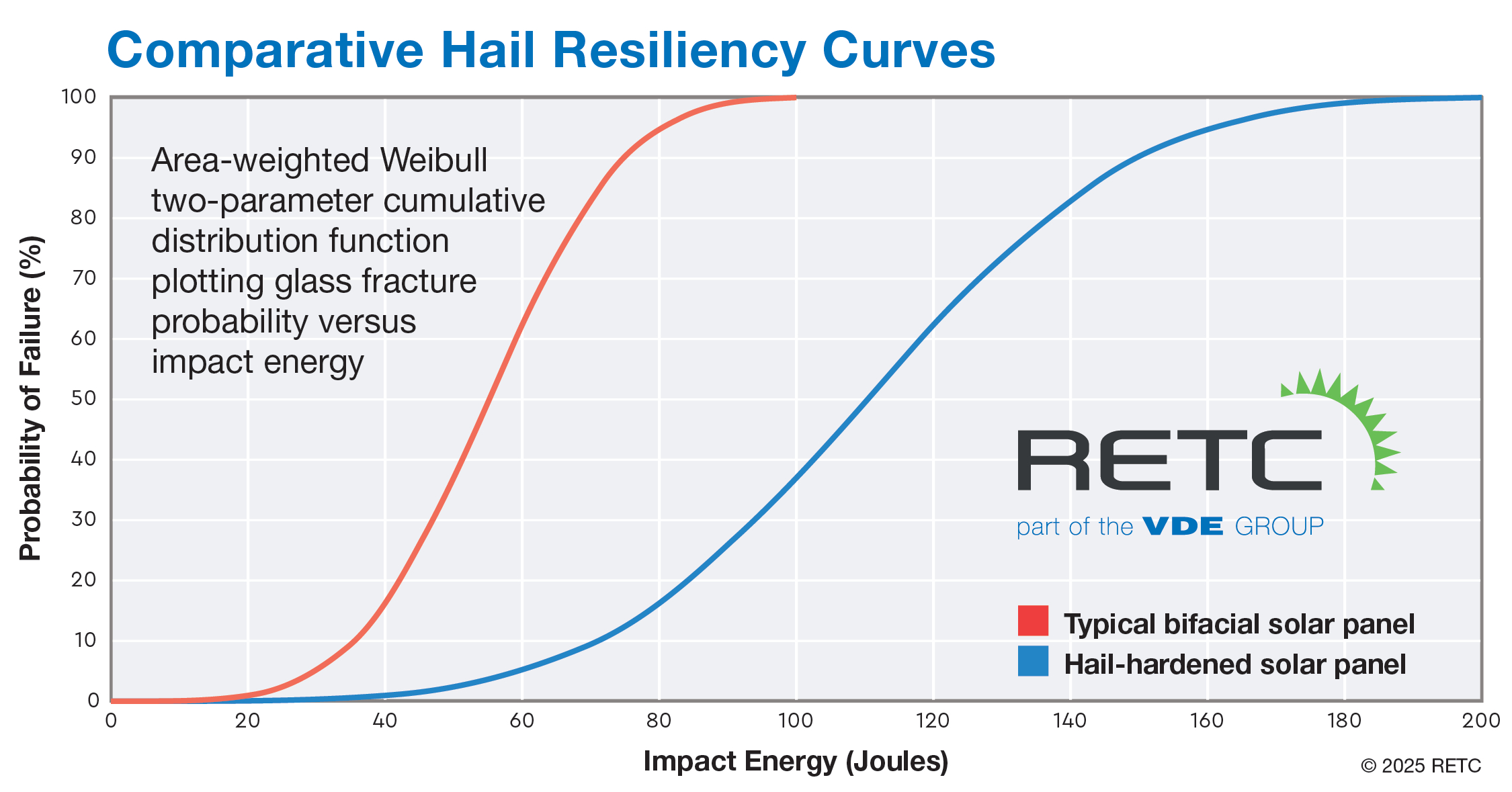
This graph compares hail damage resistance between typical bifacial solar panels (red) and hail-hardened panels (blue), showing the probability of glass fracture versus impact energy. Standard panels fail rapidly between 40-80 joules, while hail-hardened panels maintain low failure rates until 120+ joules, demonstrating significantly superior hail resistance for installations in storm-prone areas.
FREMONT, Calif.--(BUSINESS WIRE)--VDE Americas and RETC, part of the VDE Group, today introduced the Hail Resiliency Curve (HRC) Test, a groundbreaking test protocol designed to evaluate solar panel resilience against hail damage. The innovative HRC Test represents a significant advancement over current industry standard testing by characterizing resiliency across a broad spectrum of impact energies and testing products to failure.
Unlike current hail certification tests for solar panels, the HRC Test simulates real-world hailstorm conditions where solar panels face numerous impacts from a range of hailstone sizes and wind speeds during severe hailstorms. The test involves firing a series of small to large hailstones at low to high speeds at solar panels representing specific models and brands until glass fracture occurs, which gives solar developers, owners and operators accurate data for a panel’s ‘breaking point.’
The new HRC protocol enables:
- Solar panel manufacturers to optimize hail-hardened product designs and demonstrate their performance advantages relative to conventional products;
- Project developers to perform cost-benefit analyses of different solar panels and tracker tilt angle (known as hail stow) combinations to mitigate hail damage risk; and
- Insurance providers to appropriately rightsize hail damage coverage and premiums based on empirical data rather than speculation.
VDE Americas, a global leader in technical advisory and catastrophic risk assessment services, and RETC (Renewable Energy Test Center), a leading certification testing provider for the solar industry, are leveraging their knowledge and experience to arm the solar industry with information to better protect solar panels from catastrophic hail.
"The solar industry has long needed a more rigorous approach to hail testing," said Cherif Kedir, president and CEO of RETC. "The Hail Resiliency Curve Test fills this knowledge gap by providing our customers with actionable data on solar panel hail resilience across the complete impact energy spectrum of real-world hailstorms. Moreover, the rigorous sample size ensures a more thoroughly vetted solar panel characterization."
Glass industry expert Mike Pilliod, president and chief technical officer at Central Tension, who collaborated in the development of the test, emphasized its value: “What really interests me as a glass reliability engineer are measurement systems that provide a statistically representative probability of failure. The use case doesn’t really matter. Automotive glass, cellphone displays, architectural glass, you name it. If you’re not breaking glass—and not testing a representative number of samples to failure—you’re not doing your job as a reliability engineer.”
HRC Test data provide solar project stakeholders with unprecedented visibility into solar panel performance under real-world hailstorm conditions. Pilliod explained: “If you gradually increase kinetic impact energy and test a meaningful number of samples to failure, you can generate Weibull distribution curves that plot the probability of glass failure on a product- or bill of materials-specific basis with low uncertainty. Now you can stack these Weibull curves and compare them. Do the curves overlap? If not, you can be reasonably certain that there is a statistical difference in resiliency.”
Early adopters of the test program represent a broad cross section of the solar manufacturing landscape, ranging from publicly traded module and tracker companies to venture-backed startups. “We use the Hail Resiliency Curve Test to qualify glass suppliers and innovative product designs,” said Chad Medcroft, Senior Vice President of Global Energy Services at Erthos. “As the inventor of Earth Mount Solar, our focus is on module resilience rather than tracker operation. Because this approach challenges convention, we commission rigorous third-party testing to give customers, insurers, and finance partners full confidence in our technology.”
“Conventional hail risk models that are relied upon by many in the insurance community are severely antiquated and outdated,” said Brian Grenko, president and CEO of VDE Americas. “Hail Resiliency Curve Test results provide a superior characterization of solar panel hail resiliency, reducing uncertainty for investors and insurance providers.”
About RETC, part of the VDE Group
RETC (Renewable Energy Test Center) is a leading independent test lab for photovoltaic and battery products. Since 2009, downstream manufacturers, developers, independent engineers, and financiers have trusted RETC to test and vet their modules, inverters, energy storage systems, and racking products. Only the latest testing standards and industry-accepted methods of vetting products are used at RETC. Headquartered in Fremont, California, USA, RETC is united by the belief in enabling a safer and more sustainable future.
For more information, visit www.retc-ca.com
About VDE
VDE, one of the largest technology organizations in Europe, has been regarded as a synonym for innovation and technological progress for more than 130 years. VDE is the only organization in the world that combines science, standardization, testing, certification, and application consulting under one umbrella. The VDE mark has been synonymous with the highest safety standards and consumer protection for more than 100 years.
For more information, visit www.vde.com
About VDE Americas
VDE Americas provides technical advisory and risk mitigation services to renewable energy stakeholders —from project owners and financiers to equipment manufacturers and those who construct, operate and insure large-scale power generation and energy storage facilities. A wholly owned subsidiary of the VDE Group, VDE Americas is recognized globally as the leading authority in solar project hail risk intelligence and loss prevention. The company's expertise and innovative solutions have facilitated billions of dollars of investment in renewable energy assets.
For more information, visit: www.vde.com/en/vde-americas
Contacts
MEDIA CONTACT:
Mission Control Communications for VDE Americas
vde@missionc2.com