Translated Unleashes Full GPT-4 Potential for Businesses Operating in Languages Other Than English
Translated Unleashes Full GPT-4 Potential for Businesses Operating in Languages Other Than English
Combining the power of Translated's state-of-the-art machine translation technology with OpenAI's latest language model, the company’s new T-LM service empowers content creation and restructuring in 200 languages.
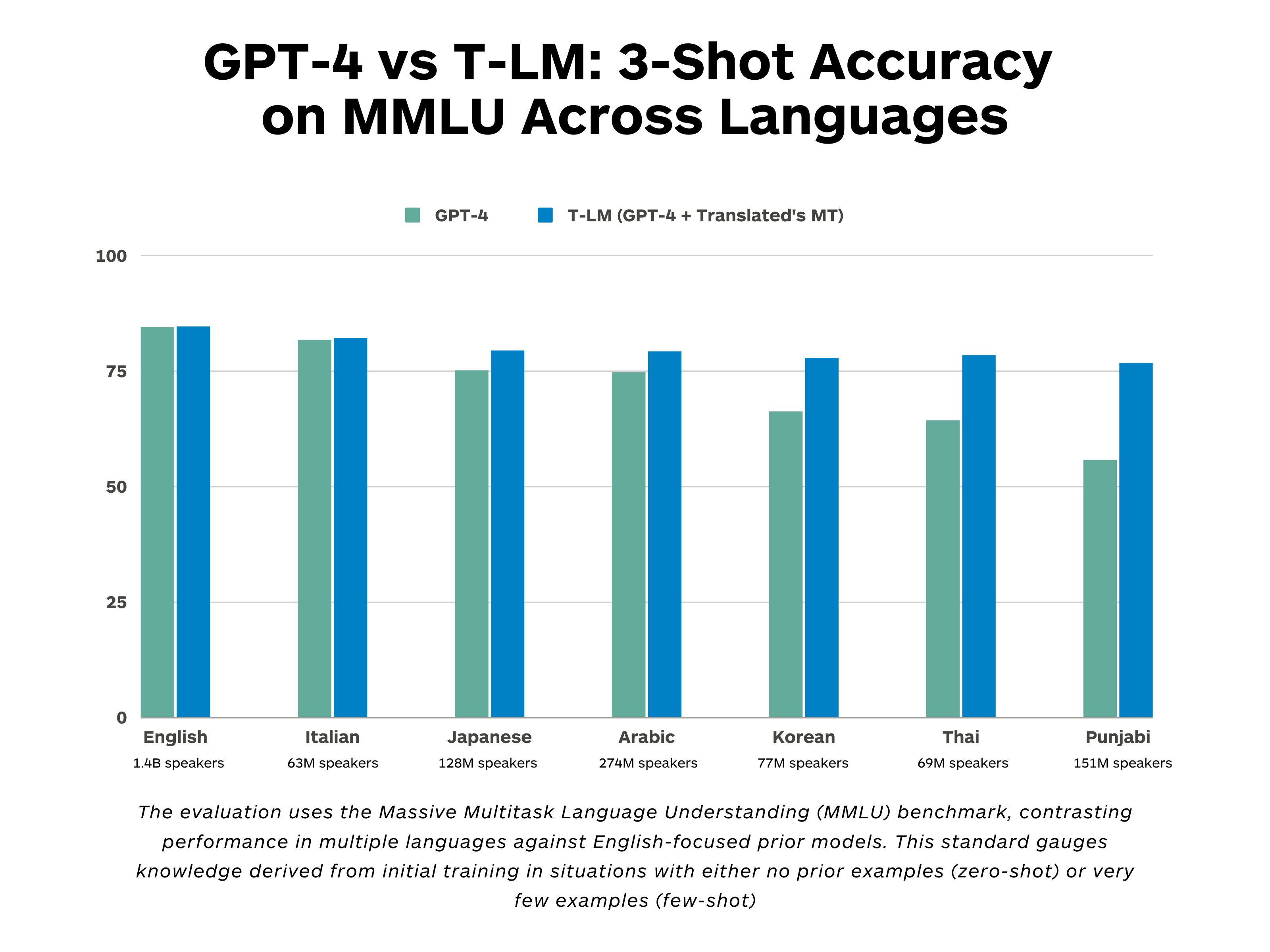
ROME--(BUSINESS WIRE)--In a significant breakthrough for generative AI and content creation, Translated, a leader in AI-enabled language solutions, is proud to introduce its innovative language model T-LM (Translated Language Model). T-LM will help unlock the full potential of OpenAI’s GPT-4 for businesses around the world. It provides companies with a cost-effective solution to create and restructure content in 200 languages, bridging the performance gap between GPT-4 in English and non-English languages.
Until now, GPT's impressive performance has been a privilege of the English-speaking world. Companies operating in languages other than English have often found their performance lagging behind that of GPT models from several years ago, with some languages trailing by as much as three years. For these companies, the performance gap in understanding, generating, and restructuring content was an ongoing challenge that often prevented them from taking full advantage of generative AI. Additionally, using GPT-4 in non-English languages can cost up to 15 times more (see attached charts). Translated's T-LM service integrates the company’s award-winning adaptive machine translation (MT) with OpenAI's GPT-4 to bring advanced generative AI capabilities to every business in the languages spoken by 95% of the world's population.
Marco Trombetti, CEO of Translated, expressed his excitement about the project: "The predominance of English in generative AI is creating an unfair competitive advantage. With T-LM, we're democratizing access to this innovative technology, enhancing efficiencies and preserving competitiveness for businesses operating in languages other than English worldwide."
The disparity in GPT-4’s performance between English and other languages arises from the predominance of English-centric sources – such as the Common Crawl dataset and Wikipedia – in training data, leading to inferior outcomes in non-English languages. T-LM addresses this disparity by translating the initial prompt from the source language to English and then back to the user's language using a specialized model. This approach also lowers the cost of using GPT-4 in languages other than English, since the pricing model is based on text segmentation (tokenization) that is optimized for English.
Use cases for T-LM include assisting global content creation teams in content creation, enhancing multilingual customer support, and facilitating the creation of user-generated content for global platforms.
T-LM is available now through API. More information on the service can be found at translatedlabs.com/gpt.
With T-LM, Translated is underlining its commitment to allow everyone to understand and be understood in their own language and to further collaboration with OpenAI in its pursuit of this mission.
Contacts
Press Contact
Silvio Gulizia
Head of Content
Mail: silvio@translated.com
Mob: +39 393.1044785