Brand Authority: Why Trust and Transparency Shape AI Search Visibility
Ask ChatGPT to explain a market, and it may name a handful of companies. Ask Google a question and an AI Overview may build its answer from a short list of sources. Everyone else on the topic can disappear from the conversation.
For years, digital visibility largely meant ranking. Now, it also means being selected as a source.
AI-powered search experiences increasingly pull information from across the web, evaluate sources, and assemble answers for users. That makes brand authority increasingly important. It’s not simply how well your website ranks or how recognizable your company name is. It’s whether you’ve built a strong enough reputation and public presence to become a source others can rely on.
For communicators, that creates an opportunity. Every announcement, executive perspective, original data point, media mention, and piece of third-party coverage can contribute to how your brand is understood online.
Discover what brand authority means, why trust and transparency matter, and how communicators can build authority that lasts.
What is Brand Authority?
Brand authority is the degree to which audiences, journalists, search engines, and AI systems recognize a company as a credible and reliable source in its area of expertise. It can show up in several ways: independent media mentions, third-party references, branded searches, citations, links, and appearances in AI-generated answers.
The concept is broader than any single measurement. Moz, for example, offers a proprietary Brand Authority score based largely on branded search demand. That can be useful to track, but it’s only one way to think about authority.
For a communications team, the more practical question is: When someone needs information about your market, do you show up as a source worth using?
That is the heart of brand authority.
Brand Awareness vs. Brand Credibility vs. Domain Authority
These terms are related, but they measure different things.
- Brand awareness measures whether people recognize your company. A business can have tremendous name recognition without being considered an expert or reliable source on a particular topic.
- Brand credibility is about whether people have reason to believe what your company says.
- Domain authority is an SEO concept used to estimate the strength of a website based on factors such as its backlink profile. It can help predict how a domain may perform in traditional search, but it does not fully describe the reputation of the organization behind it.
Brand authority brings these ideas together at a broader level. It reflects whether your organization has earned enough recognition, expertise, credibility, and independent validation to become a source people and information systems are willing to rely on.
Think of it this way:
- Awareness gets your name recognized.
- Credibility gives people a reason to believe you.
- Authority gives them a reason to turn to you.
That distinction matters as search expands beyond traditional rankings.
Research from Ahrefs found that branded web mentions were strongly associated with visibility in AI search experiences, including Google AI Overviews, Google AI Mode, and ChatGPT. The research does not mean traditional SEO or backlinks no longer matter. It suggests that your company's broader presence across the web is a key part of the picture.
Your website is only one part of your brand's search footprint.
Why Trust & Transparency Shape Brand Authority
Brand authority is built through evidence. People want to know whether a company is credible before they trust its claims. Search engines and AI systems face a similar challenge when deciding which information to surface, summarize, or cite.
That is where brand trust and brand transparency come in.
Transparency means making important information clear enough to understand and verify. An organization that consistently provides specific facts, explains its research, identifies its experts, and maintains a clear public record gives audiences more information to evaluate.
Over time, that record contributes to brand credibility.
This is also why the source matters, not just the statement itself. A claim appearing repeatedly across credible, independent sources carries a different context than a claim that exists only in a company's own marketing copy.
Your communications strategy can help build that broader context.
Brand Authority is Built Outside Your Website, Too
Your website is important. It’s where you control your messaging, explain your products, publish research, and maintain your newsroom. But your brand exists beyond your website.
Journalists write about you. Analysts reference your research. Industry publications discuss your executives. Customers mention your products. Partners announce collaborations. Financial databases carry your information. Other websites link to your news.
Together, those references create a broader picture of your organization.
This is one reason earned media matters. A company saying it is a leader in its industry is a claim. An independent publication recognizing the company for its expertise provides a different kind of evidence.
The same principle applies to original research. Publishing a report is useful. Having other organizations reference its findings creates additional authority around both the data and the company that produced it.
Brand authority grows when your expertise is reflected beyond the channels you control.
Where Press Releases Fit into Brand Authority
Press releases are one of the most direct ways communications teams can contribute to the public record. A strong press release establishes a clear record of company news: what happened, when it happened, why it matters, and who is speaking. It can also become source material for the coverage and conversations that follow.
A product launch can generate an announcement, media coverage, analyst discussion, executive interviews, and customer conversations. An earnings announcement can become part of the financial news cycle. A research report can be used by journalists and industry publications.
Distribution matters because the value of a release does not necessarily end when someone reads it on your newsroom. News can travel to media outlets, industry publications, financial audiences, databases, and other destinations where people look for company and market information.
That broader presence can contribute to brand authority by making your information easier to discover and reference.
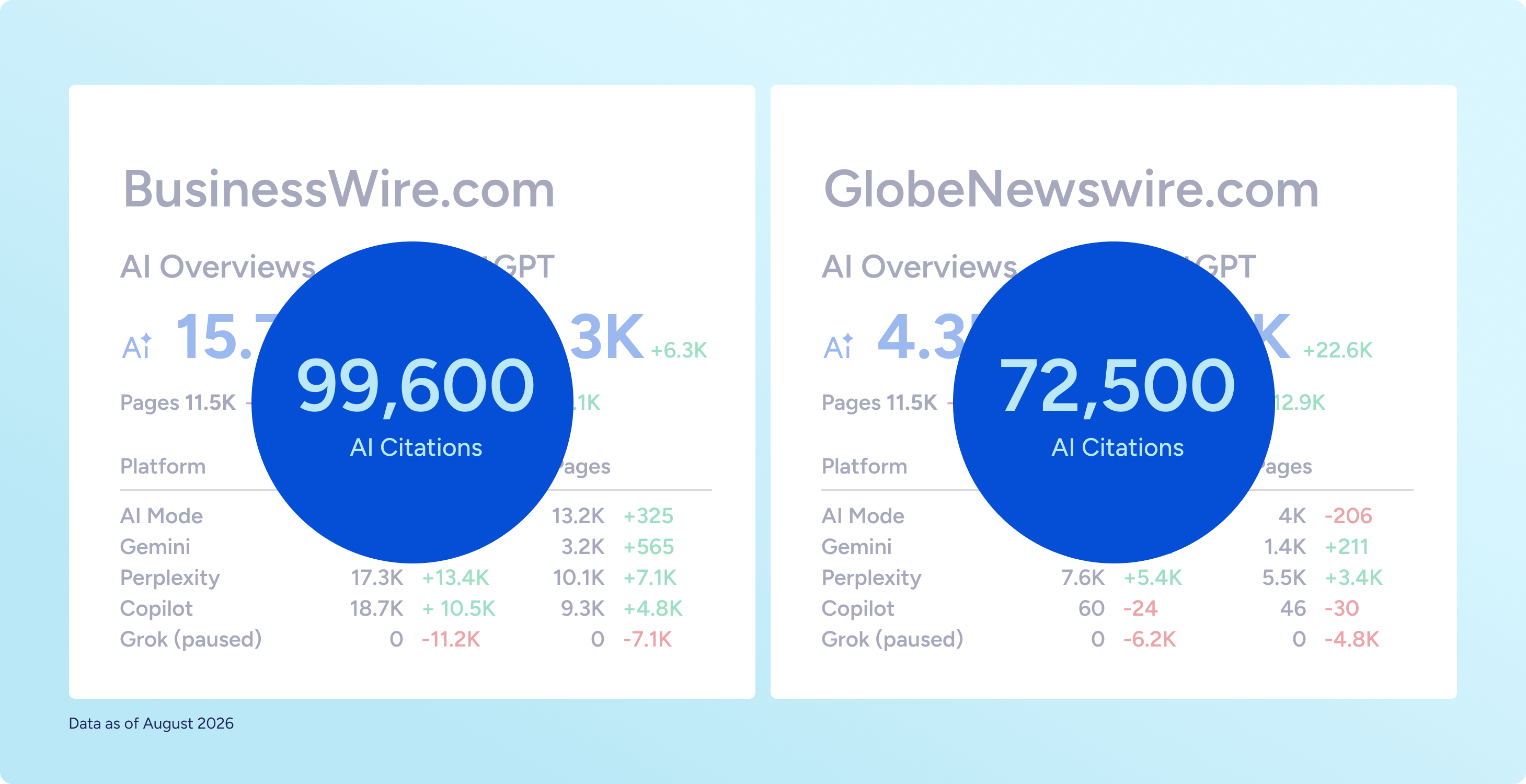
Business Wire's own data reflects the growing role of distributed news in AI visibility. As of August 2026, Business Wire had nearly 100,000 AI citations tracked by Ahrefs, compared with approximately 72,000 for GlobeNewswire across the platforms measured. These figures are a snapshot and can change over time, but they illustrate a major point: the information companies put into the public record can become source material for AI-generated answers.
How to Build Brand Authority: 5 Tips for Communicators
Building brand authority means regularly creating and distributing information that gives other people something useful to draw on. Here are five practical ways communications teams can approach it.
1. Become a Source of Information
Your company has information that no one else has. That might include proprietary research, customer trends, operational benchmarks, industry data, product insights, or executive perspectives.
Look for opportunities to turn that knowledge into useful information other people can use.
Original data is particularly valuable because your organization is the primary source. Include methodology and context so others can understand what the findings mean.
When journalists, analysts, or industry publications reference your research, they are reinforcing your association with the topic.
2. Give Your Executives Something Worth Quoting
Executives can play a major role in building brand authority when they contribute actual expertise rather than repeating corporate messaging.
Look for the questions your audience is already asking. What is changing in your industry? What does your data reveal? What are customers struggling with? What does your leadership team expect next? Then give executives opportunities to answer those questions publicly.
A useful quote has a point of view. It adds information or context that would not be available from a generic statement. Over time, those perspectives can help establish your executives and company as knowledgeable voices in a particular market.
3. Build a Public Record That Supports Your Claims
Authority compounds when today's information can be connected to yesterday’s. Maintain a consistent stream of substantive company news, research, executive commentary, milestones, and other information that demonstrates what your organization does and knows.
This does not mean announcing every minor update. It means making sure important developments become part of a durable public record.
Your newsroom is a useful part of that record. So are your financial disclosures, research reports, media coverage, interviews, and other authoritative sources. The stronger the record, the more context exists around your organization when someone encounters your name for the first time.
4. Earn Independent Validation
Brand authority is stronger when other people confirm it. Look beyond the number of media placements you generate. Pay attention to who references your company and why.
Are journalists citing your research? Are industry publications quoting your executives? Are analysts using your data? Are other organizations linking to your announcements?
These references provide something your own website cannot create by itself: independent validation. This is also where brand transparency pays off. When claims are specific and easy to verify, journalists and other third parties have a stronger foundation for using them.
5. Make Authority an Ongoing Communications Practice
Brand authority is not something you can create with one campaign. It develops through repeated evidence over time.
A company that publishes original research once may get attention. A company that regularly produces useful industry data can become known for that expertise.
The goal is consistency: keep contributing useful information to the public record and make it easy for others to discover.

How Do You Measure Brand Authority?
There is no single metric that captures brand authority. Instead, look at several indicators together:
- Independent media mentions: How often is your company mentioned without paying for the coverage?
- AI citations and mentions: Does your company appear when AI assistants answer questions about your market?
- Branded search volume: Are people searching for your company by name?
- Share of voice: How often does your company appear compared with competitors across relevant topics?
- Third-party references: Are publications, researchers, analysts, or other organizations referencing your data and expertise?
- Source visibility: When important topics in your market are discussed, is your company part of the source set?
Look at these measures over time rather than treating brand authority as a single score.
AI visibility can also change as models, search experiences, sources, and user behavior change. The goal is to build a body of credible information that creates more opportunities for your company to be included.
The Brand Authority Self-Audit
A quick self-audit can help identify where your authority is strong and where there are gaps. Answer yes or no:
- Is your company regularly mentioned by independent publications in your market?
- Does your organization publish original information or data others can use?
- Are your executives contributing meaningful expertise to industry conversations?
- Can people easily find a history of your company's major announcements?
- Do third parties reference your research, data, products, or expertise?
- Does your company appear when you ask an AI assistant about your market?
- Are your most important company claims supported by information available outside your own website?
- Does your communications program consistently contribute useful information to the public record?
A low score doesn’t mean your brand lacks authority; it shows where you have an opportunity to build it.
Brand Authority Compounds
Brand authority is the accumulated weight of credible information and independent validation surrounding your company. Every useful piece of research, substantive executive perspective, factual announcement, media reference, and third-party citation can add another piece to that record.
That is why brand authority is not a campaign. It is the result of consistent communications over time.
Your website matters. Your content matters. Your SEO strategy matters. But so does everything that happens around your brand beyond the pages you control.
The companies that become trusted sources in search and AI-generated answers are not simply the companies that publish the most. They are the companies that give people, and the systems helping people find information, something worth trusting, referencing, and repeating.
Make Your Press Release AI-Ready Explore Business Wire Services →