TitanX Publishes First Annual Phone Intent Benchmark Report: Who Actually Answers a Cold Call
TitanX Publishes First Annual Phone Intent Benchmark Report: Who Actually Answers a Cold Call
Drawn from Phone Intent™ scoring across 2.3 million B2B contacts, the report is a published benchmark of how reachable a market is by phone before a single dial is placed.
KNOXVILLE, Tenn.--(BUSINESS WIRE)--TitanX, the creator of the outbound sales industry’s Precision Dialer, today released its first annual Phone Intent Benchmark Report. Housed in the TitanX Arena, an interactive data hub that hosts novel research and data-backed insights, the report is a breakdown of the share of B2B prospects who will answer a cold call, which varies based on which industry they’re in and how senior a position they hold. Its findings are drawn from Phone Intent™ scoring of more than 2.3 million contacts over the course of a year.
The report shows that across the entire dataset, an average of roughly 20% of any market will ever answer a cold call. The other 80% will not, regardless of how many times they are dialed, from which number, or on which day. It also provides new data on how much that rule changes depending on who is being called, at a level of detail that TitanX hasn’t reported previously, and shows how much more (and less) reachable contacts in some industries and role seniority are.
“I’ve been looking at this data for years, and we’ve analyzed well over 100 million phone numbers. This ‘80/20 rule’ is incredibly consistent, and we’ve always coached our customers to follow it. But this is the first time we’re publicly sharing the data behind the rule,” said Justin Middleton, President at TitanX. “Every revenue leader is operating under the same mandate of ‘scale revenue without scaling headcount.’ The fact that the majority of the market will never answer your calls indicates that connect rate is the biggest constraint on the success of a phone-based outbound motion, not dials-per-hour. It’s the share of people on your list who will actually pick up. Until now, nobody has published what that number is.”
Reach rate is a fixed pattern of human behavior, not a technology gap
Phone Intent™ is not buyer-intent data, which says a company may be shopping, but not whether anyone there can be reached. It is also not merely phone-number validation, which says a line is live but not whether the person on it will answer. Rather, Phone Intent™ scores each prospect’s behavioral propensity to answer a cold call, giving each number a grade based on the following tiers:
- P1 = High intent. Confirmed to answer cold calls; verified that the number belongs to the contact in question.
- P2 = Verified to belong to the right contact, and is an active line, but couldn't verify they answer cold calls.
- P3 = Couldn't verify this number belongs to the right person.
- Bad data = Verified to be the wrong number.
Phone Intent™ was built from observed individual behavior across a dataset of over 100 million phone numbers, hundreds of sub-industries, and thousands of job titles.
In this report, rate reach is measured directly from that scoring. Because the measurement is behavioral rather than firmographic, it describes the people, not the companies; it is stable across data vendors, dialers, and calling teams. A market’s reach rate is a property of the market; dialing it harder does not change it.
Reach rate falls as seniority rises
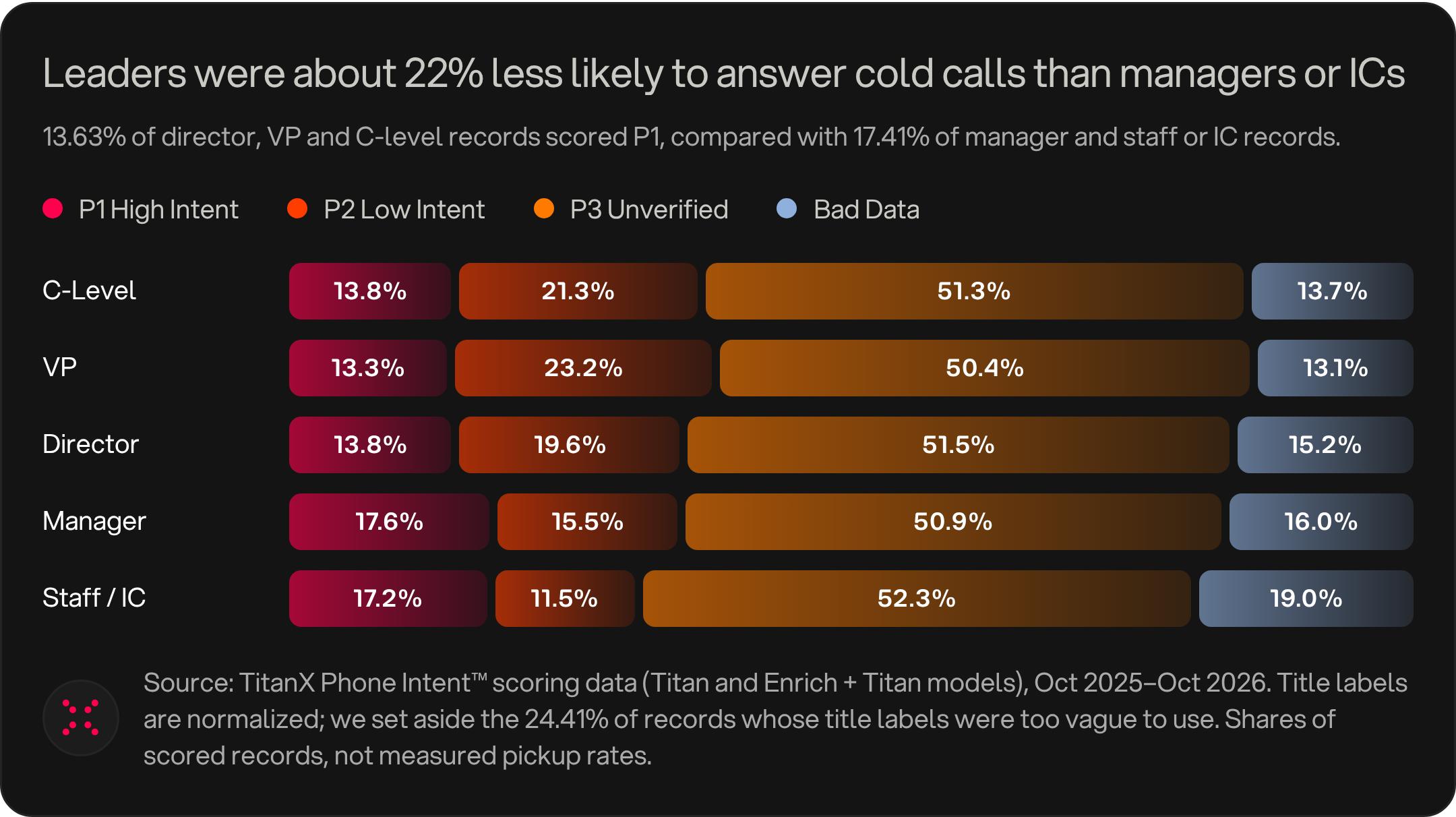
A key revelation from the report is that the more senior the title, the less likely it is that the person will answer. Based on the P1-scored contacts, 17.2% of staff (or individual contributors) were found to answer cold calls. Managers were found to answer cold calls at 17.6%. Directors at 13.8%. Vice presidents at 13.3%. C-level executives at 13.8%. The decline is obvious, with a noticeable step down of 3.8 points between managers and directors.
Joey Gilkey, CEO of TitanX, said, “What makes a dial worth your rep’s time isn’t some black-box purchase intent signal. It’s nice to know your target account might be shopping. But can you actually have a conversation with the person there? And just because it’s hard to reach the C-Suite or budget-owner doesn’t mean you don’t have a clear path to call into an account and gather intel, get introductions, and understand the need at hand.”
Reach rate by industry
When assessing reachability by industry, the report highlights more disparities. The most reachable industries in the dataset are construction, where 19% of contacts were scored P1, telecommunications at 18.2%, and law firms and legal services at 18.0%. The least reachable are hospitals and clinics, where just 12.8% of contacts received P1 Phone Intent™ scores, and insurance at 13.6%. Across 21 industries with a minimum sample of 1000 contacts each, the spread from most to least reachable is approximately seven points.
Two teams with identical list sizes, identical reps, and identical tools can therefore face structurally different ceilings. A team selling into construction starts every quarter with roughly 1.5 times the likelihood of connecting with their ICP on the phone than a team calling contacts in the software industry. Most sales leaders set activity targets, quotas, and headcount plans without taking into account the potential for real conversations in their market.
What reach rate changes about planning
This benchmark gives sales leaders a way to plan against reality. Now, they have the capability to size a territory by reachable contacts rather than total contacts, to set activity targets a team can actually hit, and to stop mistaking a low-reach market for a low-performing team.
“Outbound sales is hard enough without the B.S. narrative that hustle—or more dials, for example—is all you need to succeed. It’s not enough. In fact, the quality of life for many sellers has declined in the last decade as they hustle harder than ever before, with lower reach than ever before. This is partially because they’re hustling so hard they get their phone numbers spam-flagged. Our hope is that this new benchmark data shines a light on a need for greater precision and lowering the emphasis on volume outbound for B2B sales teams,” said Gilkey.
The full report, including methodology, sample sizes for every cut, and the complete seniority and industry tables, is available at https://titanx.io/arena/phone-intent-benchmark-2026.
About TitanX
TitanX is the precision dialer. Using a behavioral dataset built from over 100 million phone numbers, Phone Intent™ identifies which prospects will answer a cold call before a rep ever dials. That intelligence is inseparable from execution: a single-line dialer, never parallel, built for conversation quality; automatic carrier registration and spam remediation that keep numbers trusted; and a prioritized queue that puts each rep's warmest work first and enforces follow-up. TitanX's own analysis of 911 dialing records across 22 companies measures the impact at a 3.5 to 4x lift in connect rate, replicated on two independent cuts. Teams consistently reach 20 to 30%+ connect rates, and every rep spends the day in far more real conversations. More at titanx.io.
Contacts
Media Contact
Society22 PR
titanx@society22pr.com