Guava Adds WebRTC SDK, SIP Calling and Warm Transfers to Get Voice Agents onto Calls
Guava Adds WebRTC SDK, SIP Calling and Warm Transfers to Get Voice Agents onto Calls
Developers can now connect Guava voice agents to browsers, to phone platforms such as Twilio and Cisco, and to live people, with optimized phone numbers on by default
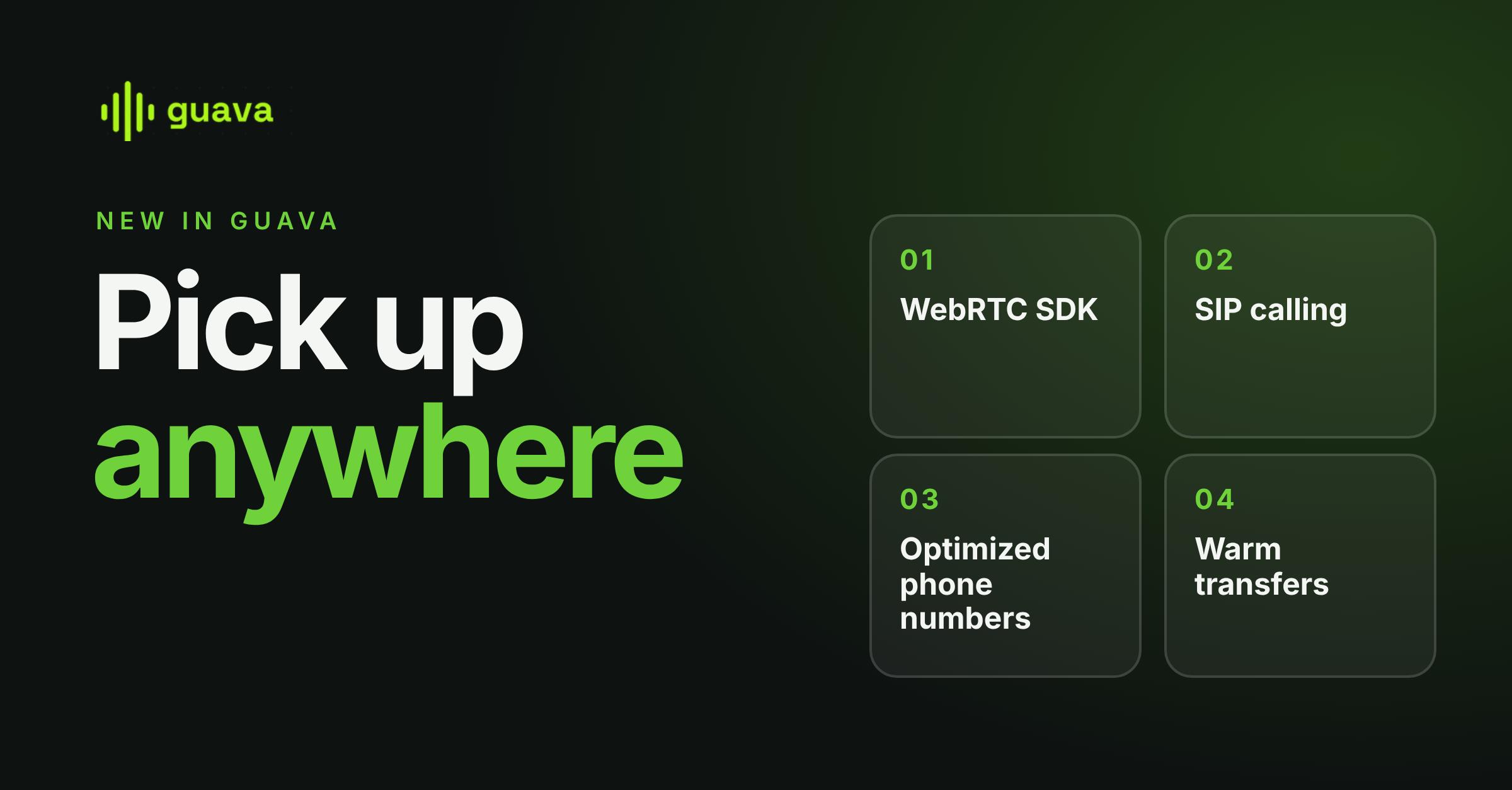
LOS ANGELES--(BUSINESS WIRE)--Guava, the developer platform for building voice agents, today announced four additions that make it easier to put an agent on a call: a WebRTC SDK, SIP calling, optimized Guava phone numbers and warm transfers.
The WebRTC SDK connects a Guava agent to a browser or app session. It includes a built-in message passing system, so a developer's frontend and the agent can exchange messages directly, without extra backend work.
SIP calling lets teams connect Guava agents to the phone systems they already run. It works with Twilio and with legacy platforms such as Cisco, and Guava has published full integration guides for both.
Native Guava phone numbers now have optimizations through Guava's partnership with CarrierX. Every number a customer buys on Guava is a CarrierX number with the optimization on by default.
Warm transfers are built in. When a caller needs a person, the agent briefs that person on why the caller is calling before connecting the two, and the caller stays on the line while the person gets up to speed. Warm transfers are available in both the Python and TypeScript SDKs, with examples in the warm transfers guide.
“Getting an agent onto a call is where a lot of voice projects slow down,” said Omri Dahan, co-founder and CEO of Guava. “With this release, developers can use the browsers and phone systems they already have, and hand a call to a person when the agent should step back.”
“We built these pieces to work the way developers expect,” said Nico Benitez, co-founder and Co-Head of Engineering at Guava. “The SDK handles message passing so teams write less backend code, and the SIP guides cover the platforms people actually run.”
The WebRTC SDK, SIP integration guides and warm transfers are documented in the Guava docs.
About Guava
Guava is a developer platform for building voice agents. It helps developers build AI voice agents for customer conversations and tasks such as scheduling appointments and live support. Guava manages the voice interaction, while businesses control what agents know and do through their own software and business rules. Guava is based in Los Angeles and was co-founded by Omri Dahan, Anthony Scodary, Nico Benitez and Mike Piechna. Learn more at goguava.ai.
Contacts
Media contact
Ankur Thakkar, Head of Marketing, Guava
ankur@goguava.ai