Aqtual Presents Data Linking Blood-Based Biomarkers to Tissue Biology and Treatment Response in Rheumatoid Arthritis
Aqtual Presents Data Linking Blood-Based Biomarkers to Tissue Biology and Treatment Response in Rheumatoid Arthritis
Second poster at ACR Convergence 2026 shows PRIMA-102 study participants are broadly representative of routine care, supporting clinical validation and clinical utility efforts
HAYWARD, Calif. & ORLANDO, Fla.--(BUSINESS WIRE)--Aqtual, Inc., a precision medicine company developing active chromatin cell-free DNA (cfDNA) diagnostics, today announced data that advance the understanding of why patients with rheumatoid arthritis (RA) respond differently to treatment and support the continued development of Aqtual’s RA treatment selection test, a blood-based biomarker test designed to help physicians choose among TNF inhibitors, JAK inhibitors, and abatacept for patients with RA before starting or switching treatment. Two posters being presented at the American College of Rheumatology (ACR) Convergence 2026, November 6–10 in Orlando, Florida, show that signals detected in blood reflect joint tissue biology associated with response to different RA medications, and that participants in Aqtual’s prospective PRIMA-102 study (NCT05936970) can be linked to real-world data to extend follow-up. Aqtual is also exhibiting at ACR at Booth #4119.
“We enrolled more than 1,400 patients as they started a new rheumatoid arthritis treatment. Even before the first dose, their blood carried biological signals associated with treatment response, with distinct patterns across drug classes,” said Diana Abdueva, PhD, co-founder and Chief Executive Officer of Aqtual. “These findings lay the foundation for choosing RA treatments based on biology rather than trial and error, and we're now working to bring that science into clinical practice.”
Both posters draw on PRIMA-102, a prospective, multicenter study that enrolled more than 1,400 adults with RA at more than 50 sites across 22 states as they started a new treatment.
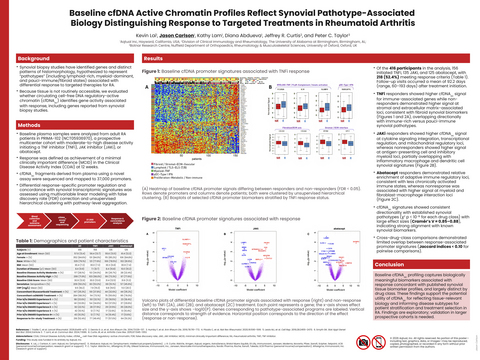
The first poster reports an interim analysis of baseline plasma samples from 416 PRIMA-102 participants who initiated treatment with a TNF inhibitor (n=156), JAK inhibitor (n=135), or abatacept (n=125). Using active chromatin cfDNA (cfDNAac) profiling across approximately 37,000 gene promoters, researchers identified largely distinct, drug-class-specific gene regulatory signatures associated with clinical response, defined as achieving a minimal clinically important difference (MCID) in the Clinical Disease Activity Index (CDAI) at 12 weeks. Response was associated with immune-rich biology for TNF inhibitors, cytokine-signaling biology for JAK inhibitors, and adaptive immune regulatory biology for abatacept, while nonresponse was associated with stromal, myeloid, and fibroblast-related biology. These signatures showed strong concordance with previously published synovial tissue pathotypes, supporting the potential of blood-based cfDNAac profiling to reflect tissue-relevant biology associated with treatment response.
The second poster, developed in collaboration with investigators from the University of Alabama at Birmingham and the non-profit Foundation for Advancing Science, Technology, Education and Research (FASTER), evaluated the representativeness of PRIMA-102 participants compared with RA patients receiving routine clinical care at the same rheumatology practices. Researchers compared PRIMA-102 participants with patients in electronic health record (EHR) and commercial insurance claims data. The populations were broadly similar in age, sex, and body mass index, although PRIMA-102 participants had higher disease activity, greater prior disease-modifying antirheumatic drug (DMARD) use, and lower oral glucocorticoid use. Researchers also assessed the feasibility of linking clinical study participants to real-world data using privacy-preserving patient matching methods. Among 1,131 PRIMA-102 participants at 20 participating sites, 580 (51.3%) were linked to at least one real-world data source. Matching was highly accurate: 99.0% of EHR matches were unique one-to-one matches, and 95.6% of claims matches were confirmed by an RA diagnosis. The findings demonstrate the feasibility of linking clinical research data with real-world patient records to extend longitudinal follow-up and augment model training and clinical validation data while informing clinical utility study plans, including potential external synthetic comparator cohorts.
“In our recent 2026 Arthritis Care & Research study of more than 37,000 newly diagnosed RA patients, TNF inhibitors, JAK inhibitors, and abatacept accounted for most first- and second-line advanced therapy choices, TNF inhibitor cycling remained common, and switching rates varied more than four-fold between rheumatologists,” said Jeffrey R. Curtis, MD, MS, MPH, Professor of Medicine at the University of Alabama at Birmingham. “That variation in part reflects the absence of a test to guide treatment switching. A blood test that accurately predicts response across RA drug classes would greatly inform the decisions that rheumatologists make most often.”
Presentation Details
Poster 1: Baseline cfDNA Active Chromatin Profiles Reflect Synovial Pathotype-Associated Biology Distinguishing Response to Targeted Treatments in Rheumatoid Arthritis (Abstract: #0080)
- Date: Sunday, November 8, 2026
- Time: 10:30 AM–12:30 PM ET
- Session: Poster Session A
- Category: Rheumatoid Arthritis: Translational Models and Mechanisms
Poster 2: Representativeness of a U.S. Biomarker Discovery Cohort Compared to Real-World Data from Enrolling U.S. Rheumatology Practices (Abstract: #2408)
- Date: Tuesday, November 10, 2026
- Time: 10:30 AM–12:30 PM ET
- Session: Poster Session C
- Category: Rheumatoid Arthritis: Treatment
Aqtual is also expanding strategic biopharmaceutical partnerships across chronic diseases and oncology. The company’s active chromatin cell-free DNA platform is giving drug developers a new, blood-based window into disease biology in cancer and autoimmune conditions beyond RA, no biopsy required. For more information on Aqtual, including a platform technology whitepaper, upcoming conferences, and details on the most recent scientific publications, please visit www.aqtual.com
About Aqtual, Inc.
Aqtual, Inc. is a precision medicine company developing products for chronic disease management and oncology utilizing a novel cell-free DNA-based platform. Aqtual’s proprietary platform evaluates protein regulation, epigenetics, and transcriptomics solely using cell-free DNA fragments found in the blood. The platform yields efficient and robust real-time analysis of disease and treatment while overcoming the limitations of previous cell-free DNA methodologies.
Contacts
Media Contact
Andrea Vuturo
Vuturo Group for Aqtual
andrea@vuturo.com
+1 (415) 689-8414