World-First Achievement: SUSMED's Blockchain-Based Clinical Trial System Supports Successful Marketing Authorization for Pharmaceutical Product
World-First Achievement: SUSMED's Blockchain-Based Clinical Trial System Supports Successful Marketing Authorization for Pharmaceutical Product
– Pioneering Solutions for Drug Lag and Loss –
TOKYO--(BUSINESS WIRE)--SUSMED, Inc. (TOKYO:4263) announced that "SUSMED SourceDataSync®" ("SUSMED SDS"), its proprietary blockchain-based clinical trial system, has contributed to obtaining marketing authorization for a pharmaceutical product1,2,3.
This marks the world's first pharmaceutical approval based on the results of an industry-sponsored clinical trial utilizing blockchain technology4.
2 :“Aculys Pharma Commences Phase 3 Clinical Trial of Pitolisant in Japan Utilizing SUSMED’s Blockchain-Based Clinical Trial System” https://susmed.co.jp/wp-content/uploads/2022/11/aw5ser6xc7tv8y9uboni870.pdf |
3: “Aculys Pharma Commences Phase 3 Clinical Trial of Pitolisant in Japan for Excessive Daytime Sleepiness Associated with Obstructive Sleep Apnea, Utilizing SUSMED’s Blockchain-Based Clinical Trial System” https://susmed.co.jp/wp-content/uploads/2023/01/roeadxfgfuihoi34w5e6r8789tfyc.pdf |
4: Based on SUSMED’s internal research of medical databases, clinical trial registries, and research tools, including PubMed (https://pubmed.ncbi.nlm.nih.gov/), ClinicalTrials.gov (https://www.clinicaltrials.gov/) managed by the U.S. National Library of Medicine at the National Institutes of Health (NIH), and the EU Clinical Trials Register (https://www.clinicaltrialsregister.eu/ctr-search/search) managed by the European Medicines Agency (EMA). |
Challenges in Pharmaceutical Development
Global research and development (R&D) expenditure for pharmaceuticals continues to rise, increasing at an annual rate of approximately 8.5% over the past decade5. Key drivers of the rise in R&D expenditure include advancement of R&D and the increasing complexity of protocols. In Japan, both labor-intensive and over-engineering practices intended to comply with the Good Clinical Practice(GCP) ordinance have been widely highlighted as major contributing factors. It also results in the fact that the number of clinical trial sites managed per Clinical Research Associate (CRA) in Japan is only one-third of that in the United States6. Consequently, rising development costs lead to serious drug lag and drug loss, which in turn is posing significant challenges to social and economic securities.
In recent years, the updated international guideline for Good Clinical Practice, ICH-E6(R3), outlined the Quality by Design (QbD) approach. The guideline states that the sponsor should avoid unnecessary complexity and not place unnecessary burden on participants and investigators. Implementing an appropriate system to manage quality throughout all stages of the trial process is also required.
5: Congressional Budget Office: “Research and Development in the Pharmaceutical Industry”, April 2021 |
6: "The Day Japan Is Excluded from Global Clinical Trials: Mindset and Behavioral Reform to Avoid the Worst-Case Scenario" (PhRMA / EFPIA Japan Joint Seminar at the 18th Conference on CRCs and Clinical Trials 2018 in Toyama). |
Our Solution and Initiatives
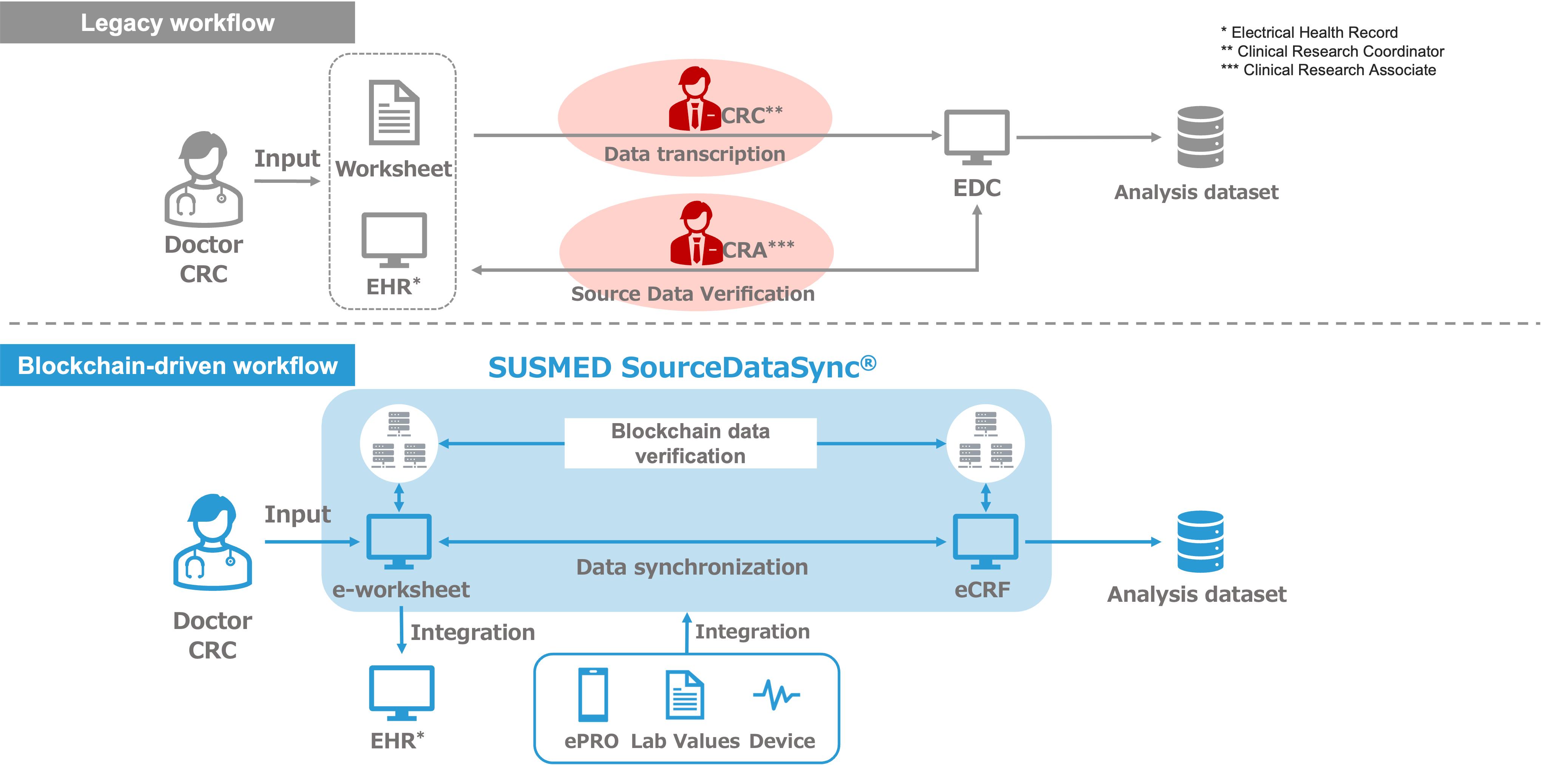
SUSMED SDS is a clinical trial management system that utilizes blockchain technology to securely syncronize medical data captured at medical institutions with Case Report Form (CRF) data. This enables a significant reduction in both data entry workload at medical sites and regulatory-mandated monitoring tasks. The verification results in the Regulatory Sandbox system were published in a peer-reviewed international medical journal in June 2020 (Hirano et al., 2020, JMIR). Based on these findings, SUSMED submitted an application under the "System of Inquiry on Regulatory Gray-Zone Areas" pursuant to the Industrial Competitiveness Enhancement Act and, on December 4, 2020, the Ministry of Health, Labour and Welfare (MHLW) issued an official notification7 confirming that substituting monitoring tasks with blockchain technology is compliant with Japan's GCP ordinance.
Furthermore, a comparative evaluation between conventional clinical trial workflows and the SUSMED SDS workflow, conducted under the Research and Development Promotion Network Project supported by the Japan Agency for Medical Research and Development (AMED), demonstrated that monitoring workload decreased by 45.9%, medical institution workload decreased by 32.0%, and data queries for verification and correction decreased by 46.7%8. These findings indicate that, while substantially reducing overall operational overhead, the use of blockchain technology for clinical trial data management contributes significantly to streamlining processes, improving productivity in alignment with Quality by Design (QbD) principles.
7: Ministry of Health, Labour and Welfare (MHLW), "Publication of Responses to Inquiries Regarding Regulatory Confirmation" (December 4, 2020). |
8: AMED R&D Database,“Development of an efficient and reliable monitoring method using blockchain technology.” |
Additionally, GAMP 5 Second Edition, the GxP guidance published by the International Society for Pharmaceutical Engineering (ISPE) in 2022, highlighted blockchain technology as a key solution for enhancing data integrity, which signals growing global expectations for the expanded use of blockchain across the clinical trial ecosystem.
Achievements and Future Outlook
The regulatory approval of a pharmaceutical product based on a clinical trial utilizing blockchain technology marks the world-first achievement, driving expectations for the broader implementation of this technology to accelerate the establishment of a modern clinical trial ecosystem.
Comment from Taro Ueno, President and CEO of SUSMED, Inc.:
“I, as a clinician, believe that the issue of Drug Loss, where pharmaceuticals used for patient care overseas remain unavailable in Japan, is a critical challenge.
In 2020, through our participation in the Regulatory Sandbox system and System of Inquiry on Regulatory Gray-Zone Areas under the Industrial Competitiveness Enhancement Act, we demonstrated that utilizing blockchain technology enables efficient compliance with the GCP ordinance.
I am deeply moved that marketing approval has now been granted for a pharmaceutical product based on this deregulation, and that is opening the door to delivering new treatment options to patients. I extend my heartiest gratitude to all stakeholders whose dedicated efforts made this milestone possible.
SUSMED remains committed to contributing to the optimal development of new therapies through the advancement of establishment of an innovative clinical trial ecosystem.”
In addition, Hirohiko Nakahara, Secretary-General, Secretariat of Intellectual Property Strategy Headquarters, Cabinet Office (former Counsellor, Economic Revitalization Bureau, Cabinet Secretariat), and Kazumi Nishikawa, Deputy Director-General, Minister's Secretariat, Ministry of Economy, Trade and Industry (former Director, Healthcare Industries Division, Ministry of Economy, Trade and Industry), sent us the following comments:
Comment from Mr. Hirohiko Nakagawa, Secretary-General, Secretariat of Intellectual Property Strategy Headquarters, Cabinet Office:
“I would like to offer my sincere congratulations on the marketing approval granted by the Ministry of Health, Labour and Welfare for a pharmaceutical product validated through blockchain-based clinical trial system. It is profoundly meaningful that this approval was achieved based on the results obtained through the Regulatory Sandbox system. We look forward to seeing innovative technologies and solutions continue to contribute to resolving societal challenges in the future.
Comment from Mr. Kazumi Nishikawa, Deputy Director-General, Minister's Secretariat, Ministry of Economy, Trade and Industry:
"I am delighted to see SUSMED's initiative progressing appropriately as an effort leading the improvement of healthcare quality through the application of technology, as well as a concrete successful example of utilizing the Regulatory Sandbox system. I look forward to their further endeavors toward achieving a 'Well Aging Society' in the future."
This world-first achievement, wherein regulatory marketing approval was granted for a pharmaceutical validated through a clinical trial leveraging blockchain technology following deregulation, represents a major step forward in addressing the challenges such as drug lag and drug loss. We have built a solid track record of reducing both costs and operational workload in clinical development through the utilization of SUSMED SDS, and we look forward to expanding its implementation among a broader range of clinical trials of pharmaceutical companies. Furthermore, by contributing to the establishment of a clinical trial ecosystem anchored in QbD principles, we aim to enhance productivity and quality in drug development, ultimately to support the optimization and long-term sustainability of future social security expenditures.
Reference Material
Key Implementation Examples of SUSMED SDS
- Industry-sponsored clinical trials9,10 not only for pharmaceuticals, but also for medical devices and regenerative medicine products.
- A wide spectrum of clinical research11, including specified clinical research and investigator initiated trials12 for prescription digital therapeutics (PDTx).
- A disease registry13 designed to support post-marketing database studies aimed at leveraging Real-World Data (RWD), expected to facilitate efficient data collection, enhance the value of post-marketing surveillance, and promote the strategic utilization of clinical data for label expansions and the development of proper-use guidelines.
9: SUSMED’s Blockchain-Based Clinical Trial System Implemented in Heartseed’s Clinical Trial https://susmed.co.jp/wp-content/uploads/2025/10/cyfot8ygufgypuigouhphui.pdf |
10: Announcement on the Operational Launch of Blockchain-Based Clinical Trial System in Pivotal Clinical Trial for Tinnitus Digital Therapeutic https://susmed.co.jp/wp-content/uploads/2026/05/20260529_kTYLyEBa.pdf |
11: Launch of Specified Clinical Research for Digital Therapeutic Targeting Premenstrual Syndrome (PMS) and Premenstrual Dysphoric Disorder (PMDD) https://susmed.co.jp/wp-content/uploads/2025/01/PR20250128_PMSPMDD_ja.pdf |
12: Announcement on the Operational Launch of SUSMED's Clinical Trial System Utilizing Blockchain Technology in Investigator-Initiated Trial at the National Center of Neurology and Psychiatry (NCNP) https://susmed.co.jp/wp-content/uploads/2024/12/susmed_press20241225_26.pdf |
13: Construction of an Integrated Venous Disease Registry System to Promote Utilization of Post-Marketing Surveillance for Medical Devices, Streamlining Site Operations while Ensuring Data Integrity https://susmed.co.jp/wp-content/uploads/2024/12/susmed_press20241211.pdf |
New Technology Demonstration system (The Regulatory Sandbox system)
The "New Technology Demonstration system" (commonly known as the Regulatory Sandbox system) was established under the Act on Special Measures for Productivity Improvement to promote business activities utilizing novel technologies and innovative business models. By limiting participants and timeframes, this framework creates a controlled environment that allows companies to conduct real-world demonstrations without being bound by existing regulations. This system enables rapid verification, and allows to leverage the resulting data and evidence to drive regulatory reform.
About SUSMED, Inc.
SUSMED, Inc. is a R&D driven enterprise dedicated to advancing digital healthcare. In addition to developing digital therapeutics (DTx), including a therapeutic application for insomnia disorder. SUSMED provides a clinical development support system powered by blockchain technology. Grounded in robust technology, SUSMED is driving the evolution of digital healthcare through a proprietary intellectual property portfolio covering various patents in digital therapeutics and medical applications of blockchain technology.
Top page: https://www.susmed.co.jp/en/
SUSMED SDS: https://www.susmed.co.jp/en/system/
Notes
The information regarding pharmaceutical products contained in this release is intended solely for corporate disclosure purposes and does not constitute an advertisement or promotion of them.
Contacts
SUSMED, Inc.
E-mail: support@susmed.co.jp