Nearly Half of Americans Who Shop With AI Have Returned a Recommended Item, Blue Yonder Survey Finds
Nearly Half of Americans Who Shop With AI Have Returned a Recommended Item, Blue Yonder Survey Finds
Only 1 in 5 U.S. consumers trusts AI to recommend the right size and fit, and more than 8 in 10 would cut back at a retailer that limits their returns
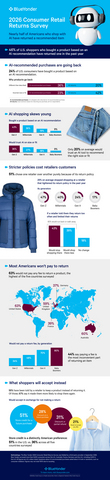
DALLAS--(BUSINESS WIRE)--Blue Yonder, the AI company for supply chain, today released its 2026 Consumer Retail Returns Survey. It found that 46% of U.S. shoppers who bought a product based on an AI recommendation have returned one in the past year. Now in its fourth year in the U.S., the survey polled more than 5,000 consumers across the U.S., Australia, France, Germany and the U.K., including 2,000 Americans. It asked how they shop, what they send back and how they respond when retailers tighten the rules. Beyond AI, it found that shoppers are quick to punish retailers that restrict returns, and that Americans are the least willing to pay a return fee of any country surveyed.
Key U.S. findings:
- Of the 24% of U.S. consumers who have purchased a product after receiving an AI recommendation, nearly half (46%) have returned one in the past year.
- The top reasons for U.S. shoppers returning an AI-recommended purchase are that it was different than described (36%) and an incorrect size or fit (23%).
- 63% of U.S. consumers would not pay any fee to return a product, the highest share of the five markets surveyed.
- 82% of U.S. respondents would shop less often or stop shopping entirely at a retailer that limits their ability to return due to high return frequency.
“Shoppers are taking AI’s advice faster than retailers are getting ready for it, and nearly half of them are sending something back,” said Duncan Angove, CEO of Blue Yonder. “That’s not really an AI problem. It’s a data problem. An AI assistant is only as good as the product information it can find, and most product data was written for a search bar, not for a machine suggesting products for someone. When what arrives doesn’t match what the shopper expected, it goes back in the box.”
AI Recommendations Fuel U.S. Consumer Returns
Nearly a quarter (24%) of U.S. respondents said they have purchased a product after receiving a recommendation from an AI tool or assistant, such as a consumer chatbot. Of those, 46% have returned an AI-recommended purchase within the past year. Among U.S. shoppers who returned an AI-recommended purchase, the most common reasons were that it was different than described (36%) and an incorrect size or fit (23%). That order reverses for U.S. returns overall, where incorrect size or fit leads at 42% and different than described accounts for only 20%. The pattern suggests AI tools struggle less with fit than with describing products accurately.
Among generations, Gen Z (43%) and Millennials (36%) are more likely to have purchased a product after receiving a recommendation from an AI tool or assistant, compared with only 19% of Gen X and 9% of Baby Boomers. More than half of Gen Z AI shoppers (56%) have returned an AI-recommended item in the past year. Trust also wanes with age. While 20% of overall respondents said they would trust an AI tool to recommend the right size or fit to avoid a return, that trust falls from 36% of Gen Z shoppers to only 9% of Baby Boomers.
Gen Z Drops Retailers Over Stricter Policies, but Boomers Walk When Flagged as Frequent Returners
Over half of U.S. respondents (51%) said that they have decided to buy from one retailer over another purely because it had a better returns policy. Nearly one-third (29%) have gone further and stopped shopping altogether at a retailer that implemented a stricter return policy in the last year. While Gen Z (47%) and Millennials (40%) were more likely to have stopped shopping at a retailer that implemented stricter returns policies in the past year, that number declines significantly among Gen X (24%) and Baby Boomers (17%).
The gap tracks how often each generation returns. Forty-two percent of Gen Z return a purchase at least once a month, compared with 14% of Baby Boomers, so a stricter policy simply affects them more. The pattern flips when a retailer singles shoppers out. If a retailer told them they return too often and limited their returns, 47% of Baby Boomers would stop shopping there entirely, compared with 33% of Gen Z.
Retailers are adopting new tracking technologies, such as using AI to monitor return histories and flag frequent returners. When asked about the practice, 30% called it a fair way to control costs and a quarter (25%) said it wouldn’t affect their shopping. However, 24% said it is invasive and would make them shop elsewhere.
“The instinct when returns go up is to tighten the rules,” said Angove. “But the data tells you how that ends. Flag shoppers as frequent returners and limit their returns, and eight in 10 say they’d cut back or walk away. And some of your most frequent returners are your best customers. The challenge is telling the difference between a shopper who abuses returns and a loyal customer who simply returns a lot. That takes systems that can set the right policy for each customer and handle every return as quickly and cheaply as possible. Done right, returns stop being just a cost and instead start earning loyalty.”
U.S. Consumers Want Free and Easy Returns, but Accept Incentives
Free and fast returns still matter most to U.S. shoppers, but many will take an alternative. For 32%, free returns shipping remains the most important factor when returning an item. Fast or instant refunds (30%) are a close second.
If presented with a fee to return a product, 63% of respondents said they would not be willing to pay, most commonly among Baby Boomers (80%) and Gen X (70%) compared with Millennials (48%) and Gen Z (34%). Of the five markets surveyed, U.S. consumers are the least willing to pay a returns fee, compared with 39% in France and 37% in Germany.
Instead, consumers are accepting “keep it” returns and alternative incentives in exchange for not making a return. Over half (55%) of U.S. respondents have been told by a retailer to keep a product they wanted to return in the past year, unchanged from 2025, with 67% of those saying it made them more likely to shop with that retailer again. For retailers, a keep-it refund often makes economic sense when the cost of shipping and processing a return exceeds what the item could be resold for, provided they can spot the shoppers who would take advantage of it. The goodwill is a bonus.
Respondents would also accept store credit for a future purchase (51%), a discount or partial refund (31%), or a discount on a future purchase (28%), while only 21% would not accept any offer in exchange for not making a return. Notably, store credit is a distinctly American preference, with only 36% of respondents across all five markets surveyed willing to accept it, compared with 51% of U.S. shoppers. Store credit also keeps the revenue with the retailer, which makes it one of the few concessions that works for both sides.
Additional Resources:
- Check out the infographic on key survey findings.
- Learn more about how Blue Yonder Returns Management helps retailers deliver a superior customer experience while effectively managing returns to maximize recovery value.
- Estimate the potential savings from more efficient returns processing with the Blue Yonder returns calculator.
Frequently Asked Questions
-
Question: What return policies do consumers care about most?
- Answer: Blue Yonder’s 2026 Consumer Retail Returns Survey found that consumers find free returns shipping (32%) and fast or instant refunds (30%) the most important aspects when returning an item.
-
Question: Do consumers return AI-recommended products more?
- Answer: Of the shoppers who have purchased AI-recommended products, nearly half (46%) have returned one within a year, compared with 41% of shoppers who bought based on a social media recommendation. Blue Yonder’s 2026 Consumer Retail Returns Survey also found that 49% of respondents who returned an AI-recommended purchase said they are more likely to return those items than purchases made directly through a retailer. Only 9% of respondents said they were less likely to.
-
Question: How have higher prices changed consumer return behaviors in the past year?
- Answer: Blue Yonder’s 2026 Consumer Retail Returns Survey found that over half (52%) of U.S. consumers said that higher prices this year have made them more careful about what they buy so they return less.
-
Question: How has AI changed consumer shopping behavior?
- Answer: Nearly one-quarter (24%) of American shoppers have purchased products recommended by AI tools, according to Blue Yonder’s 2026 Consumer Retail Returns Survey. But nearly half of them (46%) have returned one within a year, most often because the product was different than described (36%) or the wrong size or fit (23%).
-
Question: How do these findings relate to Blue Yonder and Optoro’s previous returns-focused surveys?
- Answer: Blue Yonder’s 2026 Consumer Retail Returns Survey continues Blue Yonder’s 2025 Global Consumer Retail Returns Survey, providing year-over-year insights into returns challenges facing consumers and retailers, as well as new findings around returns for AI and social recommendations. It also builds on Optoro’s 2024 Returns Unwrapped survey, conducted before Blue Yonder acquired Optoro in 2025.
Survey Methodology
The Blue Yonder 2026 Consumer Retail Returns Survey was fielded by a third-party provider in September 2026. Blue Yonder surveyed more than 5,000 consumers, including 2,000 in the U.S., and global consumers across Australia, France, Germany and the U.K. to gather insights on how returns restrictions and the rise of AI and social recommendations are impacting consumer behaviors. The survey builds upon Blue Yonder’s 2025 Global Consumer Retail Returns Survey, which collected responses from consumers who confirmed they were aware of increasingly tightened returns policies, and Optoro’s 2024 Returns Unwrapped survey.
About Blue Yonder
Blue Yonder is the AI company for supply chain. As the world leader in end-to-end digital supply chain transformation, Blue Yonder offers a unified, AI-driven platform and multi-tier network that empowers businesses to operate sustainably, scale profitably, and delight their customers—all at machine speed. A pioneer in applying AI solutions to the most complicated supply chain challenges, Blue Yonder’s modern innovations and unmatched industry expertise help more than 3,000 retailers, manufacturers, and logistics service providers confidently navigate supply chain complexity and disruption. blueyonder.com
“Blue Yonder” is a trademark or registered trademark of Blue Yonder Group, Inc. Any trade, product or service name referenced in this document using the name “Blue Yonder” is a trademark and/or property of Blue Yonder Group, Inc. All other company and product names may be trademarks, registered trademarks or service marks of the companies with which they are associated.
Contacts
Blue Yonder Corporate Communications:
media@blueyonder.com