Today’s Workforce Overwhelmingly Turns to Voice for Communication in High-Value and Critical Moments
Today’s Workforce Overwhelmingly Turns to Voice for Communication in High-Value and Critical Moments
As AI reshapes how work gets done, voice is emerging as the most natural way for workers to engage, especially in the moments where speed, safety, and service are on the line
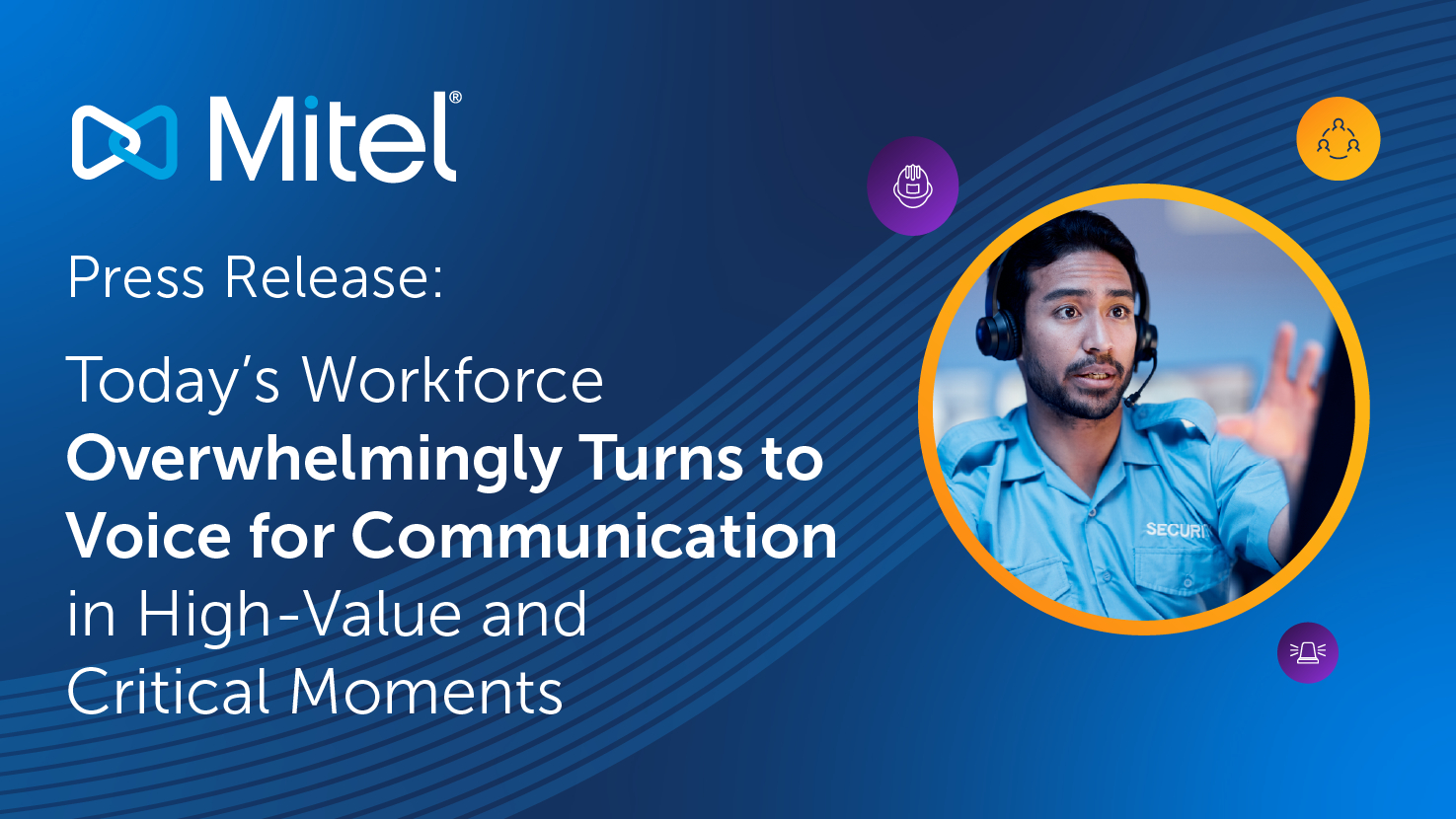
OTTAWA, Ontario--(BUSINESS WIRE)--When workers need to act quickly, they continue to rely on voice-centric communications. Findings from Mitel's recently released ‘State of Workforce Communication’ report show that 79% of workers agree they prioritize voice communications to align quickly when an issue needs rapid action, before using messaging or video to follow up if needed. When asked which specific communication method they prefer for urgent or time-critical situations, voice remains the top choice across generations, ranging from 43% of Gen Z workers to 54% of Baby Boomers. This underscores the continued role of real-time communication in high-stakes work environments where delays can affect service, safety, or operational performance.
The research, conducted by Vanson Bourne on behalf of Mitel, surveyed IT decision-makers, desk workers, and frontline workers to better understand how workforce communication tools are performing across different roles and work environments. That lens is especially important because eight in ten (80%) workers globally operate in frontline roles, including employees across healthcare, manufacturing, retail, hospitality, financial services, and the public sector, where communication gaps can have immediate and material consequences.
As organizations modernize workplace technology and introduce more AI-enabled tools, the measure of progress should include whether those investments make communication easier in real-world environments, are optimized for the given workforce profile, and drive the desired outcome at the point of activity.
How communication complexity impacts frontline workers
Despite their central role in service delivery and operations, many frontline employees work in communication environments that were not built for field-based mobile and time-sensitive work. In practice, that often means more places to look for information and a greater chance that messages get missed in the moments that matter most.
Desk and frontline workers use an average of seven communication channels, creating a fragmented experience that can make it harder to find information, reach the right person, or respond quickly. Among frontline workers, 65% say they waste time switching between multiple tools, while 64% say messages are missed because they are spread across different channels.
These issues affect more than productivity. Mitel found that 70% of frontline workers say complex or unreliable communication tools make it harder to provide the best possible support to customers, patients, or clients. More than one-third say communication problems create safety risks for customers, patients, or staff.
“The future of workforce communication is not voice-only, but it must be voice-first in the moments where real-time coordination matters most,” said Martin Bitzinger, Senior Vice President of Product Management at Mitel. “For frontline and critical industry workers, voice is often the fastest, clearest, and most trusted way to coordinate when work cannot wait. As organizations modernize and adopt AI, they cannot lose sight of creating a flexible communication infrastructure that supports employees, regardless of role or function, to complete tasks and drive outcomes.”
Why voice-first communication must be an operational priority in critical industries
Healthcare is one of the clearest examples. In fast-moving clinical environments, workers need to coordinate quickly across care teams, locations, and devices. Communication breakdowns can lead to delayed care at critical moments, prolonging the time a patient waits to be admitted or discharged and reducing a hospital’s capacity to serve the next patient in line. For healthcare leaders, these are not abstract risks. They translate directly into patient satisfaction, operational costs, and safety outcomes. Mitel’s research found that healthcare is among the sectors where communication issues are most likely to create safety risks, and frontline healthcare workers report some of the most acute gaps in whether their needs are considered when communications technology and infrastructure decisions are made. These challenges also extend across other critical industries, including manufacturing, financial services, hospitality, and retail.
"In a crisis, the interface has to disappear. Voice does that,” said Zeus Kerravala, Founder and Principal Analyst at ZK Research. “You don't train a nurse or a dispatcher to navigate a UI under pressure — you give them a channel that works the moment they need it. That's why voice remains the only modality that holds up when the stakes are real."
Voice as the Natural AI Interface
With AI adoption increasing across the enterprise, voice is also emerging as the most natural and efficient way for workers to interact with technology. For frontline workers especially, a voice-first AI user interface can improve user adoption and productivity, reducing the time spent navigating menus, toggling between applications, or typing messages. Evolving workplace technology strategies should not treat voice as a legacy channel or a fallback, but make it part of the modern communications strategy. This allows it to serve as the interface layer through which AI delivers its greatest value to the workers who need it most.
“AI has the potential to dramatically impact those workers who have been most underserved by digital transformation, but we must meet them where they are,” said Luiz Domingos, CTO at Mitel. “Whether it is an emergency room nurse or a technician in the field, voice-first AI closes the gap in a way no previous technology has. We believe the app of the future, especially for frontline workers, isn’t a chat window or a dashboard—it’s a conversation.”
To review the complete State of Workforce Communication report and findings, click here.
To learn more about Mitel’s approach to workforce communications, visit the company’s website.
Survey Methodology
This study was conducted by Vanson Bourne on behalf of Mitel and gathered insights from 2,000 respondents across five key markets: the US, Canada, Germany, UK and France. Three respondent types were surveyed: IT decision makers, desk workers and frontline workers from organizations with 500 or more employees, working within a variety of key industries such as healthcare, manufacturing, financial services and the public sector.
About Mitel
A global market leader in business communications powering more than two billion business connections, Mitel helps businesses and service providers connect, collaborate, and provide innovative services to their customers. Our innovation and communications experts serve business users in more than 100 countries. For more information, go to www.mitel.com and follow us on LinkedIn.
Mitel is the registered trademark of Mitel Networks Corporation.
All other trademarks are the property of their respective owners.
Source: Mitel Networks Inc
Contacts
Media Contacts
Mitel Public Relations
pr@mitel.com