OpenEvidence Integrates ASCO Guidelines, Figures and Flowcharts into Specialty Oncology Model
OpenEvidence Integrates ASCO Guidelines, Figures and Flowcharts into Specialty Oncology Model
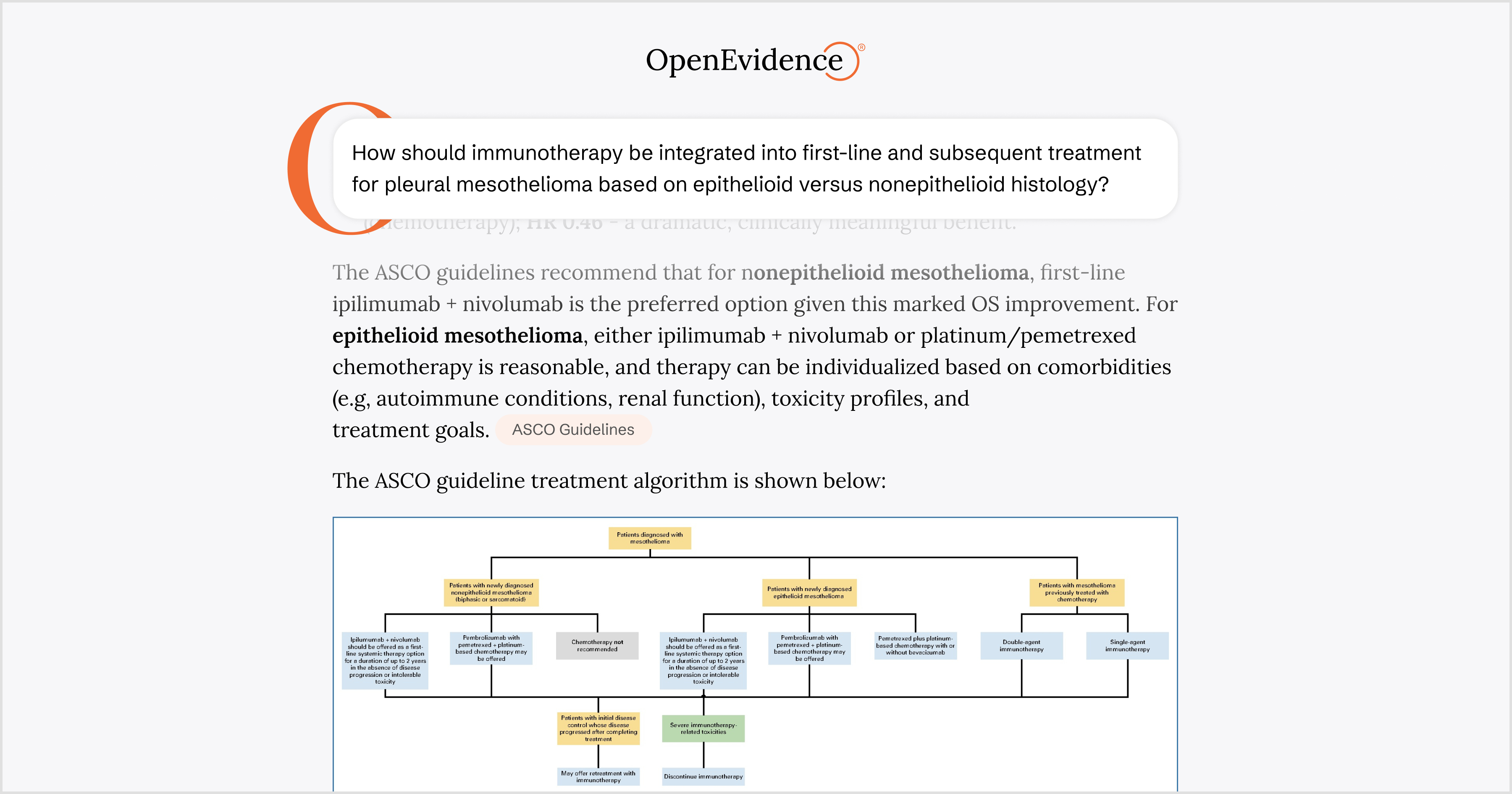
MIAMI--(BUSINESS WIRE)--Today, OpenEvidence, the most widely used medical knowledge platform, announced an integration of ASCO Guidelines, figures, and flowcharts into the OpenEvidence model.
“ASCO is committed to helping clinicians access our Guidelines and the evidence behind them." --Clifford A. Hudis, MD, FACP, FASCO
Share
As a part of OpenEvidence's commitment to creating advanced AI models for medical specialties, the company has extended their oncology model to include the ASCO Guidelines. ASCO Guidelines will now appear within OpenEvidence answers, accompanied by peer-reviewed evidence, precise citations, and a direct link to the ASCO website.
“ASCO is committed to helping clinicians access our Guidelines and the evidence behind them," said Clifford A. Hudis, MD, FACP, FASCO, Chief Executive Officer of ASCO. "Our license agreement with OpenEvidence makes it easier for their users to find information to help determine the next best steps in a patient's care.” The OpenEvidence team incorporated the ASCO Guidelines within its oncology model and conducted a thorough evaluation to ensure the system accurately reflects the original evidence. All responses include direct links to ASCO's source documents, allowing users to view the full guidance alongside the broader body of clinical evidence available on the OpenEvidence platform throughout the United States.
"As an oncologist, I recognize the complexity of clinical decision making as the number of treatment options multiply. Expert guidance and recommendations through algorithms and decision trees are natural for clinicians to read and interpret, but represent a challenge for language models. I’ve been excited to work directly on this project to train models to incorporate the ASCO Guidelines, figures, and flowcharts into the broader medical literature and make them more accessible to our users," said Travis Zack, MD PhD, Chief Medical Officer of OpenEvidence."
About OpenEvidence
OpenEvidence is the most widely used medical AI platform among U.S. physicians, and is trusted by hundreds of thousands of verified clinicians to make high-stakes clinical decisions at the point of care with answers that are sourced, cited, and grounded in peer-reviewed medical literature. OpenEvidence was founded with the mission to organize and expand the world's collective medical knowledge. Learn more at openevidence.com.
Contacts
OpenEvidence
media@openevidence.com