Omdia: Amazon, Netflix and Google to Capture Half of $81 Billion CTV Advertising Market by 2030
Omdia: Amazon, Netflix and Google to Capture Half of $81 Billion CTV Advertising Market by 2030
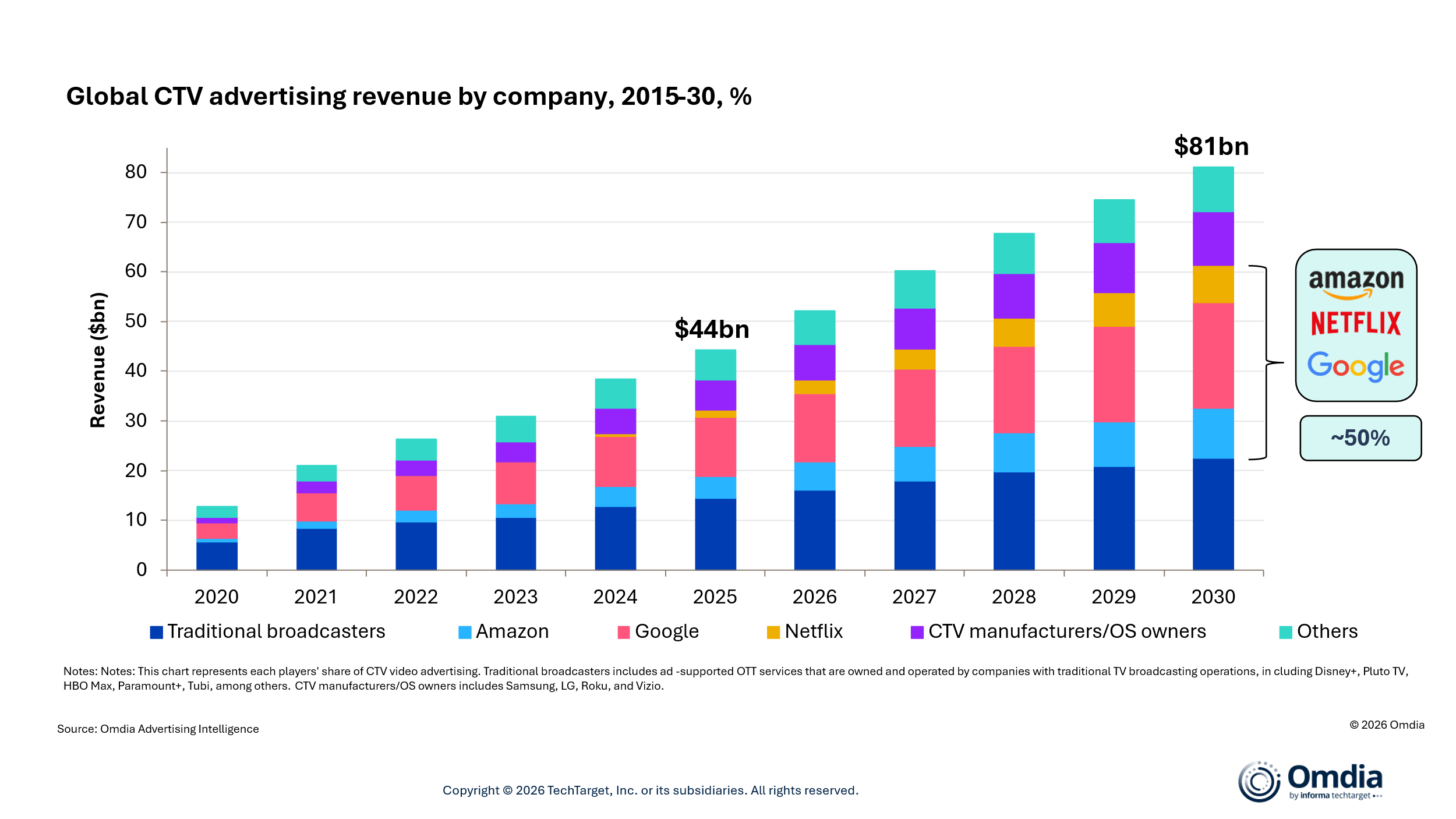
LONDON--(BUSINESS WIRE)--Global connected TV (CTV) advertising revenue will surge from $44 billion in 2025 to $81 billion by 2030, with CTV ad revenues expected to surpass traditional linear TV advertising during the 2030s, according to new research by Omdia.
“The battle for the living room is no longer only about streaming content,” said Maria Rua Aguete, Head of Media & Entertainment at Omdia.
Share
Google, Amazon and Netflix Dominate the Evolving TV Landscape
The global fight to “own the living room” is entering a new phase as Google, Amazon and Netflix are projected to capture 50% of the global connected TV advertising market by 2030. The findings highlight how the center of power in television is rapidly shifting away from traditional broadcasting toward streaming platforms, TV operating systems and advertising ecosystems. By the end of the decade:
- Google is forecast to command 26% of global CTV advertising revenue
- Amazon is expected to account for 13%
- Netflix is projected to represent 9%
Combined, Google, Amazon, and Netflix will account for half of the entire global CTV advertising market by 2030.
CTV Advertising Growth Accelerates as Platforms Compete for Connected Households
The shift comes as media companies, streamers, retailers and technology giants race to secure premium positioning in connected households. Amazon is leveraging Prime Video and retail media integration to expand its TV advertising footprint, while Netflix continues to scale its advertising business globally through its ad-supported tier. Google remains dominant through YouTube’s massive connected TV reach and broader advertising infrastructure.
Omdia expects several trends to accelerate the transformation of television advertising over the next five years:
- Expansion of ad-supported streaming services
- Convergence of retail media and television advertising
- Growth in programmatic and targeted TV advertising
- Increasing importance of TV operating systems and smart TV ecosystems
- Greater competition for consumer attention and platform ownership
Omdia also revealed that the European TV operating system landscape is shifting rapidly. According to the research firm, VIDAA is becoming Europe’s third-largest TV operating system this year after Android TV and Tizen, overtaking several established competitors as manufacturers seek greater ownership of the smart TV experience.
TV Operating Systems Evolve into Strategic Commerce Gateways
“The battle for the living room is no longer only about streaming content,” said Maria Rua Aguete, Head of Media & Entertainment at Omdia. “It is increasingly about controlling the platform, the advertising layer, the operating system, the data and ultimately the consumer relationship.”
Rua Aguete noted that television is becoming one of the most strategic gateways for digital advertising, retail media and commerce integration, with tech companies increasingly competing to control the TV interface itself.
“CTV companies are at risk of losing incredibly valued ground to these tech giants and many cannot afford to do so as the hardware business becomes increasingly unprofitable,” added David Tett, Principal Analyst at Omdia. “Strategies are needed to fight for their own advertising revenues in the new-look landscape and avoid ceding too much ground to players such as Google and Amazon.”
The findings reinforce how television, commerce and digital advertising are converging into a single ecosystem and why the connected TV environment is becoming one of the most strategically valuable positions in media.
ABOUT OMDIA
Omdia, part of TechTarget, Inc. d/b/a Informa TechTarget (Nasdaq: TTGT), is a technology research and advisory group. Our deep knowledge of tech markets grounded in real conversations with industry leaders and hundreds of thousands of data points, makes our market intelligence our clients’ strategic advantage. From R&D to ROI, we identify the greatest opportunities and move the industry forward.
Contacts
Fasiha Khan: fasiha.khan@omdia.com
Eric Thoo: eric.thoo@omdia.com