Pioneering feat in regenerative medicine, the BEES-HAUS cell therapy: Paracrine effect and cell engraftment, together healing urethral stricture. Its simplified version, BHES-HAUS’ results to be presented in AUA 2026
Pioneering feat in regenerative medicine, the BEES-HAUS cell therapy: Paracrine effect and cell engraftment, together healing urethral stricture. Its simplified version, BHES-HAUS’ results to be presented in AUA 2026
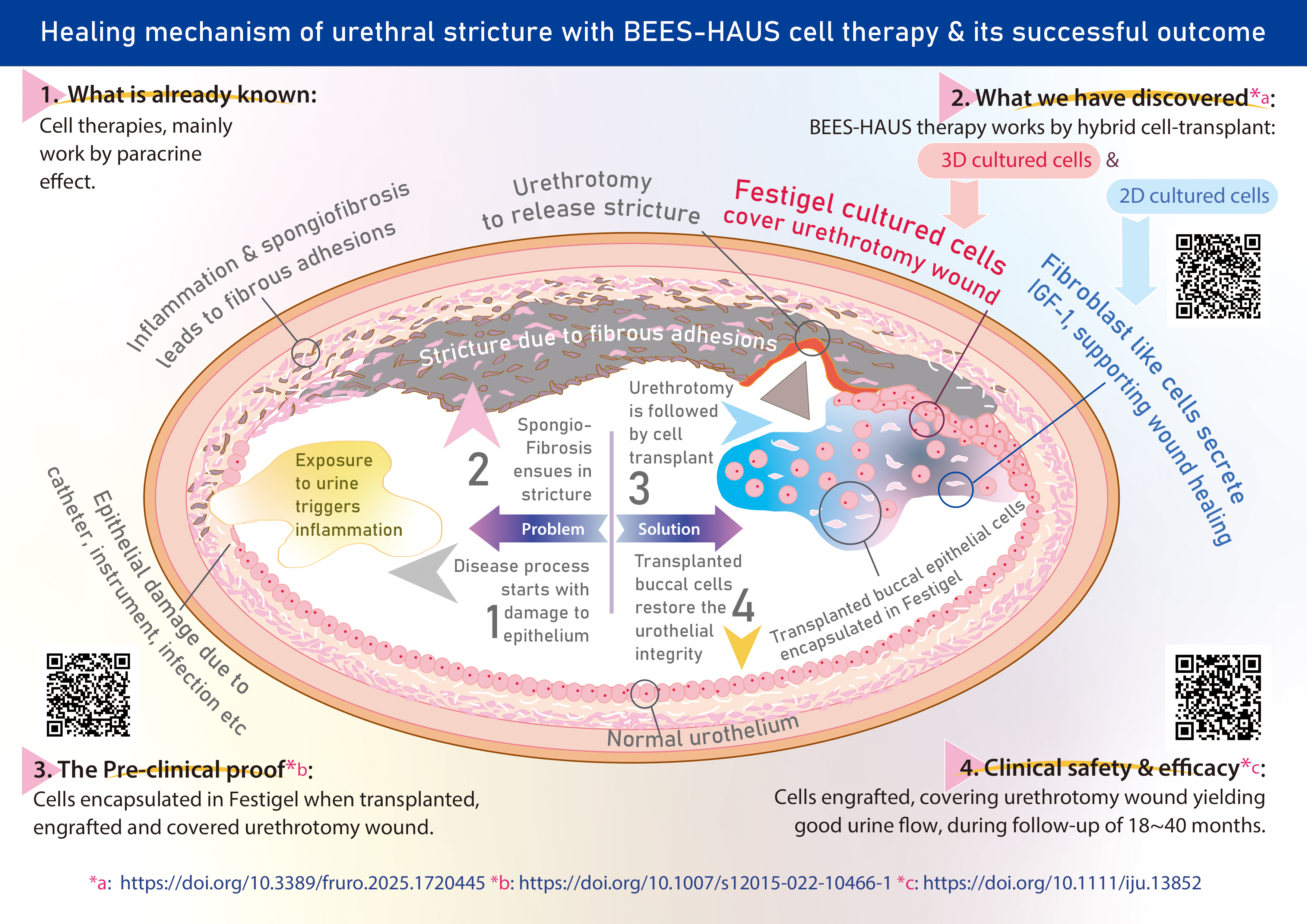
Urethral stricture starts with narrowing of a short segment of urethral lumen. At early stages, it is managed by balloon dilatation or DVIU Urethrotomy. The open urethrotomy wound after dilatation or DVIU has to heal from the edges of the wound, which may take a longer time. In BEES-HAUS cell therapy, the cell transplant having proven successful engraftment, covering the urethrotomy wound, yielding clinical safety and efficacy may be considered to be included in the treatment guidelines after validation. Its simplified version, the BHES-HAUS (Buccal epithelium Hashed and Encapsulated in Scaffold—Hybrid Approach to Urethral Stricture) accomplished in one-go without need for cell culture in a lab, works on similar principles. After long term follow-up, BHES-HAUS minimally invasive approach may be worth combining with DVIU and balloon dilatation, as it may be able to provide longer duration of recurrence-free, good quality of life without need for intermittent self-catheterization.
TOKYO--(BUSINESS WIRE)--A path breaking scientific discovery, unraveling successful wound healing mechanism in urethral stricture with BEES-HAUS cell therapy has been reported by Indo-Japan physician-scientists. This milestone achievement in regenerative medicine, yielding clinical safety and efficacy, is the first of its kind, wherein a hybrid approach of mixing two groups of autologous buccal epithelial cells, one cultured in 2D and another in 3D in Festigel scaffold were used in the management of urethral stricture; paracrine effect of IGF-1 produced by 2D-cultured cells and engraftment of 3D-Festigel cultured cells, which cover the urethrotomy wound, together repairing the urothelial defect, has been published in Frontiers in Urology. This feat though modest, is a global first in terms of both in vitro tissue engineering and clinical benefits by in vivo healing, restoring the urothelial integrity and is a giant leap for its potential of yielding stricture recurrence-free good quality of life to patients with voiding problems, opined the researchers.
BHES-HAUS minimally invasive cell therapy for male urethral stricture, using hashed autologous buccal tissue transplanted in Festigel in one sitting, without any lab processing of cells, yields encouraging outcome; Results to be presented in AUA 2026
Share
Tissue engineering technologies to create organs in the lab such as urethra have been reported. But long-term recurrence free solution for male urethral stricture remains a challenge. Balloon dilatation or DVIU urethrotomy exposes the sub urothelial tissue to urine which triggers inflammation causing spongiofibrosis and stricture recurrence. Covering the urethrotomy wound, to restore the urothelial integrity of stricture inflicted urethra, currently accomplished by BMG-plasty with a sheet of autologous buccal tissue, in BEES-HAUS procedure is managed with cell transplant for short segment strictures. Further simplified one-step cell transplant ‘BHES-HAUS’, that doesn’t require cell culture in a lab, yielding encouraging outcome, has been accepted for an interactive presentation at the American Urological Association meeting, AUA 2026.
Inflammatory reaction of urethra provoked by catheterization, instrumentation or infection varies between individuals and some develop urethral stricture. To predict the risks and develop better management strategies, following futuristic research have been initiated:
- Artificial intelligence (AI) based scoring system, HAUS SCORE to evaluate inflammatory biomarkers correlating with spongiofibrosis.
- Tissue friendly, bio-inert BLIS-COAT catheter for those prone to urethral stricture.
BEES-HAUS, having been approved in Japan as per Act on Safety of Regenerative Medicine, GN Corporation and Global Niche Corp., USA are open for out-licensing and tech-transfer of BHES-HAUS for clinical translation after approvals worldwide.
Contacts
Samuel JK Abraham
info@gncorporation.com