Every Second Counts: T-Mobile Advances a Stronger, Smarter, More Resilient Network for Americans
Every Second Counts: T-Mobile Advances a Stronger, Smarter, More Resilient Network for Americans
Ahead of hurricane and wildfire season, AI-powered network intelligence, satellite connectivity and advanced emergency response capabilities are helping keep communities and first responders connected in critical moments.
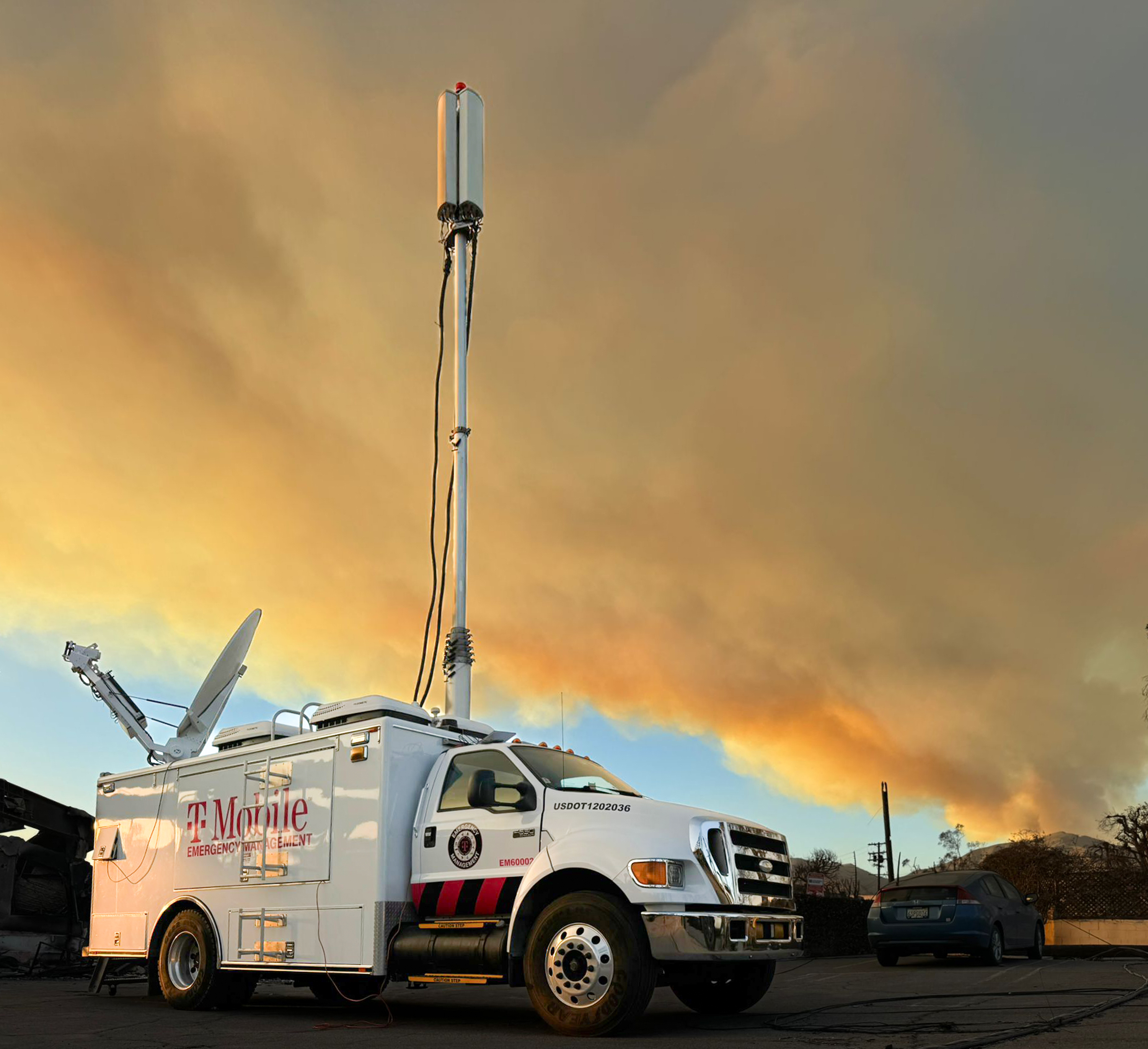
BELLEVUE, Wash.--(BUSINESS WIRE)--The National Oceanic and Atmospheric Administration (NOAA) predicts a potential Super El Niño this summer, which could bring increased risk of extreme weather. As T-Mobile (NASDAQ: TMUS) works with communities across America to prepare, it is strengthening emergency preparedness through continued investments in network resilience, intelligent technologies and expanded support for communities and first responders.
“When disaster strikes, people don’t think about whether their devices are connected—they think about reaching family, calling for help or knowing they’re not alone,” said John Saw, Chief Technology Officer, T-Mobile.
Share
Key highlights:
- AI-powered network intelligence restoring connectivity faster, including tens of thousands of automated adjustments during Winter Storm Fern
- T-Satellite with Starlink supported more than 250,000 users with over 1.5 million messages sent during Fern, and is now expanding to international locations with reciprocal roaming service in Canada and New Zealand
- An expanding fleet of deployable assets, including smaller rapid-deploy SatCOLTs, hybrid generators and enhanced drone capabilities
- Real-time telemetry tools helping teams respond faster, monitor network conditions remotely and keep sites running longer
“We start with the knowledge that keeping communities connected during storm season is vital and serves as a lifeline for safety and security,” said Jon Freier, Chief Operating Officer, T-Mobile. “With technologies like T-Satellite now supporting hundreds of thousands of Americans during real-world disasters and beginning to expand internationally, we’re continuing to make our network smarter and more resilient so people can reach loved ones, first responders can act quickly and communities can recover faster.”
Built for Critical Moments
T-Mobile’s nationwide 5G Advanced network is designed to perform under pressure and is supported by a robust fleet of rapidly deployable assets, including SatCOLTs (Satellite Cell on Light Trucks), SatCOWs (Satellite Cell on Wheels), COWs (Cell on Wheels), generators, portable satellite antennas and drones. These assets are actively used to quickly restore and maintain connectivity when extreme weather and other emergencies impact network performance, supporting first responders, public safety partners and the communities they serve in critical moments.
The company continues to expand its fleet and capabilities with additional assets, including:
- Sleep units that support extended field operations and help crews stay on site, supporting impacted communities for longer periods of time
- New drones with enhanced capabilities that provide real-time situational awareness, helping teams assess conditions from above and make faster, more informed decisions in the field
- Smaller, rapid-deploy COLTs that can be set up quickly to restore coverage in dense or hard-to-access areas
- Hybrid portable generators that can extend uptime by 50%, conserving battery power and reducing refueling needs
- Portable satellite kits using both low Earth orbit (LEO) and geostationary (GEO) satellite solutions support connectivity in the field and help restore network backhaul in challenging conditions
In 2025 alone, T-Mobile supported communities and first responders through more than 60 disaster events nationwide and deployed thousands of assets to help maintain connectivity, including thousands of generator deployments and refueling missions. These efforts helped communities stay connected to loved ones, emergency services and critical resources. This nationwide fleet continues to evolve with new capabilities designed to respond faster and operate more efficiently in challenging conditions.
Smarter, Stronger Networks
T-Mobile’s AI-powered Self-Organizing Network (SON) continuously monitors network conditions and automatically adjusts performance in real time, rerouting traffic, optimizing signal strength and prioritizing critical connections when infrastructure is impacted so people can stay connected when they need it most.
“When disaster strikes, people don’t think about whether their devices are connected—they think about reaching family, calling for help or knowing they’re not alone,” said John Saw, Chief Technology Officer, T-Mobile. “That’s why we’ve built a network that shows up in those moments, with tens of thousands of SON-driven automated adjustments during major events like Winter Storm Fern and real-time AI-driven optimization, so it can adapt instantly and keep communities connected no matter the conditions.”
During Winter Storm Fern in January 2026, which impacted more than 30 states and left more than one million people without power, T-Mobile’s network remained resilient under pressure. With SON, the company was able to quickly adapt and prioritize connectivity in affected areas, helping keep network sites running for more than 250,000 additional minutes by conserving battery power and optimizing performance. Among customers that were impacted, 68% were reconnected within the first hour and 98% within eight hours.
More recently, during Winter Storm Hernando and the torrential March storms in Hawaii, SON delivered more than 10,000 additional adjustments and extended connectivity across impacted areas, helping people stay in touch and access critical information.
In some cases, these capabilities allow T-Mobile to streamline and expedite response and recovery without deploying additional equipment. During a tornado event, network teams remotely optimized coverage in about an hour, restoring service faster and reducing the need for on-site response.
Extending Connectivity Beyond the Network
T-Mobile continues to expand connectivity beyond traditional infrastructure with satellite-based innovation, helping maintain communication during critical situations.
When disasters struck in 2025, T-Satellite supported more than one million messages and connected hundreds of thousands of people when terrestrial networks were unavailable. During the devastating Texas flooding, it enabled hundreds of thousands of messages, providing a critical lifeline for impacted communities to reach loved ones and emergency services.
More recently, during Winter Storm Fern, T-Satellite saw significant spikes in usage, supporting more than 250,000 users and 1.5 million messages as people connected with loved ones and stayed informed when traditional networks were unavailable. During the recent Kona storms, thousands more users relied on T-Satellite to help them stay connected.
T-Satellite also enables Wireless Emergency Alerts (WEAs), with more than 100 alerts delivered during Winter Storm Fern alone, helping deliver critical safety information to compatible devices regardless of provider. Anyone who signs up can also access Text to 911 capabilities at no cost on supported devices.
T-Mobile is also expanding satellite connectivity internationally, starting with Canada and New Zealand, enabling automatic connectivity abroad for customers with T-Satellite on compatible devices when cellular service isn’t available.
Combined with deployable assets and drone-enabled capabilities, these solutions extend coverage into some of the most difficult-to-reach areas during emergencies, including remote and rural environments. For many, these moments are about more than connectivity; they’re about reaching family, checking on loved ones or messaging for help in an emergency.
Rapid Response
Speed matters in an emergency. Before disasters strike, T-Mobile strengthens readiness through network monitoring, pre-positioning of equipment and coordination with partners.
When emergencies do occur, teams deploy mobile assets, provide technical expertise and support emergency operations to maintain communication and coordination, ensuring responders have the connectivity and tools they need to coordinate effectively and serve their communities.
T-Mobile also offers T-Priority, a dedicated solution for first responders built on T-Mobile’s 5G Advanced platform using network slicing technology, delivering prioritized connectivity and clearer connections during emergencies and times of congestion.
Behind the scenes, real-time generator telemetry plays a key role in response efforts by giving teams live visibility into site conditions, including fuel levels and performance. This allows crews to prioritize resources, reduce downtime and keep sites running longer without needing to physically check each location, while new hybrid generators also extend uptime by up to 50%.
Together, these capabilities enable faster, more efficient recovery in large-scale disasters.
“In an emergency, communication is everything, but it has to work instantly, reliably and at scale,” said Freier. “Our teams are focused on equipping first responders with the connectivity and tools to coordinate in real time, make faster decisions and stay one step ahead of rapidly changing conditions, while ensuring communities can reach help and stay connected during critical moments.”
Supporting Communities When It Matters Most
T-Mobile’s commitment extends beyond network performance to include on-the-ground support, community partnerships and disaster response efforts to help people and communities.
T-Mobile teams have helped small businesses reconnect and process payroll, enabled customers to charge essential medical devices like hearing aids, and restored connectivity and power to critical infrastructure and community lifelines such as utilities, grocery, fuel, pharmacies, transportation, lodging and hospitals.
In the past quarter, T-Mobile supported multiple severe weather events, including Winter Storm Fern and storms in Hawaii, deploying to provide connectivity and distributing hundreds of power packs.
In 2025 and early 2026, T-Mobile teams:
- Helped thousands get reconnected and charged
- Distributed more than 17,000 power packs
- Deployed 34 community support teams with trucks and trailers to provide Wi-Fi, charging and critical resources at shelters and impacted areas
- Supported recovery efforts across 13 severe weather events nationwide
- Monitored and assessed 174 additional potentially impacting events
T-Mobile and its employees have contributed millions of dollars in donations to disaster response and relief efforts, including more than $360,000 in employee giving to disaster response organizations. The company also recently joined the American Red Cross Disaster Responder Program with a $250,000 commitment to support disaster preparedness and response efforts nationwide.
In times of crisis, T-Mobile also rallies employees and customers to support impacted communities, working alongside partners to provide connectivity, resources and assistance where it’s needed most.
The Future of Emergency Response
T-Mobile continues investing in next-generation technologies built on its 5G standalone network and nationwide 5G Advanced capabilities, laying the groundwork for future AI-native 6G networks.
These advancements enable:
- Real-time data and video sharing
- Drone as First Responder (DFR) capabilities, enabled by T-Mobile’s 5G network and T-Priority
- AI-driven monitoring and automation that can adapt network performance in real time based on changing conditions
- Next-generation 911 technologies, including expanded Text to 911 capabilities that help more people connect to emergency services in areas with limited coverage
Year-Round Commitment
T-Mobile continues to strengthen readiness, investing in resilience, advancing technologies and working with partners nationwide.
The company engages with leaders through numerous forums such as the National Hurricane Conference, the All Hazards Consortium (AHC), the U.S. Chamber of Commerce and Federal Communications Commission (FCC) roundtables, helping inform industry best practices.
This work happens year-round, from preparation to response to recovery, with a continued focus on strengthening network resilience and supporting communities through every stage of an emergency.
For more information on T-Mobile’s preparedness and response capabilities, visit the company’s Emergency Response hub and follow @TMobileNews on X and Instagram.
T-Satellite: Texting & select satellite-ready apps with compatible device in most outdoor areas in the U.S., Canada, and New Zealand where you can see the sky. Satellite service, including text to 911, or emergency services may be delayed, limited, or unavailable. Included with Experience Beyond or $10/mo.; auto renews monthly. Cancel anytime in T-Life App. Text to 911: Lets you text 911 when you're beyond cellular coverage. Service is text-only (not voice) and may be limited by satellite availability, message delivery delays, or location accuracy. See T-Mobile Terms & Conditions for details. T-Priority for qualifying organizations on eligible plans. Some features only available in areas of Ultra Capacity 5G coverage with capable device and 5G Standalone settings; see T-Mobile.com/5Glayers. Coverage not available in some areas.
About T-Mobile US, Inc.
As the supercharged Un-carrier, T-Mobile US, Inc. (NASDAQ: TMUS) is powered by an award-winning 5G network that connects more people, in more places, than ever before. With T-Mobile’s unique value proposition of best network, best value and best experiences, the Un-carrier is redefining connectivity and fueling competition while continuing to drive the next wave of innovation in wireless and beyond. Headquartered in Bellevue, Wash., T-Mobile provides services through its subsidiaries and operates its flagship brands, T-Mobile, Metro by T-Mobile and Mint Mobile. For more information, visit https://www.t-mobile.com.
Contacts
Media Contact
T-Mobile US, Inc. Media Relations
MediaRelations@t-mobile.com
Investor Relations Contact
T-Mobile US, Inc.
Investor.Relations@t-mobile.com
https://investor.t-mobile.com