Omdia Raises 2026 Semiconductor Forecast to 62.7% as AI Drives Global Memory Crunch
Omdia Raises 2026 Semiconductor Forecast to 62.7% as AI Drives Global Memory Crunch
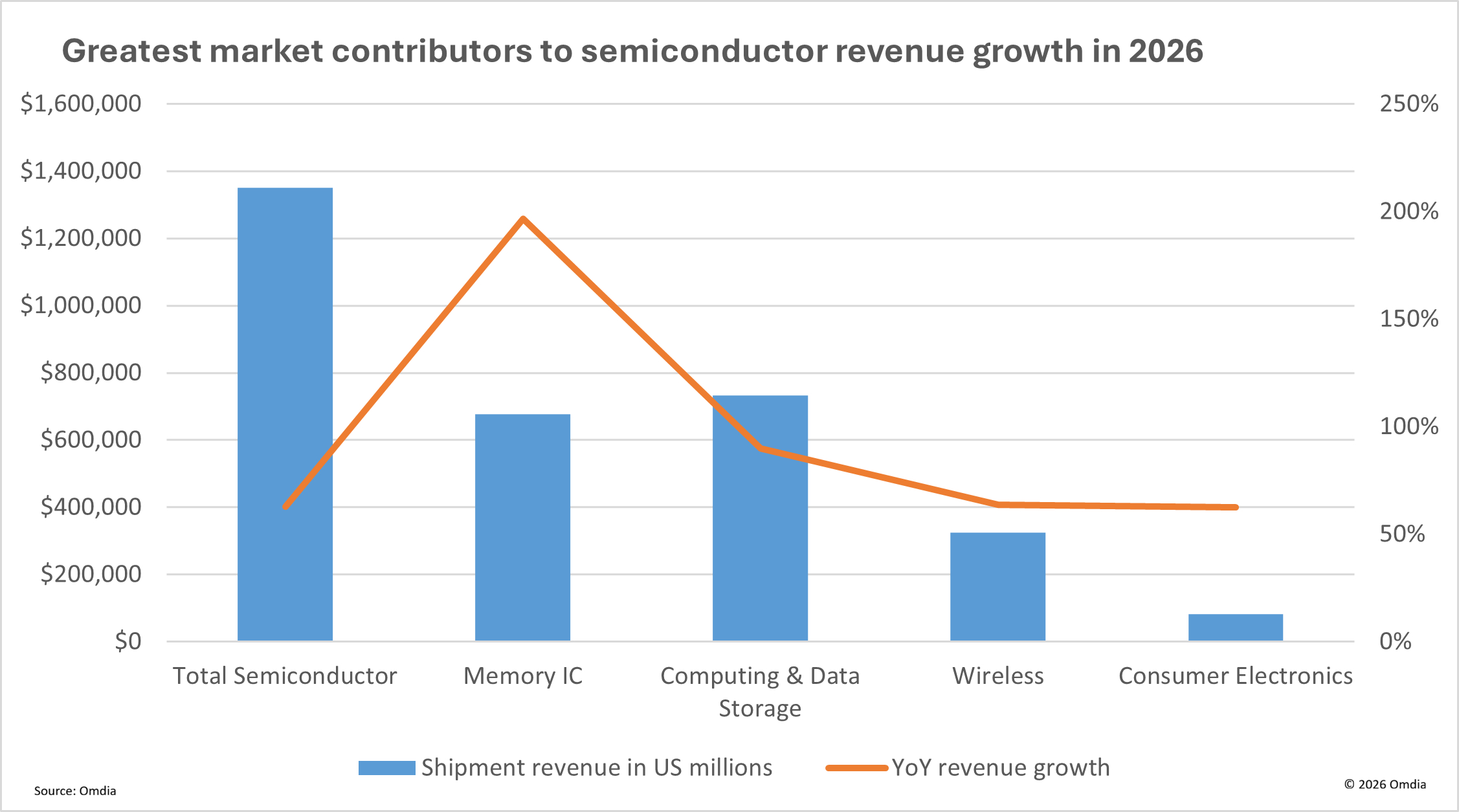
LONDON--(BUSINESS WIRE)--Omdia has significantly raised its semiconductor revenue forecast for 2026 to 62.7%, again reflecting unprecedented growth in DRAM and NAND driven by sustained demand and ongoing supply shortages expected to persist through the year. The DRAM market is forecast to nearly double in value, while the smaller NAND segment could quadruple compared to 2025.
“Supporting the progression of AI beyond simple Q&A use cases has exponentially increased demand for memory and processing ICs, fueling semiconductor industry revenues overall,” said Myson Robles-Bruce, Senior Principal Analyst at Omdia.
Share
Supply constraints in conventional memory IC supply are being exacerbated by the industry’s focus upon High Bandwidth Memory (HBM) production, which delivers lower volumes but commands significantly higher prices. Strong enterprise and data center demand will continue to shape the 2026 market outlook, with meaningful supply relief unlikely until well into 2027.
Enterprises are implementing a major server refresh cycle in 2026, coinciding with exceptional levels of hyperscaler capital expenditure. Organizations are accelerating the retirement of legacy hardware to support more demanding workloads, creating a significant market opportunity given the scale of installed systems. At the same time, there is a clear shift toward higher-value system designs built on next-generation silicon and advanced connectivity. This trend combined with the ongoing components shortage will push average selling prices upward.
Computing and data storage will lead all segments in semiconductor revenue growth, rising 90% year-on-year in 2026 to exceed $700bn. This is due to strong demand for data center servers and other memory–intensive applications, alongside elevated memory IC pricing.
As previously reported, consumer electronics and wireless applications also present a positive outlook for semiconductor revenue growth in 2026. While smartphone unit shipments are expected to remain relatively flat, semiconductor revenues will increase due to higher memory pricing, significantly raising overall bill of materials (BOM) costs. The market will see multiple flagship launches in addition to the usual model updates. This will include a range of a new wave of foldables, and feature-rich models incorporating AI-enabled capabilities such as advanced photography. Meanwhile, smart watches and fitness and wellness wearables are also projected to deliver meaningful revenue growth.
Looking Ahead
“Supporting the progression of AI beyond simple Q&A use cases has exponentially increased demand for memory and processing ICs, fueling semiconductor industry revenues overall,” said Myson Robles-Bruce, Senior Principal Analyst at Omdia. ”However, questions remain around how quickly suppliers can scale capacity and output of supply, and longer term, which applications will generate sufficient return on investment to justify the current levels of capital expenditure in AI.”
Aside from the macroeconomic pressures, such as tariffs, energy costs, and geopolitical tensions, the industry also faces risks associated with the amount of capital being allocated to AI infrastructure. Current semiconductor revenue growth is being driven primarily by higher average selling prices rather than unit shipment volumes. While similar dynamics have been observed in past cycles such as crypto mining and previous memory super cycles, the scale and breadth across the industry are unprecedented.
Omdia will continue to monitor market developments over the coming quarters and refine its 2026 baseline forecast accordingly.
ABOUT OMDIA
Omdia, part of TechTarget, Inc. d/b/a Informa TechTarget (Nasdaq: TTGT), is a technology research and advisory group. Our deep knowledge of tech markets grounded in real conversations with industry leaders and hundreds of thousands of data points, make our market intelligence our clients’ strategic advantage. From R&D to ROI, we identify the greatest opportunities and move the industry forward.
Contacts
Contact
Fasiha Khan: fasiha.khan@omdia.com
Eric Thoo: eric.thoo@omdia.com