OpenEvidence Introduces Dotflows: AI-Native Customization For Every Clinician
OpenEvidence Introduces Dotflows: AI-Native Customization For Every Clinician
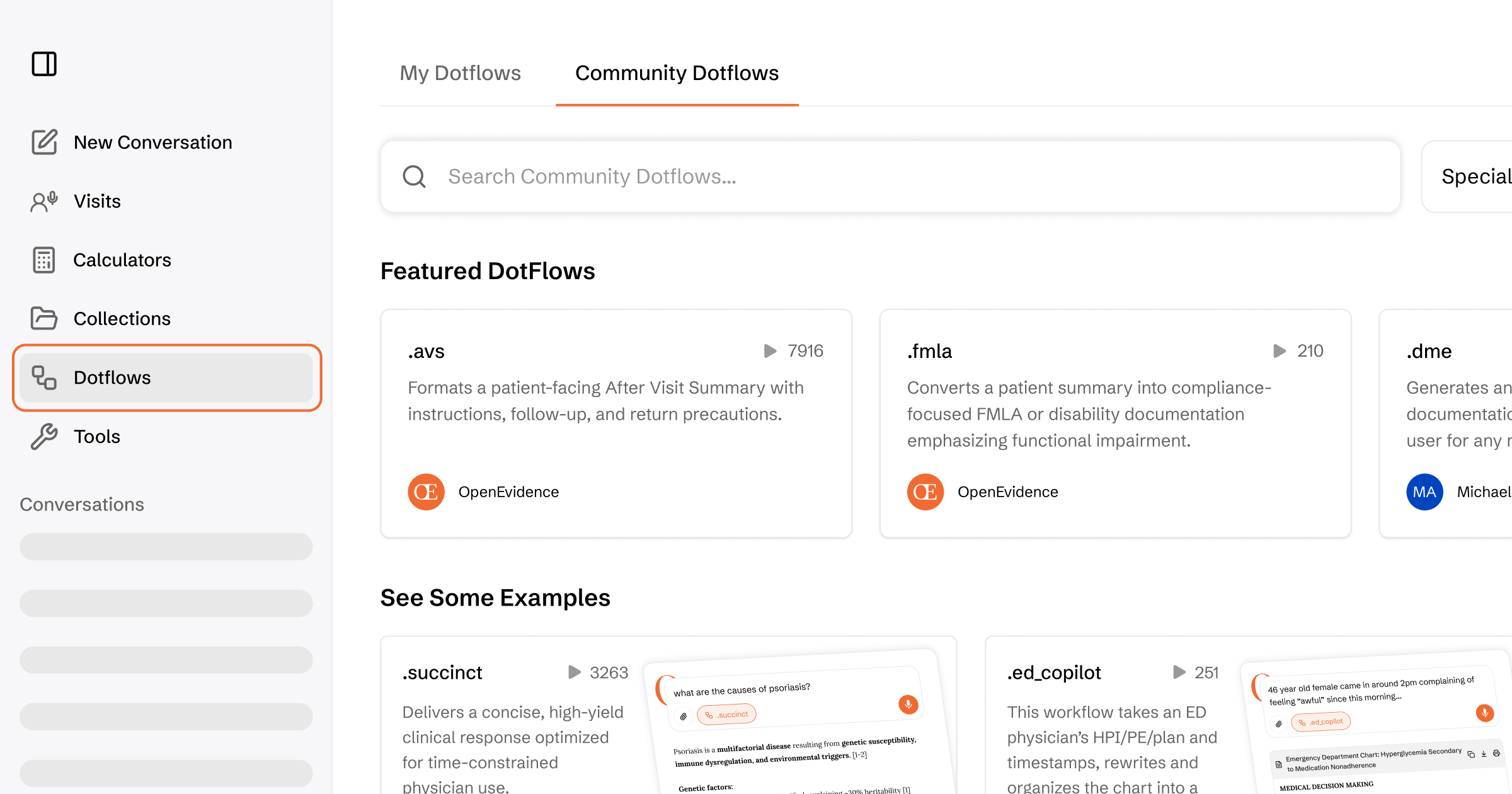
The Community Dotflows hub is a collaborative marketplace where clinicians discover and share expert-vetted automation. This central library allows users to instantly deploy specialized workflows—like .avs for patient summaries or .fmla for documentation—standardizing high-quality care across any practice.
MIAMI--(BUSINESS WIRE)--OpenEvidence, the most widely used medical AI and clinical decision-support platform among U.S. physicians, today announced the release of Dotflows, enabling clinicians to tailor the platform to the way they uniquely practice medicine.
"Dotflows let users define that fit, encoding their personal styles and mental models into the platform itself." Dr. Mondira Ray, SVP of Clinical Informatics at OpenEvidence.
Share
Evidence-based medicine is universal—but its application is not. Clinical practice is shaped by differences in specialty, care setting, patient population, and individual preference, and supporting high-quality care means embracing this diversity. In traditional EHRs, dot phrases begin to address this need by allowing clinicians to define and share simple copy/paste text and templates. Dot phrases have become a valuable part of many clinicians' practice, supporting personalized workflows that match the way each provider practices.
Dotflows represent the extension of dot phrases for full natural language customization in the AI-native era. Dotflows are reusable natural language prompts that customize how OpenEvidence responds. This simple concept enables a wide range of customization and personalization capabilities, expanding to the limits of clinician creativity. Some example uses include personalizing the response style, pre-defining recurring clinical context, and running structured workflows. Clinicians can create their own Dotflows or browse Dotflows shared and used by other clinicians in the community.
"The value of any clinical tool depends on how well it fits into the way a clinician actually practices," said Dr. Mondira Ray, SVP of Clinical Informatics at OpenEvidence. "Dotflows let users define that fit, encoding their personal styles and mental models into the platform itself."
Clinicians invoke Dotflows by typing “.” in the search bar, or by setting them as defaults for all queries. Over time, these reusable commands enable OpenEvidence to become increasingly aligned with each clinician’s preferences and practice patterns.
The release also establishes a living library of community-created Dotflows. Clinicians can browse the library, clone Dotflows from the library, and share their own Dotflows with the broader community.
Dotflows are available today for all verified clinicians on OpenEvidence.
About OpenEvidence
OpenEvidence is the most widely used medical AI platform among U.S. physicians, and is trusted by hundreds of thousands of verified clinicians to make high-stakes clinical decisions at the point of care with answers that are sourced, cited, and grounded in peer-reviewed medical literature. OpenEvidence was founded with the mission to organize and expand the world's collective medical knowledge. Learn more at openevidence.com.
Contacts
OpenEvidence
media@openevidence.com