Introducing OpenEvidence Access Intelligence: Bringing Affordability and Access to the Point of Care
Introducing OpenEvidence Access Intelligence: Bringing Affordability and Access to the Point of Care
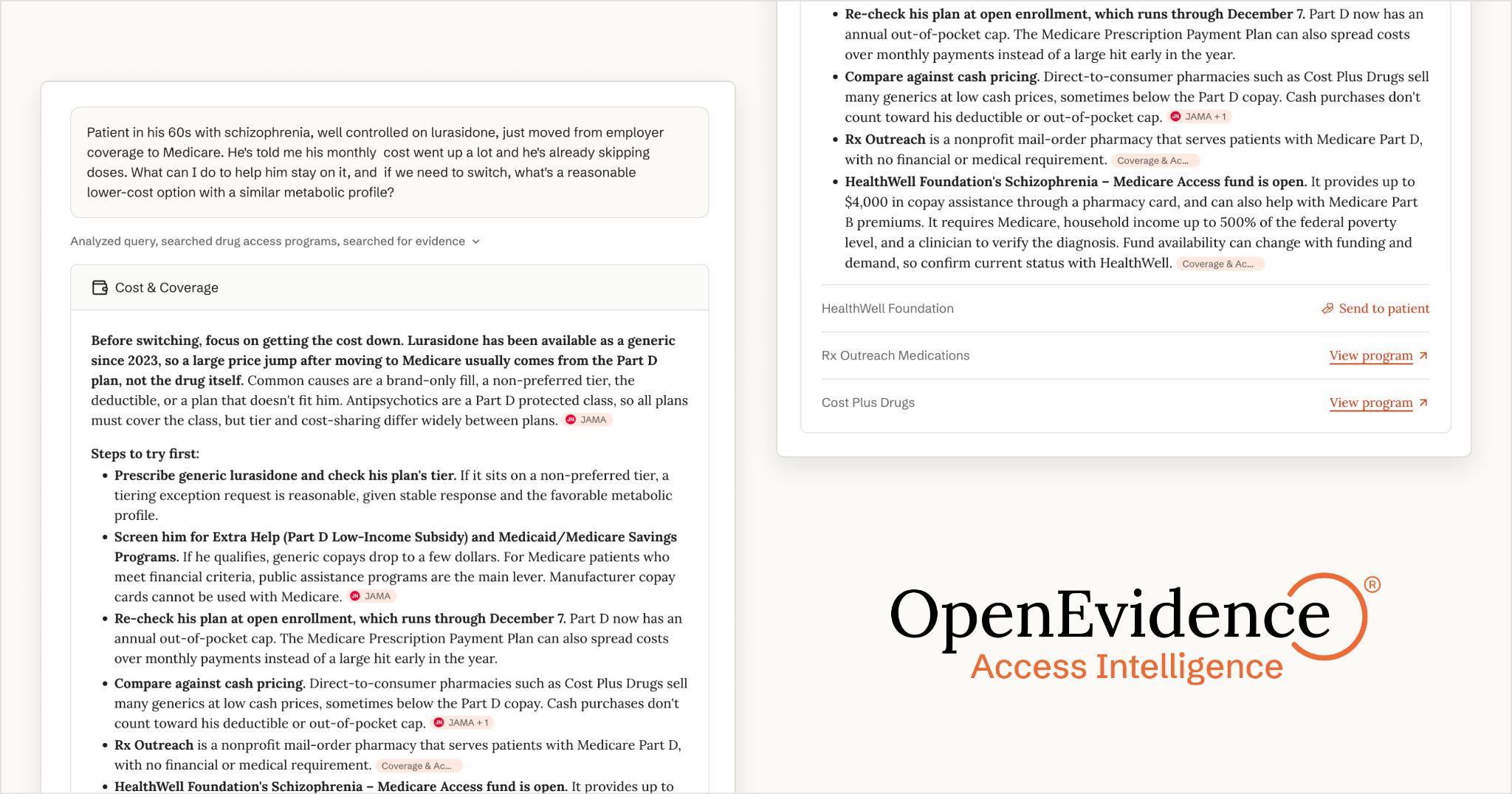
MIAMI--(BUSINESS WIRE)--OpenEvidence, the most popular AI for doctors in the United States, today launched OpenEvidence Access Intelligence, a suite of tools built directly into the platform that helps clinicians ensure their patients can access and afford the care they need.
"Choosing the right treatment should be the hard part. Getting the patient access to it shouldn’t be."
Share
Understanding the right treatment for the patient is critical, but it’s only the first step on the patient’s journey. Too often, the complexity of the healthcare system prevents or delays care, even after the right clinical decision has been made. While systems exist to ease this burden, the tools available are fragmented across thousands of sources, payers, and formats, each with its own forms, criteria, and paperwork. Clinicians are left to navigate this in the minutes they have with a patient, or not at all.
Access Intelligence is OpenEvidence’s commitment to continue to support clinicians and their patients after the clinical decision. It brings cost and access directly into the clinical conversation, and extends past information into action, supporting clinicians with the administrative work that stands between a patient and their treatment.
“As a physician, I experience firsthand the barriers patients face in getting appropriate treatment, and it’s one of the most frustrating parts of the job,” said Ania Bilski, MD, VP of Clinical AI at OpenEvidence. “Programs exist to help patients with treatment access, and prior authorizations can be won, but the process is so fragmented and time-consuming that engaging with it is nearly impossible. Access Intelligence is our commitment to helping physicians and patients close the loop of care, from identifying support programs to completing enrollment to getting a prior authorization approved. Choosing the right treatment should be the hard part. Getting the patient access to it shouldn’t be.”
The following components of Access Intelligence are available now on OpenEvidence, free for all clinicians:
- Support program information in the flow of care: OpenEvidence answers questions about availability and eligibility for more than 2,500 patient support programs, including copay savings, patient assistance, insurance support services, and more, updated daily.
- Savings sent straight to the patient: Clinicians can share copay savings and discount offers via Patient TakeHome, giving patients access to lower-cost prescriptions.
- Program enrollment on OpenEvidence: For programs requiring clinician and patient enrollment, clinicians can download pre-populated enrollment forms or enroll directly on OpenEvidence.
- Grounded prior authorization materials: Clinicians have already written over 500,000 prior authorization documents on OpenEvidence. Those letters are now stronger: prior authorization requests, appeal letters, and letters of medical necessity are grounded in available clinical guidelines and best practices, including prior authorization checklists and relevant ICD-10 codes. Clinicians can edit generated letters directly in OpenEvidence, and on OpenEvidence’s most advanced models, Sackett and Snow, they can work through letters interactively, with follow-up questions that surface the details reviewers look for.
Access Intelligence is available today for all clinicians and will continue to evolve to best support clinicians through the complex affordability and coverage landscape.
About OpenEvidence
OpenEvidence is the most popular AI for doctors in the United States. According to independent studies, more American physicians use OpenEvidence than all other AI platforms combined. OpenEvidence is trusted by millions of verified U.S. healthcare professionals making high-stakes clinical decisions at the point of care, with evidence that is sourced, cited, and grounded in peer-reviewed medical literature. Founded with the mission to organize and expand the world's collective medical knowledge, OpenEvidence is now used daily, on average, by the majority of physicians in the United States. OpenEvidence is free for all verified U.S. clinicians. Learn more at openevidence.com.