Omdia: Global PC Shipments to Decline 12% in 2026 Amid Severe Memory and Storage Supply Challenges
Omdia: Global PC Shipments to Decline 12% in 2026 Amid Severe Memory and Storage Supply Challenges
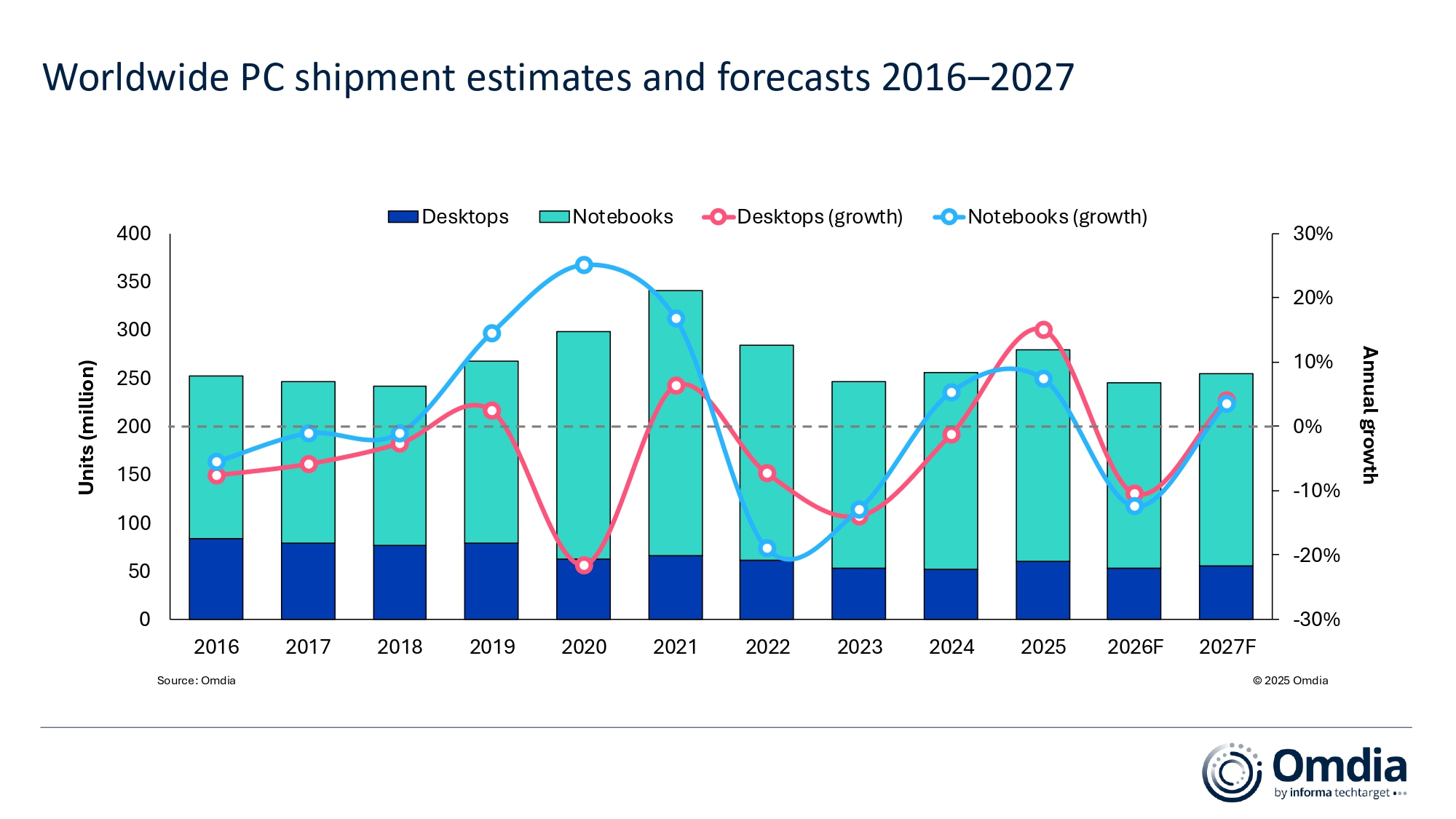
LONDON--(BUSINESS WIRE)--Worldwide shipments of desktops, notebooks and workstations in 2026 are expected to decline by 12% to 245 million units, according to the latest outlook from Omdia. This forecast is grounded in sharp increases in memory and storage prices - particularly the expected minimum 60% rise in 1Q26. Further upward price pressure is anticipated throughout the remaining quarters of the year, though subsequent increases are expected to be more moderate. Since 1Q25, the costs of mainstream memory and storage configurations have risen by between US$90 and US$165, placing substantial financial pressure on PC vendors and forcing them to reduce promotions, raise product prices, and adjust configurations. The impact across PC product categories is expected to be broadly consistent. Desktops are set to decline by 10% to 53.2 million units, while laptops will decline by 12% to 192.2 million units.
“For lower-priced products, there is less margin room to absorb rising costs, and consumers in this segment are typically more sensitive to price fluctuations,” said Omdia Principal Analyst Ben Yeh.
Share
Considering how quickly the situation is evolving, Omdia has conducted a multi-scenario analysis of the impact. Based on the latest available information and market signals, the forecast carries a higher downside risk, namely a widening of shortages for both memory and storage and increasingly steep price hikes. This could further suppress consumer demand and tighten PC vendors’ supply, pushing PC shipments toward a 15% decline or potentially worse. In addition, the recent outbreak of conflict in the Middle East has introduced substantial uncertainty for international transportation and regional market growth, although it remains to be seen whether this situation will persist.
Further analysis by price band shows that shortages and price increases have affected products across different price tiers to varying degrees. “For lower-priced products, there is less margin room to absorb rising costs, and consumers in this segment are typically more sensitive to price fluctuations,” said Omdia Principal Analyst Ben Yeh. “In addition, lower-price-band products often rely on lower-capacity, previous-generation components and receive lower allocation priority while facing the hurdle of some suppliers discontinuing production. Within the limited bit supply PC vendors could obtain, prioritizing premium products will be a preferred strategy to mitigate impacts to business performance.”
In 2026, PCs priced below US$500 are expected to be hit hardest, declining by 28% to around 62.1 million units shipped. By contrast, shipments of high-end PCs priced at US$900 and above are better supported and may even maintain modest growth. “Beyond the stronger ability of higher price bands to absorb cost increases, we also factored in that some consumers and IT decision makers will accept higher price points to meet essential needs, which will drive an upward shift in the price mix,” Yeh added. “However, the movement toward higher price bands does not necessarily represent improved product configurations.”
Worldwide desktop and notebook shipments (market share and annual growth) Omdia PC Forecast: 2025 and 2026 |
|||||
Platform |
2025
|
2025
|
2026
|
2026
|
Annual
|
Windows & Others |
231,679 |
83.1% |
203,550 |
83.0% |
-12.1% |
MacOS |
27,740 |
10.0% |
26,401 |
10.8% |
-4.8% |
ChromeOS |
19,317 |
6.9% |
13,990 |
5.7% |
-27.6% |
HarmonyOS |
141 |
0.1% |
1,404 |
0.6% |
897.0% |
Total |
278,876 |
100.0% |
245,344 |
100.0% |
-12.0% |
|
|
|
|
|
|
Note: Unit shipments in thousands. Percentages may not add up to 100% due to rounding. Source: Omdia PC Horizon Service (sell-in shipments and forecast), March 2026 |
|
||||
“The supply-driven downturn in 2026 will not affect all PC platforms equally,” said Kieren Jessop, Research Manager at Omdia. "Windows PCs, which account for 83% of shipments, are forecast to decline 12% in 2026 as the platform bears the brunt of memory and storage constraints. Chrome devices face the steepest decline at 28%, as the education-heavy platform is particularly exposed to tighter component allocation, lower margins and the discontinuation of some memory and storage products. Macs are set for a comparatively modest 5% decline, supported by Apple’s vertically integrated supply chain and premium positioning. Meanwhile, HarmonyOS-based PCs are emerging as a notable growth segment, forecast to expand tenfold year on year from a small base as Huawei ramps up its PC ecosystem in China.”
ABOUT OMDIA
Omdia, part of TechTarget, Inc. d/b/a Informa TechTarget (Nasdaq: TTGT), is a technology research and advisory group. Our deep knowledge of tech markets grounded in real conversations with industry leaders and hundreds of thousands of data points, make our market intelligence our clients’ strategic advantage. From R&D to ROI, we identify the greatest opportunities and move the industry forward.
Contacts
Fasiha Khan: fasiha.khan@omdia.com
Eric Thoo: eric.thoo@omdia.com