Kioxia Begins Mass Production of Industry’s First QLC UFS Ver. 4.0 Embedded Flash Memory Devices
Kioxia Begins Mass Production of Industry’s First QLC UFS Ver. 4.0 Embedded Flash Memory Devices
New 512GB Device Brings the Higher Bit Density of QLC to UFS
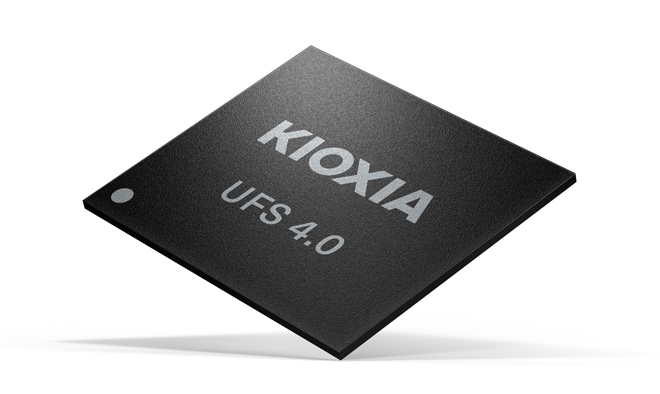
TOKYO--(BUSINESS WIRE)--Kioxia Corporation, a world leader in memory solutions, today announced that it has begun mass production of the industry’s first1 Universal Flash Storage (UFS)2 Ver. 4.0 embedded flash memory devices with 4-bit-per-cell, quadruple-level cell (QLC) technology.
QLC UFS offers a higher bit density than traditional TLC UFS, making it suitable for mobile applications that require higher storage capacities. Advancements in controller technology and error correction have enabled QLC technology to achieve this while maintaining competitive performance. Kioxia’s new 512 Gigabyte (GB) QLC UFS achieves sequential read speeds of up to 4,200 megabytes per second (MB/s) and sequential write speeds of up to 3,200 MB/s, taking full advantage of the UFS 4.0 interface speed.
Kioxia’s QLC UFS is well-suited for smartphones and tablets, as well as other next-generation applications where higher storage capacity and performance are key considerations - including PCs, networking, AR/VR, and AI.
Kioxia was the first to introduce UFS technology3, and continues to develop new products. The new QLC UFS Ver. 4.0 device integrates the company’s innovative BiCS FLASH™ 3D flash memory and a controller in a JEDEC standard package. UFS 4.0 incorporates MIPI M-PHY 5.0 and UniPro 2.0 and supports theoretical interface speeds of up to 23.2 gigabits per second (Gbps) per lane or 46.4 Gbps per device. UFS 4.0 is backward compatible with UFS 3.1.
Key Features include:
- Supports High Speed Link Startup Sequence (HS-LSS) features: With conventional UFS, Link Startup (M-PHY and UniPro initialization sequence) between device and host is performed at low-speed PWM-G1 (3~9 megabits per second4), but with HS-LSS, it can be performed at a faster HS-G1 Rate A (1,248 megabits per second). This is expected to reduce the time for Link Startup by approximately 70% compared to the conventional method.
- Enhances security: By utilizing Advanced RPMB (Replay Protected Memory Block) for improved read and write access to security data, such as user credentials on RPMB area, and RPMB Purge to ensure discarded security data may be sanitized securely and rapidly.
- Supports Extended Initiator ID (Ext-IID): Intended to be used with Multi Circular Queue (MCQ) at the UFS 4.0 host controller for improved random performance.
Notes
|
(1)Industry first claim based on Kioxia survey of publicly available information as of October 30, 2024
|
(2)Universal Flash Storage (UFS) is a product category for a class of embedded memory products built to the JEDEC UFS standard specification. Due to its serial interface, UFS supports full duplexing, which enables both concurrent reading and writing between the host processor and UFS device.
|
(3)Kioxia Corporation's first sample shipment, as of February 8, 2013.
|
(4)PWM-G1 communication speed depends on the host and the device.
|
*In every mention of a Kioxia product: Product density is identified based on the density of memory chip(s) within the Product, not the amount of memory capacity available for data storage by the end user. Consumer-usable capacity will be less due to overhead data areas, formatting, bad blocks, and other constraints, and may also vary based on the host device and application. For details, please refer to applicable product specifications. The definition of 1KB = 2^10 bytes = 1,024 bytes. The definition of 1Gb = 2^30 bits = 1,073,741,824 bits. The definition of 1GB = 2^30 bytes = 1,073,741,824 bytes. 1Tb = 2^40 bits = 1,099,511,627,776 bits.
|
*1 Gbps is calculated as 1,000,000,000 bits/s. Read and write speeds are the best values obtained in a specific test environment at Kioxia and Kioxia warrants neither read nor write speeds in individual devices. Read and write speed may vary depending on device used and file size read or written.
|
*Company names, product names and service names may be trademarks of third party companies. |
About Kioxia
Kioxia is a world leader in memory solutions, dedicated to the development, production and sale of flash memory and solid-state drives (SSDs). In April 2017, its predecessor Toshiba Memory was spun off from Toshiba Corporation, the company that invented NAND flash memory in 1987. Kioxia is committed to uplifting the world with “memory” by offering products, services and systems that create choice for customers and memory-based value for society. Kioxia's innovative 3D flash memory technology, BiCS FLASH™, is shaping the future of storage in high-density applications, including advanced smartphones, PCs, SSDs, automotive and data centers.
*Information in this document, including product prices and specifications, content of services and contact information, is correct on the date of the announcement but is subject to change without prior notice.
Contacts
Media Inquiries:
Kioxia Corporation
Sales Strategic Planning Division
Satoshi Shindo
Tel: +81-3-6478-2404