New Canva Research Reveals Amid Burnout, Teachers Are Ready to Embrace AI
New Canva Research Reveals Amid Burnout, Teachers Are Ready to Embrace AI
New data examines the state of teacher well-being in the U.S. and how the profession has changed in the year of AI.
- 35% of all K-12 educators experienced burnout daily
- 66% report working beyond contractual hours
- 92% of teachers using AI found it helpful in addressing pain points at work
SYDNEY--(BUSINESS WIRE)--As the 2023-2024 school year comes to an end, Kindergarten through 12th Grade (K-12) teachers in the US are widely experiencing strain at work: one-third (35%) of U.S. educators reported experiencing burnout on most days, leading to absenteeism and a decline in instructional quality as consequences.
That’s according to new data from Canva, the all-in-one visual communication platform empowering over 60 million teachers and students with free tech tools for the classroom. Released in time for Teacher Appreciation Week (May 6-10), the report investigates what is causing teacher burnout, how it impacts their work, and whether technology like AI is emerging as a helpful resource.
When it comes to burnout, the findings indicate that most teachers experience it, and it often inhibits them from thriving at work:
-
K-12 teachers experiencing burnout aren’t alone:
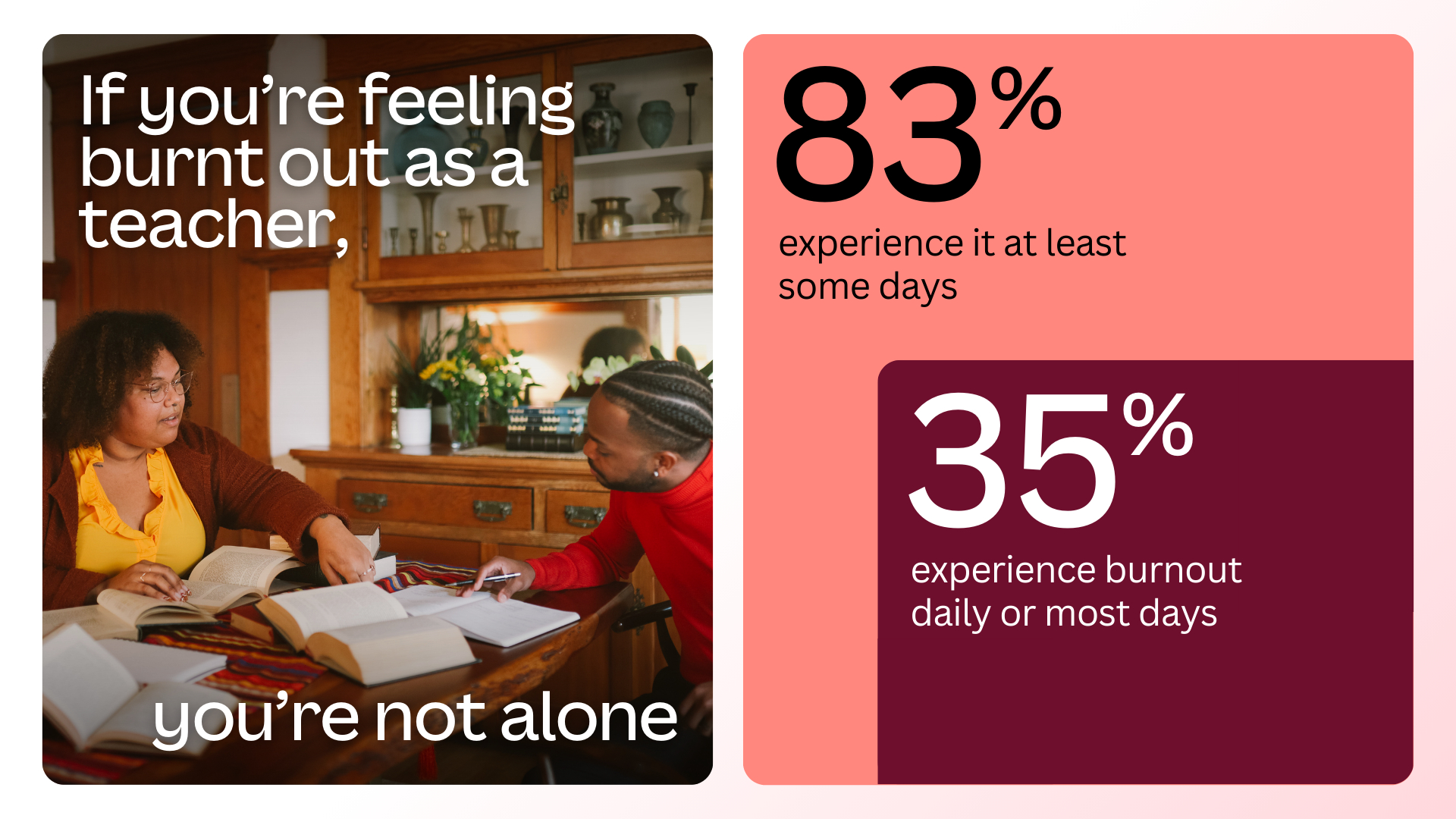
- Nearly all (83%) teachers experience burnout at least some days, with 35% experiencing burnout daily or most days.
- Primary drivers include strenuous classroom and student management responsibilities (46%), lack of administrative support (42%), low compensation (38%), and the need to work outside of school hours (37%).
- 66% of teachers report working beyond contractual hours, with 24% clocking an additional three hours daily.
-
Burnout can have a dire impact on the classroom experience:
- Teacher burnout can lead to heightened absenteeism, with 55% of teachers missing school days.
- 53% also agree that it has caused them to feel overwhelmed by their responsibilities, and 45% have less patience with students.
- An additional 34% have lost interest in their job and decreased the quality of their instruction.
-
Burnout sets in early in the year and impacts teachers’ feelings about the professional overall:
- 35% of teachers felt burnout within the first two months of the most recent school year.
- Regardless of age or generation, 57% have considered quitting or switching schools due to burnout.
When it comes to reducing the strain, teachers cited receiving higher salaries (61%) and maintaining a healthier work-life balance (44%) as things that would help. Technology alone is not a solution, but many teachers are open to AI as a solution to address some of their pain points and support their work:
-
There’s a strong correlation between educator AI use and job satisfaction:
- 46% of satisfied teachers use AI more than their unsatisfied counterparts (26%).
- During this past school year, 42% of K-12 teachers used AI in the classroom.
-
AI can improve the education experience:
-
Among those using AI, 92% found it helpful in addressing teaching pain points.
- 60% agreed AI could improve work efficiency
- 58% attested that AI helped alleviate burnout
-
AI has also helped promote more creativity and visual communication in the classroom.
- 51% use AI to create and supplement classroom materials
- 38% use AI to spark students' imagination and creativity
- 37% use it to improve the visual elements of their work
-
Among those using AI, 92% found it helpful in addressing teaching pain points.
-
Those who haven't tried AI yet are optimistic about its potential:
- Over half (56%) of teachers who haven’t tried AI believe it can help reduce burnout, with a pronounced belief among Gen Z and Millennial teachers (63%) and teachers with less than five years of experience (75%).
- Among those who haven’t adopted the technology, 68% are likely to try AI for curriculum and planning, with Kindergarten and Elementary teachers most likely (72%).
“We often hear from our teacher communities about needing to achieve more with less. Teaching stress is complex and can’t be solved with any one tool. Still, it’s encouraging to see that teachers benefit from AI in alleviating their workloads, saving time, and unlocking their creativity,” said Carly Daff, Head of Teams and Education at Canva. “We hope that Canva can play a part in allowing teachers to focus on the parts of their job that they’re most passionate about, like creating engaging lessons, and work with students in ways they wouldn’t have been able to before.”
Part of Canva’s mission is to do the most good possible, which includes a focus on supporting access to quality education for all. To empower teachers to create visual lessons, streamline their work and unlock creativity in the classroom, Canva provides Canva for Education 100% free for all K-12 teachers, students, schools, districts, campuses, ministries and school systems, with more than 100,000 education and lesson templates and over 10 AI tools with the safety assurances of Canva Shield.
Survey Methodology
Canva commissioned Sago, a research panel company, to survey a panel of 1,000 teachers from March 21, 2024, to April 1, 2024. All respondents were based in the United States, full-time, in-person teachers who are teachers between kindergarten and 12th grade.
About Canva
Launched in 2013, Canva is a free online visual communications and collaboration platform with a mission to empower everyone to design. Featuring a simple drag-and-drop user interface and a wide range of templates, from presentations, documents, websites, social media graphics, posters, and apparel to videos, plus a huge library of fonts, stock photography, illustrations, video footage, and audio clips, anyone can take an idea and create something beautiful.
Canva for Education provides K-12 teachers and students free access to Canva’s full suite of visual communication tools, combined with extra features designed just for the classroom.
Downloadable Assets
Click here.
Contacts
Press Contacts
Olivia Johnson for Canva North America and Australia (oliviajohnson@canva.com)