Vagus nerve stimulation reduces inflammation in children with Inflammatory Bowel Disease, Feinstein Institutes study finds
Vagus nerve stimulation reduces inflammation in children with Inflammatory Bowel Disease, Feinstein Institutes study finds
Bioelectronic medicine researchers at the Feinstein Institutes for Medical Research, published results from a proof-of-concept clinical trial in the journal Bioelectronic Medicine
MANHASSET, N.Y.--(BUSINESS WIRE)--Chronic inflammatory bowel disease (IBD), including Crohn’s disease and ulcerative colitis, is rising in prevalence among children and can lead to abdominal pain, incontinence, diarrhea and delayed growth. While some biologic therapies are effective, medications are often accompanied by immunosuppressive side effects and many patients are left with unresolved chronic inflammation. Bioelectronic medicine researchers at The Feinstein Institutes for Medical Research and Cohen Children’s Medical Center published today in the journal Bioelectronic Medicine results from a proof-of-concept clinical trial that showed non-invasive, non-pharmacological transcutaneous auricular vagus nerve stimulation (ta-VNS), or stimulating in the ear, significantly reduced inflammation in more than 64 percent of pediatric patients with IBD.
The vagus nerve is often referred to as the body’s superhighway – it connects the brain with all major organs and controls functions like heart rate, breathing and our body’s immune response, including the release of inflammatory molecules. Inflammation and the inflammatory reflex – the neuronal signaling between the brain and body – is an important immune response. However, if uncontrolled, it can lead to severe conditions such as Crohn’s disease, ulcerative colitis, rheumatoid arthritis, lupus and other inflammatory diseases. Using electricity and vagus nerve stimulation devices, like implants or in this clinical trial’s case a non-invasive device placed in the ear, clinicians can retune the vagus nerve to function properly, mediating the amount of pro-inflammatory proteins released in the body and reducing chronic, painful inflammation.
In this trial, led by Benjamin Sahn, MD, MS, instructor at the Feinstein Institutes’ Institute of Bioelectronic Medicine, 22 patients diagnosed with IBD (for at least six months) between the ages of 10-21 with elevated fecal calprotectin (FC), an inflammatory protein, were randomized into two groups. Some patients received once-daily stimulation with ta-VNS in their left external ear, while others received once-daily sham stimulation. Eventually, all of the trial participants switched to receiving ta-VNS twice daily for the final 12 weeks. At the conclusion of the trial, 50 percent of the participants with Crohn’s disease symptoms and 33 percent of participants with ulcerative colitis symptoms were in remission. Interestingly, improved FC and symptoms occurred earlier for ulcerative colitis patients than those with Crohn’s disease.
“Currently approved biological medications for children with IBD have the potential for side effects and may not help fully alleviate symptoms or lead to disease healing,” said Dr. Sahn, co-director of the Pediatric Inflammatory Bowel Disease Center, division of Gastroenterology, Liver Disease & Nutrition at Cohen Children’s Medical Center. “These proof-of-concept study results show that non-invasive vagus nerve stimulation should be studied further and considered an alternative or additive to pharmacologic therapy.”
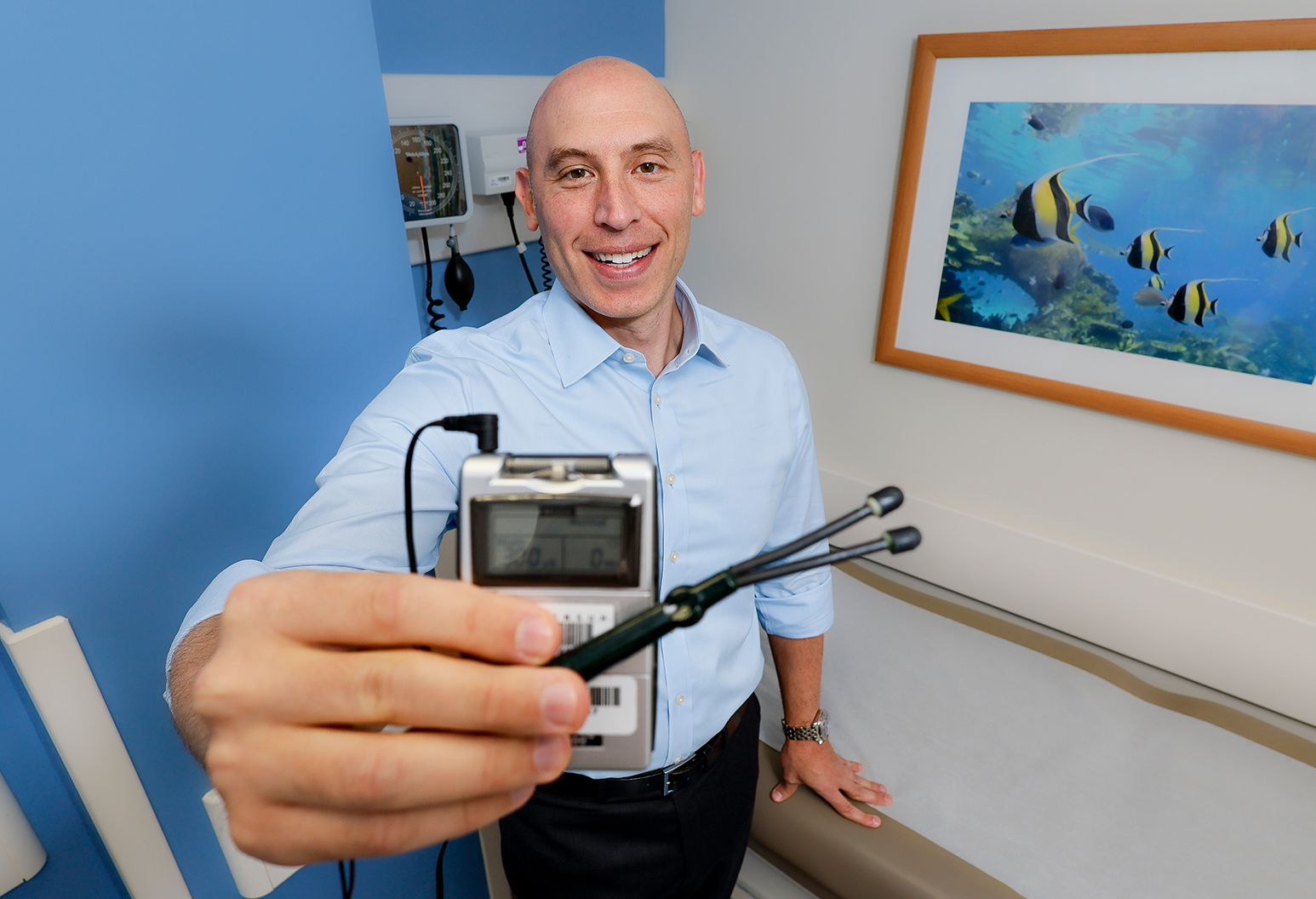
Dr. Sahn and his team used a commercially available transcutaneous electrical nerve stimulator (TENS) unit (TENS 7000) and sensor probe for the trial. Two earbuds on the probes were placed on a small area of the external ear called the cymba conchae, where the vagus nerve is most accessible. For five-minute intervals, the patients received the stimulation for a total of 16 weeks. Stimulation of this auricular nerve branch delivers neuronal impulses toward the central nervous system, where the signals are relayed to the body. This differs from implanted devices that deliver nerve stimulation to the body and brain directly. Previous research and functional MRI studies have mapped stimulation of the auricular branch of the vagus nerve to activate the same brain regions as implanted devices, confirming this nerve as a suitable non-invasive target to administer vagus nerve stimulation.
“IBD is a complex, life-altering disease that impacts a person’s quality of life, especially for a child,” said Charles L. Schleien, MD, MBA, senior vice president and chair of pediatric services at Northwell Health and professor in the Institute of Molecular Medicine at the Feinstein Institutes. “Dr. Sahn’s research is valuable, as it may help lead to alternative, more effective treatments for kids who need them.”
The Feinstein Institutes is the global scientific home of bioelectronic medicine, which combines molecular medicine, neuroscience, and biomedical engineering. At the Feinstein Institutes, medical researchers use modern technology to develop new device-based therapies to treat disease and injury.
“This study adds to the growing evidence that the vagus nerve can suppress inflammation in patients,” said Kevin J. Tracey, MD, president and CEO of the Feinstein Institutes and Karches Family Distinguished Chair in Medical Research and editor-in-chief of Bioelectronic Medicine. “It will be interesting in the future to further explore the mechanisms of vagus nerve stimulation in other clinical trials.”
Built on years of research in molecular disease mechanisms and the link between the nervous and immune systems, Feinstein Institutes researchers discovered neural targets that are activated or inhibited with neuromodulation devices, like vagus nerve implants or ultrasound technologies, to control the body’s immune response and inflammation. If inflammation is successfully controlled, diseases – such as arthritis, pulmonary hypertension, Crohn’s disease, ulcerative colitis, diabetes, cancer and autoimmune diseases – can be treated more effectively.
Recent vagus nerve and bioelectronic medicine accomplishments achieved by the Feinstein Institutes team include research published in Nature Communications that shows electrically stimulating the vagus nerve can trigger the body’s “neural tourniquet” and reduce bleeding in preclinical hemophilic mice models – a finding that could translate to humans. Also, Feinstein Institutes researchers, in collaboration with GE Research, published research that harnessed ultrasound technology to reduce inflammation in the body non-invasively. And, bioelectronic medicine researchers shared early results of efforts to anatomically map the entire vagus nerve, which is part of a $6.7M National Institutes of Health grant.
About the Feinstein Institutes
The Feinstein Institutes for Medical Research is the home of the research institutes of Northwell Health, the largest health care provider and private employer in New York State. Encompassing 50 research labs, 3,000 clinical research studies and 5,000 researchers and staff, the Feinstein Institutes raises the standard of medical innovation through its five institutes of behavioral science, bioelectronic medicine, cancer, health system science, and molecular medicine. We make breakthroughs in genetics, oncology, brain research, mental health, autoimmunity, and are the global scientific leader in bioelectronic medicine – a new field of science that has the potential to revolutionize medicine. For more information about how we produce knowledge to cure disease, visit http://feinstein.northwell.edu and follow us on LinkedIn.
Contacts
Matthew Libassi
631-793-5325
mlibassi@northwell.edu