Just 4.7% of Financial Institutions Continuously Update Their Compliance Monitoring and Controls as Risk Changes, New Research Finds
Just 4.7% of Financial Institutions Continuously Update Their Compliance Monitoring and Controls as Risk Changes, New Research Finds
As financial crime threats, regulations and transaction volumes evolve dynamically, most compliance programs remain built around periodic review
PALO ALTO, Calif.--(BUSINESS WIRE)--SymphonyAI, a global leader in vertical AI product platforms, and AML Intelligence, the leading source of news and insight for the financial crime compliance community, today released the FinCrime Frontier 2026–27 Report, finding that most financial institutions still rely on periodic review cycles to manage financial crime risk, even as the threats and regulations they are meant to track continue to evolve dynamically.
SymphonyAI and AML Intelligence: AI and model governance are now the top regulatory concern for financial institutions. But 76.3% of firms still review alerts manually or semi-manually. New research exposes the gap between investment and operational change
Share
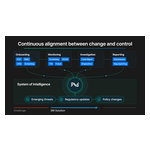
Based on the perspectives of more than 200 financial crime and compliance leaders, including senior leaders from major global financial institutions, the research finds that just 4.7% of financial institutions continuously update their compliance monitoring and controls as risk changes, while 56.8% have not adopted always-on compliance monitoring at all, are only exploring it, or remain at an early, pilot-stage level. The finding points to a structural gap: financial crime typologies, payment ecosystems and regulatory expectations are evolving continuously, while most compliance programs are still built around scheduled review cycles.
The research points to the practical cost of that gap. Without the ability to continuously recalibrate what warrants attention, investigators are left sorting through volume rather than focusing on real risk: seven in ten respondents (70.8%) report that 5% or fewer of the alerts they investigate result in an escalation or SAR/STR filing — meaning the vast majority of investigative effort never translates into identified risk.
The regulatory environment is intensifying the challenge. AI and model governance and the adequacy of technology and systems have jointly become the most frequently cited regulatory concern, each selected by 40.8% of respondents — overtaking cross-border regulatory complexity, which topped the list a year ago. The shift suggests regulators are moving from evaluating whether firms have a policy to evaluating whether the technology behind it performs as expected and can be evidenced.
The research also finds that operating models have changed less than investment levels might suggest. AI and automation is now the leading compliance investment priority, cited by 61.9% of respondents, yet 76.3% of institutions still review alerts manually or with only partial automation — little change from the prior year. The result is a widening gap between how much institutions are investing in AI and how much their day-to-day operations have actually changed.
There are signs of movement. Fully manual alert review has declined from 21.3% to 16.5% year-over-year. Additionally, more than half of the respondents describe their organization’s response to regulatory change as forward-leaning in some form — accelerating modernization, reshaping their operating model, or enabling a shift to proactive, intelligence-led compliance — even though reactive workload remains the single largest response. Taken together, the findings suggest an industry that is beginning to move, but not yet at the pace its risk and regulatory environment now demands.
"This year's data draws a clear line," said Stephen Rae, Co-Founder and Chair of AML Intelligence. "Most financial institutions aren't short on commitment to modernizing compliance, they're short on operating tempo. Criminal typologies shift by the week, transaction volumes keep climbing, and regulatory expectations are tightening — yet compliance functions are still largely built to reassess risk on a schedule rather than as conditions change. That gap, more than any single technology choice, is what the industry needs to close next."
"The research shows an industry moving in the right direction, but the pace of change in financial crime compliance — across emerging threats, regulation and increasing business complexity — continues to outrun most compliance programs' ability to adapt," said John Edison, President of Financial Services at SymphonyAI. "The next phase will be defined by how effectively institutions use AI to connect risk intelligence with institutional judgment, transforming detection, investigation and governance so that controls respond dynamically as risk changes, while maintaining appropriate human oversight and accountability."
The FinCrime Frontier 2026–27 Report examines regulatory change, the economics of compliance, operational performance, AI and automation maturity, data and governance readiness, and the future of financial crime compliance.
Download the FinCrime Frontier 2026–27 Report: www.symphonyai.com/resources/fincrime-frontier-2026-27-report
About SymphonyAI
SymphonyAI Financial Services provides AI software to tackle the most complex challenges in financial crime detection, risk management, and compliance. With a global presence and more than 25 years of industry expertise, it combines deep domain knowledge with the latest AI innovation. Its pioneering agent-led solutions enable the Always-on Compliance™ operating model, helping financial institutions strengthen risk coverage, reduce costs, and adapt to changing threats and regulations. Its mission is to make the financial system safer while enabling institutions to grow with confidence. Learn more at symphonyai.com/financial-services.
About AML Intelligence
AML Intelligence delivers trusted Business Intelligence on Anti-Money Laundering (AML) and Financial Crime for executive leaders worldwide. We are dedicated to delivering high-quality journalism, analysis, and data-driven insights on money laundering, terrorist financing, and broader financial crime issues. Our mission is to empower the AML community through authoritative content, professional events and valuable networking opportunities that foster continuous learning and collaboration in the fight against financial crime. With a foundation built on integrity, accuracy, and credibility, AML Intelligence is your trusted source for understanding new regulations, legislation, and industry thought leadership. For AML leaders and executives, the smartest way to stay ahead is to attend our events and subscribe to our newsletters, your gateway to expert insights and community connection. Learn more at www.amlintelligence.com.
Contacts
Media Contact
SymphonyAI
media@symphonyai.com