Lessengers Unveils Breakthrough 3.2T Glass-Substrate Near-Packaged Optics (NPO) Powered by Direct Optical Wiring (DOW) Technology
Lessengers Unveils Breakthrough 3.2T Glass-Substrate Near-Packaged Optics (NPO) Powered by Direct Optical Wiring (DOW) Technology
Next-generation architecture redefines optical interconnect density, driving up to 50% power savings and unyielding thermal stability for AI clusters.
SEOUL, South Korea & MÁLAGA, Spain--(BUSINESS WIRE)--Lessengers, a pioneer in advanced optical interconnect solutions, today announced a major architectural milestone for high-performance computing (HPC) with the unveiling of its 3.2T glass-substrate near-packaged optics (NPO) platform at ECOC 2026 in booth 2184 at FYCMA in Malaga, Spain. Powered by the company’s proprietary direct optical wiring (DOW) technology, this new 3.2 Terabits-per-second (Tbps) architecture bypasses traditional packaging limitations to deliver unparalleled bandwidth density and radical power efficiency directly inside the network switch chassis.
By merging the superior mechanical and optical properties of glass substrates with our DOW, we have crafted a scalable 3.2T platform that changes the physics of data center networking.
Share
As generative AI clusters scale past physical copper boundaries, data centers face unprecedented power and signal attenuation constraints. Lessengers’ 3.2T glass-substrate NPO eliminates front-panel pluggable transmission bottlenecks by shifting the optical engine onto a shared, ultra-stable glass packaging core situated mere millimeters from the host ASIC.
Next-generation architecture: Glass substrate powered by high-density ultra-low-profile DOW technology. Moving away from organic material substrates, Lessengers’ latest architecture utilizes an advanced glass packaging core integrated with vertical through-glass vias (TGVs)
- Thermal synchronization: Glass provides a low coefficient of thermal expansion (CTE) that flawlessly aligns with silicon processors. This eliminates substrate warping and micro-shifting during intense workload fluctuations, a historical vulnerability for high-speed optics.
- Integrated planar waveguides streamlined with DOW-based polymer waveguides: Leveraging the optical clarity of the glass core, precision internal pathways route light cleanly through the physical substrate layer itself, enabling near-lossless signal integrity at ultra-high frequencies.
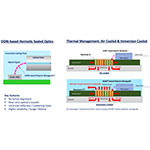
- No active alignment / No lenses: DOW discards costly, multi-channel lens assemblies and tedious active micro-alignment steps during manufacturing.
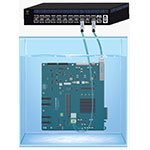
- Immersion-cooling native: DOW creates a hermetic seal around the active optical junctions, the 3.2T NPO module is dynamically suited for immersion-cooled server racks without requiring costly additional packaging.
- Density Footprint: Aggregates a massive 3.2 Tbps throughput within a hyper-compact form factor, enabling switch manufacturers to easily deploy 51.2T and 102.4T generation networking hardware.
"The binding constraint in AI infrastructure is no longer just compute power—it is the energy and signal loss born by moving data between chips," said Chongcook Kim, CEO of Lessengers. "By merging the superior mechanical and optical properties of glass substrates with our DOW, we have crafted a scalable 3.2T platform that changes the physics of data center networking, offering an open, socketable ecosystem that drastically slashes power and assembly complexity."
Lessengers will host live demonstrations of its direct optical wiring ecosystems and architectural portfolios. For engineering inquiries or to schedule an evaluation architecture review, please visit lessengers.com.
About Lessengers
Lessengers is a leading provider of innovative optical interconnect solutions based on its patented Direct Optical Wiring (DOW) technology. The company resolves structural roadblocks in packaging and manufacturing complexity to deliver high-density, low-power, and cost-effective optical components designed to empower next-generation AI/ML clusters, high-performance computing (HPC), and hyperscale data centers.
Contacts
Taeyong Kim, Ph. D
Chief Marketing Officer
+82-10-6549-7654
taeyong.kim@lessengers.com