Mintlify's 2026 State of Knowledge Report Finds AI Agents Have Overtaken Humans as the Primary Readers of Company Documentation
Mintlify's 2026 State of Knowledge Report Finds AI Agents Have Overtaken Humans as the Primary Readers of Company Documentation
New research shows AI agents traffic interacting with Mintlify-powered sites outpaces humans traffic for the first time, 2 to 1 — a shift most companies aren't structured to handle
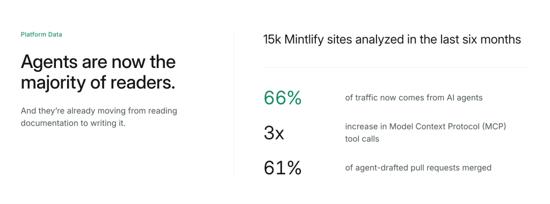
SAN FRANCISCO--(BUSINESS WIRE)--Mintlify, the AI-native knowledge infrastructure company powering the knowledge layer for companies like Anthropic, Microsoft, Spotify, and Coinbase, today released its 2026 State of Knowledge Report. The report reveals that AI agents have overtaken humans as the primary readers of company documentation for the first time on record. The research also found that AI agents are quickly moving from reading documentation to writing it, with 83% of surveyed companies saying AI agents now draft documentation updates for their teams. This means that for modern-day companies, their number-one knowledge consumer is no longer human. At the same time, new findings from Gartner unveil that only 14% of organizations report confidence that their internal company content is ready for AI agent consumption.
Historically, companies have written documentation and content for humans, by humans. However, human-managed documentation often lacks detail and stays out of date, consistently ranking among developers' top causes of lost time. Research shows that 69% of developers lose 8+ hours a week of work, due in part to insufficient documentation. However, with the rise of AI agents, there has been a step change in how company data is processed, with AI coding agents and support bots taking over as the core functions "reading" documentation to do things like write code correctly, answer support tickets, or understand how a product's API works.
"For the first time, company intelligence is being read by more AI agents than humans, with AI-written internal documents also increasing exponentially. This means that the companies that have built their internal knowledge for the human audience, are now building for the minority,” said Han Wang, co-founder and CEO of Mintlify. “Companies that treat knowledge as infrastructure, not a static site someone updates when they remember to, are the ones whose agents and human teams will work together cohesively. This feeds through the entire organization, how it functions, and ultimately how it delivers the best outcomes to customers.”
In addition to the rise of AI agent readers, Mintlify’s data also found:
- Agents have moved from reading documentation to writing it. Leading companies are no longer just structuring documentation for agents to read, they're using agents to update them. The majority (83%) of surveyed companies say AI agents now draft documentation updates for their team, though only 9% let agents publish without human review.
- Company knowledge is scattered across too many surfaces. More than half of respondents say their organization's knowledge lives across five or more surfaces (docs, help center, community, changelog, etc.), and less than a third rate most or all of it as AI-ready.
- Navigation, not content, is the primary failure point. Across 2,400 controlled tests, agents answered questions correctly 94–99% of the time regardless of format. However, the failure point proved to be in the navigation. Agents repeatedly requested pages that didn't exist. The research found that stripping documentation down to markdown alone wasn’t sufficient; however, adding a single link to a navigation map reduced failed requests by 20x compared to raw HTML.
The research found that despite 57% of companies stating they have no specific team responsible for making non-docs AI-ready, their confidence levels have outpaced true readiness broadly. 79% of companies rate their knowledge as average or ahead of peers, while just 7% have made every surface they own readable by an agent.
"The gap between how ready companies feel and how ready they are is exactly where the next competitive advantage lives,” said Hahnbee Lee, co-founder and CTO of Mintlify. “In a year, AI-ready knowledge won't be a nice-to-have; it will be table stakes for whether your company flourishes or flounders. The companies closing that gap now are the ones buying themselves time everyone else won't have."
To review the results in full, download at: https://www.mintlify.com/state-of-knowledge
Methodology:
Mintlify’s 2026 State of Knowledge Report combines server-side traffic data from Mintlify-hosted documentation sites (February 1–August 31, 2026), Mintlify product telemetry, a controlled open-source navigation benchmark across 20 documentation sites, and a survey of 329 companies. Human traffic is measured through client-side analytics; agent traffic is measured through server-side requests for machine-readable page versions, agent-specific assets, and recognized AI user-agents. Because the two collection methods differ, direct comparisons are estimates. Full methodology is available in the complete report.
About Mintlify:
Mintlify is the AI-native knowledge infrastructure company that makes knowledge accessible to humans and agents. As AI agents become the primary consumers of documentation, Mintlify is building the layer that makes every product understandable, usable, and discoverable by AI. Mintlify powers the knowledge layer for more than 20,000 companies, including Anthropic, Microsoft, Coinbase, Spotify, and HubSpot, and reaches over 50 million people a month. Mintlify has raised $67M to date from backers like Andreessen Horowitz and Salesforce Ventures.
Contacts
Abby McAdams
ASM Communications
abby@asmcomms.com