New Logitech Study Exposes a “Million Dollar Design Flaw” that Silently Drains Organizational Productivity
New Logitech Study Exposes a “Million Dollar Design Flaw” that Silently Drains Organizational Productivity
Research reveals fragmented decision-making, late technology integration, and meeting disruptions cost companies significant time and revenue
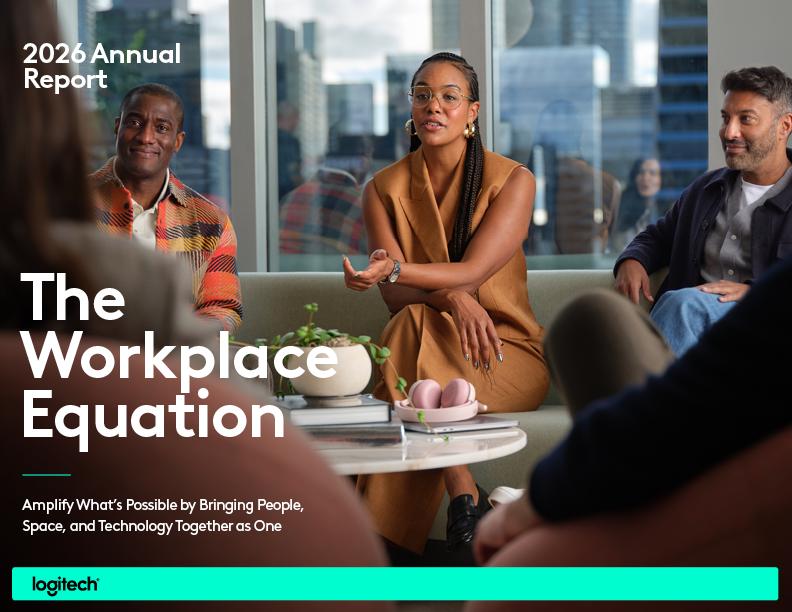
LAUSANNE, Switzerland & SAN JOSE, Calif.--(BUSINESS WIRE)--Today, Logitech (SIX: LOGN) (NASDAQ: LOGI) released the results of The Workplace Equation research study of 1,700 workplace experience decision-makers in 11 countries, highlighting a critical gap between workplace intent and real-world execution. The findings show that while leaders recognize the importance of workplace experience on productivity and collaboration, siloed decision-making and delayed IT involvement are leading to widespread—and costly—friction.
“Strong workplace experiences start when IT, HR, and Real Estate teams work from the same playbook,” said Henry Levak, general manager of Team Workspace Solutions at Logitech.
Share
Key Findings:
- The Late-Tech Trap: Only 24% of organizations involve IT/AV teams before space planning begins. Technology is routinely brought in after room designs are already in-progress or finalized, forcing technology to support or retrofit spaces it did not help create.
- The Cost of Meeting Tech Failures: Technical issues in meetings—such as failed audio or connection drops—result in a median productivity loss of 12.2 minutes per person. In fact, 30% of respondents report losing 16 or more minutes per person during a single technical disruption.
- Fragmented Authority: No single department holds a unified view of the workplace experience. While HR views itself as the primary authority (81%), IT/AV and Real Estate leaders also see their departments as the primary authority, underscoring an urgent need for clarity and collaboration.
- The ROI Proof Gap: Although 87% of leaders link strong workplace experience directly to improved productivity and collaboration outcomes, only 58% feel confident they possess the right ROI data to justify workplace experience and technology investments and only 27% treat workplace experience as a core business strategy.
The cumulative impact of productivity loss* and retrofitting spaces to fit new technology** can be in the millions of dollars, depending on the size of the company.
“Strong workplace experiences start when IT, HR, and Real Estate teams work from the same playbook,” said Henry Levak, general manager of Team Workspace Solutions at Logitech. “When these three functions run on separate tracks, no one owns the friction problem. Dissolving these boundaries can turn everyday work environments into a true competitive advantage.”
The study outlines key strategies for organizations to bridge the gap in workplace friction. The recommendations include:
- Bring IT, HR, and Real Estate together early: Involve cross-functional teams and align on shared metrics before space planning begins.
- Treat tech downtime as a workplace experience indicator: Measure ticket volumes, device performance, and meeting start delays alongside standard employee experience metrics.
- Design for purpose, not presence: Align physical spaces with performance outcomes—such as deep focus and dynamic collaboration—rather than simple attendance tracking.
- Make data-informed decisions: Combine sensor and sentiment data to demonstrate ROI and continuously adapt as business and employee demands shift.
View the full report here.
Study methodology
Logitech commissioned The Harris Poll to survey workplace experience decision-makers at companies with 500 or more employees. The 1,700 respondents were leaders across four key roles: workplace experience (375), real estate/facilities (441), IT (442), and HR (442) in 11 markets: Canada, France, Germany, India, Japan, Philippines, Saudi Arabia, Singapore, United Arab Emirates, United Kingdom, and United States.
About Logitech
Logitech designs software-enabled hardware solutions that help businesses thrive and bring people together when working, creating and gaming. As the point of connection between people and the digital world, our mission is to extend human potential in work and play, in a way that is good for people and the planet. Founded in 1981, Logitech International is a Swiss public company listed on the SIX Swiss Exchange (LOGN) and on the Nasdaq Global Select Market (LOGI). Find Logitech and more of its business products and enterprise solutions at www.logitech.com/business, the company blog, Logitech Business or @LogitechBiz.
*Ivanti: 2025 Digital Employee Experience (DEX) Report
**Facilities Management Journal: Measuring What Matters: 6 occupancy metrics that drive smart space decisions
Contacts
Media contact:
Leila Lewis
Head of Communications
Logitech for Business
llewis@logitech.com