New MAX Report Separates True Gen Z Behaviors From Life-Stage Trends
New MAX Report Separates True Gen Z Behaviors From Life-Stage Trends
Study of more than 14,000 U.S. consumers challenges common assumptions about Gen Z, from beauty spending and online shopping to crypto adoption and alcohol consumption
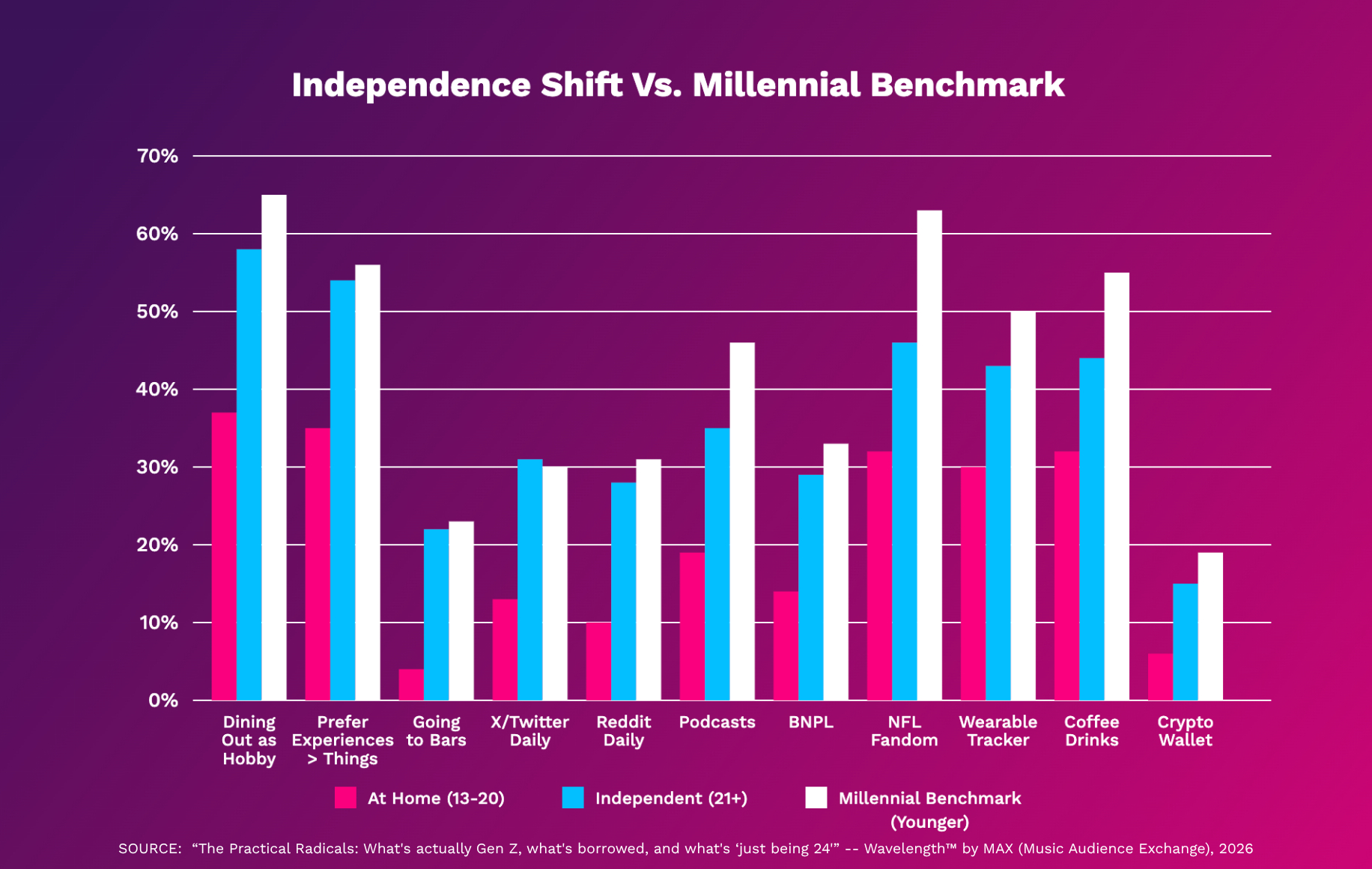
Watch what happens when Gen Z gains independence: bar-going (predictably) jumps from 4% to 22%. Dining out, 37% to 58%. Coffee, 32% to 44%. Podcasts nearly double. Reddit and X adoption triple. BNPL doubles. Each bar on this chart stretches toward the millennial benchmark, and most of them get there within a few years of their first paycheck.
DALLAS--(BUSINESS WIRE)--A new report from Wavelength™ by MAX (Music Audience Exchange) suggests that many behaviors commonly labeled as “Gen Z trends” may not be generational at all. Instead, they often reflect the life stage of younger consumers or habits already established by millennials.
Marketers are handed a new list of ‘Gen Z trends’ every year, but many of those trends are really about becoming an independent adult.
Share
The report, “The Practical Radicals: What’s Actually Gen Z, What’s Borrowed, and What’s Just Being 24,” takes a different approach to generational research. Rather than treating Gen Z as a single group, it separates respondents into “At Home” Gen Z, ages 13–20, and “Independent” Gen Z, ages 21 and older. It then compares Independent Gen Z with millennials to determine which behaviors change after age 21 and which remain consistent.
The analysis found that behaviors moving closer to millennial levels after age 21 are more likely tied to life stage. Those that remain consistent across both Gen Z groups are stronger indicators of a lasting generational difference.
Five Common Gen Z Assumptions Reconsidered
The report challenges five widely repeated beliefs about Gen Z:
- The “Sephora Generation”: Gen Z spends less than millennials across every beauty category measured, including makeup, skincare, fragrance, and premium beauty. Eighty-four percent qualify as affordable personal-care shoppers, the highest percentage of any generation studied. The findings suggest Gen Z is less defined by premium beauty spending than by its ability to find lower-cost alternatives.
- Experiences Over Things: Gen Z is more likely than millennials or Gen X to prefer purchasing products over experiences. However, that preference shifts considerably after age 21, when Gen Z begins to look more like millennials across most travel and experience categories. Solo and premium travel remain notable exceptions.
- The BNPL, Crypto, and AI Generation: Buy-now-pay-later services, crypto wallets, and paid AI subscriptions all peak among younger millennials, not Gen Z. Gen Z may use AI more frequently, but millennials are more likely to pay for it.
- The Sober Generation: Gen Z does drink less, although the difference is smaller than popular narratives often suggest. Twenty-three percent of Independent Gen Z respondents abstain from alcohol, compared with 17% of millennials. The larger distinction is what they purchase: Gen Z buys budget liquor at twice the millennial rate, while purchases of craft beer and premium liquor are nearly one-third lower.
- Digital Natives Shop Online: Despite growing up with digital commerce, Gen Z shops in physical stores more often than millennials and shops online less. The findings support the idea that younger consumers are helping drive renewed interest in malls and in-person retail.
The Behaviors That Appear to Be Truly Generational
The report identifies six characteristics that remain consistent across both younger and older Gen Z respondents:
- Using social media as a search engine. Fifty-nine percent of Gen Z searches through social platforms, compared with 46% of millennials and 30% of Gen X.
- Treating gaming as a mainstream pastime rather than a niche hobby, with women representing the fastest-growing segment of Gen Z gamers.
- Participating in creative hobbies, from painting and crafting to digital content creation, at higher rates than older generations.
- Shifting sports fandom away from some legacy leagues and toward esports, the WNBA, and combat sports.
- Prioritizing low prices across income levels, suggesting that value is a lasting mindset rather than simply a response to limited spending power.
- Expressing mixed feelings about technology. Gen Z’s heaviest social media users are also the most likely to say they have attempted a “social media diet.”
“Marketers are handed a new list of ‘Gen Z trends’ every year, but many of those trends are really about becoming an independent adult,” said Jeff Rosenfeld, Chief Product Officer at MAX. “If a behavior changes as soon as someone turns 21, brands should be careful about building a long-term generational strategy around it. The more meaningful signals are the behaviors that remain consistent, including how Gen Z searches, plays, creates, and thinks about value.”
One Generation, Two Distinct Strategies
The study also found that several behaviors often attributed to Gen Z, including TikTok Shop purchases, buy-now-pay-later use, and tequila consumption, are more closely associated with ethnicity than age.
Because Gen Z is the most racially and ethnically diverse generation included in the study, multicultural behaviors can appear to be generational when viewed only through an age-based lens. As a result, brands may unintentionally treat “Gen Z strategy” and “multicultural strategy” as separate initiatives while targeting many of the same consumers.
“Our findings make a strong case for looking beyond broad generational labels,” Rosenfeld said. “Age still matters, but life stage, ethnicity, and culture often provide the context marketers need to understand what is actually driving a behavior.”
The full report, “The Practical Radicals: What’s Actually Gen Z, What’s Borrowed, and What’s Just Being 24,” is available free at https://wavelength.max.live/reports/gen-z in both an interactive web format and a downloadable version featuring presentation-ready graphics.
Wavelength by MAX is based on a survey of more than 14,000 nationally representative U.S. consumers ages 13–64. The research includes additional sampling of young Black and Latino consumers to support reliable analysis of more narrowly defined audience segments.
About MAX (Music Audience Exchange):
MAX (Music Audience Exchange) is the marketing technology company powering authentic partnerships between brands and music artists. More than 7,000 artists (including Alicia Keys, Luke Combs, Jon Batiste) use MAX’s direct-to-fan platform, SET®, to engage with fans and better understand their audiences. These insights enable MAX to connect brands with the right artists and reach consumers through voices they already know and trust. Every partnership is designed to drive measurable brand outcomes, from awareness and brand lift to engagement and customer acquisition. Across content, social media, and interactive live music experiences, MAX turns fan passion into results for brands including Ford, McDonald’s, Dr Pepper, Credit Karma, and more.
Contacts
Rosemary Waldrip
MAX (Music Audience Exchange)
rosemary@max.live
972-421-6218
www.max.live