Rare Earths Americas Establishes the Foothills Rare Earths District, Expanding Beyond Shiloh with Multiple High-Priority Targets
Rare Earths Americas Establishes the Foothills Rare Earths District, Expanding Beyond Shiloh with Multiple High-Priority Targets
Highlights:
- What began as exploration centered on the Shiloh target has evolved into the Foothills Rare Earths District, which incorporates Liberty Peak and three principal target areas, resulting in a district-scale exploration footprint approximately 17.5 times larger than the original Shiloh area
- Early exploration drilling at Liberty Peak, where drilling has intercepted monazite-bearing sands similar to those found at Shiloh more than 50 kilometers (km) away, underscores the exploration potential across the emerging district
- 260,000+ acres of airborne radiometric and magnetic surveys are planned in the second half of 2026 across Targets 1, 2 and 3, linking Shiloh and Liberty Peak to create the broader Foothills Rare Earths District
- Drilling underway at Liberty Peak with over 8,000 meters (m) planned for 2026 and over 2,000m drilled in 2Q26 alone.
- Over 4,600m drilled at Shiloh in 2Q26 testing saprolite potential, and diamond drilling underway to assess bedrock enrichment (assays results pending)
- The active land position across the district at the end of 2Q 2026 totaled 4,254 acres, a 53% increase over 1Q 2026
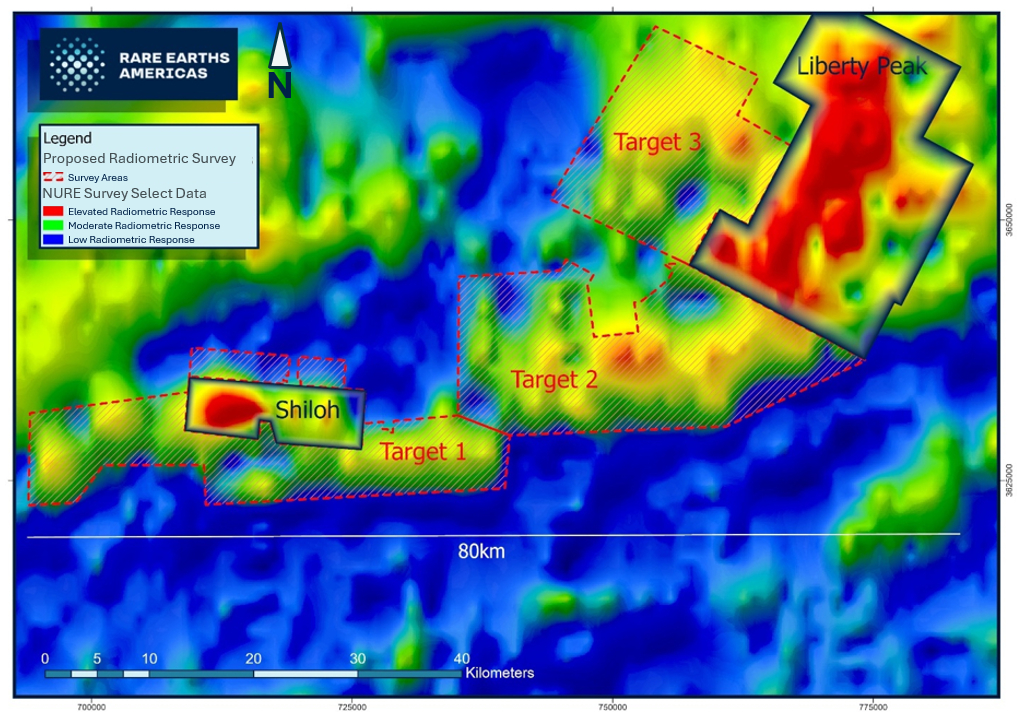
Figure 1 - Foothills Rare Earths District showing survey areas and existing exploration targets. NURE select radiometric data from the National Uranium Resource Evaluation survey. Areas shown include active land positions (defined in the “Strategic Land Expansion Strengthens District-Scale Growth Opportunity” section below) as well as prospective land that remains subject to finalized land and access agreements with REA.
MANCHESTER, Ga.--(BUSINESS WIRE)--Rare Earths Americas, Inc. ("REA" or the "Company") is expanding beyond its flagship Shiloh Project to establish the Foothills Rare Earths District (the “District”), a large and growing exploration district in Georgia, USA. Supported by continued exploration drilling at Shiloh and an increasingly refined geological model, the Company believes the mineralized sands system may extend across multiple properties, including the adjacent Liberty Peak property and three additional high-priority exploration targets (see Figure 1). Collectively, these properties form the Foothills Rare Earths District, which covers an area approximately 17.5 times larger than the original Shiloh target area of over 22,000 acres. Appendix A presents additional drilling information and figures associated with this release.
Figure 1 - Foothills Rare Earths District showing survey areas and existing exploration targets. NURE select radiometric data from the National Uranium Resource Evaluation survey. Areas shown include active land positions (defined in the “Strategic Land Expansion Strengthens District-Scale Growth Opportunity” section below) as well as prospective land that remains subject to finalized land and access agreements with REA.
Foothills Rare Earths District |
Acres | Relative Size to Shiloh (x) |
| Shiloh | 22,000 |
- |
| Liberty Peak | 122,000 |
5.5x |
| Target 1 | 82,000 |
3.7x |
| Target 2 | 111,000 |
5.0x |
| Target 3 | 71,000 |
3.2x |
| Total (Excl. Shiloh) | 386,000 |
17.5x |
| Total (Incl. Shiloh) | 408,000 |
18.5x |
Table 1 - Acreage of respective Foothill Rare Earths District areas. Note: Acreages shown are approximate and are rounded down to the nearest 1,000 acres.
Increasing Confidence in District Scale Potential — As previously released (see here), extensive drilling over the first quarter reinforced the Company’s exploration thesis that a potential for monazite-bearing sands systems across the Shiloh property exists. The Company believes the sands system has district-scale continuity, extending from the Shiloh property into adjacent northeastern areas, including the Liberty Peak property (see Figure 1), thereby establishing the Foothills Rare Earths District.
To strengthen the exploration model, sonic and direct push drilling at the Liberty Peak property commenced late in the first quarter of this year. Initial assays have yielded encouraging results, with mineralized intercepts up to 10 meters wide and multiple holes ending in enrichment, implying mineralization is potentially open at depth.
Early exploration drilling at Liberty Peak, where drilling has intercepted monazite-bearing sands similar to those encountered at Shiloh more than 50 kilometers away, further supports the district-scale potential of the emerging Foothills Rare Earths District (see Figures 2 and 3). The presence of laterally extensive monazite-bearing sand units may be indicative of deposit characteristics that, in some mineral sand operations, can be associated with advantages such as near-surface, free-dig mining conditions and the use of conventional mineral processing and beneficiation methods. However, the extent, continuity, economic significance, and metallurgical characteristics of these sands across the District have not yet been established and remain subject to further drilling, technical studies, and evaluation.
Highlights from initial drilling at Liberty Peak include:
- 26-DPBF-046 with >0.2% total rare earth oxides (TREO) from 0-10m
- 26-DPBF-060 with >0.2% TREO from 3.1 to 4.5m and 6.1-10.3m
- 26-DPWB-033 with >0.3% TREO from 4.5-7.6m and 10.7-11.8m
Figure 2 - Cross section outlining the potential monazite-bearing sands system and drilling completed at Liberty Peak. See Appendix A for map outlining location of the associated drill holes and cross section.
In addition, drilling at Shiloh has continued to deliver promising results consistent with those reported on June 15, 2026, increasing confidence that a broader monazite-bearing sands system exists as the Company advances toward defining a maiden resource.
Highlights from recent drilling at Shiloh include:
- 26-SRLC-020 with 0.95% TREO from 8.6-11.5m
- 26-SRLC-027 with 0.57% TREO from 7.7-9m
- 26-SRLC-039 with 0.93% TREO from 13.4-14.1m
Figure 3 - Cross section outlining the potential monazite-bearing sands system and drilling completed at Shiloh. See Appendix A for map outlining location of the associated drill holes and cross section.
Strategic Land Expansion Strengthens District-Scale Growth Opportunity — As of the end of the second quarter of 2026, the Company’s active land position under Exploration & Development Agreements ("EDAs"), mining leases and option agreements totaled 4,254 acres across the District, representing a 53% increase compared to the first quarter of 2026. In addition, REA has short-term access agreements and exploration agreements for initial assessments of prospective properties; total land position for these agreements totaled over 11,500 acres.
This continued expansion underscores the Company's ongoing land acquisition efforts and growing strategic footprint across the District. REA remains focused on further strengthening its land position as it advances exploration programs, generates new targets, and works to realize the district-scale potential of the Foothills Rare Earths District.
Next Steps — Given the initial promising drilling results, the Company is expanding its 2026 Georgia exploration program to include over 8,000m of sonic and direct push drilling at Liberty Peak. This is in addition to the previously announced 20,000m drill program at Shiloh. Rare Earths Americas will also undertake airborne radiometric surveys, geological mapping, and soil sampling across Target Areas 1–3 (See Figure 1) to further define and advance high-priority drill targets across the District. In total, the Company expects to invest approximately $15 million over 2026 to unlock and define the District's rare earths resource potential. The Company will release additional assay results and exploration updates throughout the third quarter of 2026 and into year-end.
Rare Earths Americas’ CEO, Donald Swartz, commented: “What began as a targeted exploration program at Shiloh is evolving into what we believe could become a significant domestic rare earths district. Encouraging drilling results from both Shiloh and Liberty Peak, combined with our expanding land position, continue to strengthen our district-scale exploration thesis. We are focused on advancing multiple targets across the Foothills Rare Earths District while progressing toward a maiden resource at Shiloh and unlocking the broader potential of this emerging rare earths system.”
About Rare Earths Americas
Rare Earths Americas, Inc. is an exploration stage company advancing a portfolio of critical minerals projects focused on high-grade rare earth mineral assets in the United States and Brazil. REA’s portfolio includes three material projects, which the Company believes positions REA as a future potential cornerstone of non-Chinese rare earth supply, aligning with Western industrial and national security priorities. Rare earths elements are essential for advanced U.S. industries including robotics, electric vehicles, energy, defense, and consumer electronics.
Forward-Looking Statements & Technical Notes
This communication contains forward-looking statements within the meaning of Section 27A of the Securities Act of 1933, as amended, and Section 21E of the Securities Exchange Act of 1934, as amended. When used in this communication, the words “plan,” “target,” “anticipate,” “believe,” “estimate,” “intend,” “potential,” “will” and “expect” and similar expressions are intended to identify such forward-looking statements. Any statements regarding potential future exploration, the presence of a monazite-bearing sands system across multiple properties, that high-grade selective samples may be representative of broader mineralization, that mineralization is potentially open at depth, the possible delineation of a mineral resource, or any subsequent technical or economic studies are forward-looking in nature. There is no certainty that continued exploration will result in the definition of a mineral resource, the amount of investment in drilling in 2026, the meters to be drilled, or that any future development scenario will be realized. These forward-looking statements are based on assumptions and expectations that may not be realized and are inherently subject to numerous risks and uncertainties, which could cause actual results to differ materially from these statements. These risks and uncertainties include, among others: the execution and timing of our planned exploration activities; our use and evaluation of historic data; our ability to achieve our strategic goals; the state of the economy and financial markets generally and the effect on our industry; and the market for our common stock. The foregoing list is not exhaustive. For additional information regarding factors that may cause actual results to differ materially from those indicated in our forward-looking statements, we refer you to the risk factors included in the Company’s Rule 424(b)(4) Prospectus filed on May 7, 2026, which are available at www.sec.gov. We caution investors not to place undue reliance on the forward-looking statements contained in this communication. These statements speak only as of the date of this communication, and we undertake no obligation to update or revise these statements, whether as a result of new information, future events or otherwise, except as may be required by law. We do not give any assurance that we will achieve our expectations.
Quality Assurance & Quality Control
Quality assurance/quality control measures consist of regular insertion of certified reference materials, duplicate samples, and blanks into the sample stream. Samples are submitted to the ALS Geochemistry sample preparation facility in Reno, Nevada, where they are logged, dried, crushed, split, and pulverized (methods CRU-21, CRU-31, LOG-22, LOG-24, SPL-22Y, PUL-31, SND-ALS, WEI-21). Rare earth element and multi-element analyses are performed at the ALS Geochemistry laboratory in North Vancouver, British Columbia, including determination of lanthanum (La), cerium (Ce), praseodymium (Pr), neodymium (Nd), and samarium (Sm) by the OGREE method, multi-element analysis by inductively coupled plasma mass spectrometry and optical emission spectroscopy (ICP-MS and ICP-AES; Methods ME-MS81, ME-MS81h, ME-ICP06, TOT-ICP06), and loss on ignition by gravimetry (OA-GRA05). ALS Minerals is an ISO/IEC 17025:2017 accredited laboratory for select methods and analytes. Assay results are reviewed, and discrepancies are investigated and resolved prior to incorporation of these data into the Company database.
Qualified Person Information
The scientific and technical information contained in this news release has been reviewed and approved by Paul Dockweiler, Senior Geologist with Geosyntec Consultants [CPG-11379/SME Registered Member], a Qualified Person (QP) as defined by US Securities and Exchange Commission SEC Regulation S‑K 1300. The scientific and technical information in this press release has been reviewed and approved by Paul Dockweiler, CPG, a “Qualified Person” as defined under Regulation S‑K 1300. Mr. Dockweiler’s review was limited to the geological and technical information presented, which remains subject to verification and refinement as additional data becomes available. The Qualified Person has performed verification procedures considered appropriate; aspects of the underlying data remain subject to ongoing analytical refinement and validation.
Appendix A
Figure 4 - Drill hole and cross section location associated with Figure 2
Figure 5 - Drill hole and cross section location associated with Figure 3
Note: for additional drilling information associated with this release, see the Supplemental Technical Data section of the REA investor website.
Appendix B
What are Rare Earths?
Rare earth elements are a group of 17 specialty metals critical to a wide range of advanced and everyday technologies. They are used in high-performance permanent magnets, particularly neodymium-iron-boron (NdFeB) magnets, which enable high strength and efficiency in applications such as robotics, electric vehicles, defense systems, wind turbines, and consumer electronics. In simple terms, motion generated by electricity is often powered by NdFeB magnets, making rare earths essential inputs in everyday items, from the motor that raises and lowers a car window to the motors used in drones and humanoid robots.
Of the 17 rare earth elements, neodymium (Nd), praseodymium (Pr), dysprosium (Dy), and terbium (Tb) are the key materials used in high-performance permanent magnets. Dy and Tb are particularly valuable due to their ability to enhance magnet performance at high temperatures.
According to Adamas Intelligence, China accounts for over 90% of global Dy and Tb production. This concentration has increased the strategic importance of developing new rare earth projects in other jurisdictions to support supply chain diversification and long-term demand growth.
Contacts