Ten Finalists Announced for the Reply AI Film Festival, the International Competition Bringing Together Cinema and Artificial Intelligence
Ten Finalists Announced for the Reply AI Film Festival, the International Competition Bringing Together Cinema and Artificial Intelligence
The jury, chaired by Gabriele Salvatores, will announce the winners in Venice on Sunday, 6 September.
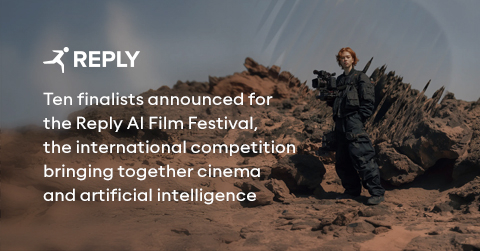
TURIN, Italy--(BUSINESS WIRE)--The Reply AI Film Festival returns for its third edition, reaffirming its role as a meeting point for cinema, creativity and artificial intelligence. The international competition created by Reply – open to creatives experimenting with new AI technologies and tools in the production of short films – has announced its ten finalists.
The festival will take place in Venice during the days of the 83rd Venice International Film Festival of La Biennale di Venezia. Selected from more than 3,000 short films submitted from 76 countries, the finalist works will take centre stage at the awards ceremony organised by Reply and Mastercard, scheduled for Sunday, 6 September, at the Match Point Arena, set up at Tennis Club Venezia on the Lido. The event will be dedicated to new forms of cinematic storytelling, bringing together emerging talent, technological experimentation and creative visions.
The winners will be selected by an international jury chaired by Oscar®-winning director Gabriele Salvatores and comprising Rob Minkoff (co-director of The Lion King and animator and filmmaker), Catherine Hardwicke (director of the global phenomenon Twilight), Jed Weintrob (director and partner at 30 Ninjas), Giacomo Mineo (VFX supervisor for major productions including Christopher Nolan’s Oppenheimer and The Odyssey), Jacopo Reale (winner of RAIFF 2025), Christina Lee Storm (film producer, former executive at DreamWorks Animation and Netflix, and Head of Studio, Narrative at Secret Level), Nils Hartmann (producer of television series including Gomorrah, The Young Pope and ZeroZeroZero), Brian Welk (film journalist and IndieWire reporter), Denise Negri (film journalist at Sky Italia), Filippo Rizzante (Chief Technology Officer of Reply), and Guillem Martinez Roura (AI & Robotics Lead at ITU’s “AI for Good”, the United Nations initiative focused on harnessing AI to improve society).
Alongside the award for Best Short Film, the jury will present two special awards recognising works that stand out for their impact and experimentation. The AI for Good Award, promoted in collaboration with the International Telecommunication Union (ITU), will honour the short film that most effectively interprets the United Nations Sustainable Development Goals (SDGs). The Reply AI Studios Grand Prix will be awarded to the project demonstrating the highest levels of innovation and excellence in the use of artificial intelligence throughout the creative process.
The ten finalist short films stood out for their interpretation of the theme of the 2026 edition, “Imaginatio Nova”, exploring a new phase of imagination in which human creativity and technology come together to create new languages and visions. The works were selected based on their creativity, production quality and use of artificial intelligence across the different stages of the filmmaking process, from screenwriting to post-production.
The ten finalists are:
A Face Only A Mother Could Love, by Robert Gaudette, AI filmmaker and director (Canada)
The story follows Marcel, a solitary Parisian dancer who is firmly convinced of his own beauty. His secluded life changes when a woman who has secretly watched him for years finally decides to approach him in a park, sparking a profound connection. Using Grok, Nano Banana and Seedance, AI offered the only viable way to bring the screenplay to life visually, despite having no budget, cast or crew.
Centenarian Kindergarten, by 2xLabs, a creative studio and collective of visual artists (China)
In a dystopian future set in 2090, where births have ceased, four centenarians escape from a sterile facility in which AI assistants enforce compulsory happiness, in an attempt to reclaim their human imperfections. With Nano Banana Pro and Jimeng SeedAce 2.0, AI removed financial barriers, making it possible to reproduce aged skin with remarkable precision in synthetic environments without expensive futuristic sets or complex prosthetic make-up.
GO HOME, by Simone Paradiso, AI filmmaker and director (Italy)
In New York in 1999, four teenagers discover a hidden military bunker, setting off on a science-fiction adventure involving mystery, fear and an enigmatic connection with a solitary girl in the group. Using Higgsfield Soul Cinema, GPT Image 2.0 and Seedance 2.0, AI removed physical and financial barriers, enabling a small crew to recreate complex 1990s settings and vast underground military structures, while also accelerating the creative development and revision process.
Kev, by Mike Bennion, director (United Kingdom)
The short film offers an intimate exploration of Kev’s personal experience of blindness, highlighting the people, relationships and aspects of everyday life that matter most to him. Using Midjourney, Nano Banana, Kling, Veo 3 and ElevenLabs, AI was essential in overcoming otherwise insurmountable financial barriers and creating a deeply personal film that would have been too costly and complex to produce using traditional tools.
Le Drip, by Alex Naghavi and Ezra Li, visual artists and directors (Australia and the United States)
This animated short, with its painterly aesthetic, depicts the last day on Earth through living oil paintings animated by dense, textured brushstrokes in motion, exploring human emotion. Produced primarily with Flora, alongside Nano Banana, Claude, Seedance and Runway, the project used AI to create complex painterly animation in considerably less time than a single artist would have required, making this distinctive visual style accessible to independent filmmakers.
Little Mes, by Salad Collective, a creative studio and collective of directors (Spain)
An inner monologue contemplates the many parallel and possible lives of a character, all coexisting at the same moment, exploring the tension between the life actually lived and the paths left open. Developed using Kling, Veo 3.1, Seedance and Suno, the project adopted AI as its central medium, enabling a continuous process of experimentation to explore new forms of storytelling that would be difficult to achieve through traditional production models.
Once Upon a Time on the Dnieper River, by Yi Wang, director (China)
Set in 2026 against the backdrop of the Russian-Ukrainian front, the story follows a soldier stranded on the banks of the Dnieper River who is entrusted with a particularly sensitive and dangerous mission. Using Nano Banana for image generation, together with Dreamina and Vidu for video, AI made it possible to create complex scenes of contemporary warfare and nuanced dialogue that would have been impossible to film given severe resource constraints.
Passenger, by Yuanbo Song, AI filmmaker and director (China)
Mira, a tsunami survivor, restores her parents’ sculptures, but a mysterious intruder destroys them shortly before a devastating earthquake. Only later does she discover that he was actually trying to save her. Using Runway Gen 4.5, Higgsfield, Seedance 2.0 and Kling 3.0, AI enabled large-scale disaster scenes and ruined urban landscapes to be created efficiently, significantly reducing time and costs compared with traditional special-effects and CGI processes.
The Child of the Sea, by Ibai Abad, stop-motion artist and director (Spain)
A fish-boy embarks on a journey across 17th-century Spain to reunite with his mother, facing ridicule and fear. The film explores themes of diversity, belonging and acceptance. Through a hybrid workflow using Magnific and editing guided by human input, AI acted as a production assistant, making it possible to create a vast, tactile stop-motion universe that would have been financially and technically unfeasible using traditional physical methods.
Website, by Jiaze Li, interactive media artist and director (China)
A speculative science-fiction film exploring a platform capable of broadcasting impossible events from other worlds, where the very act of observation actively alters reality and influences culture. Using Veo 3, Runway, Kling and Seedance 2, alongside the development of an interactive web experience, AI enabled rapid creative iteration, expanding the production process and making it possible to create an immersive narrative experience that would be difficult to realise with traditional tools.
This year, the public is also invited to join the jury: until 1 September, viewers can watch the ten finalist short films on aiff.reply.com and WeShort and vote for their favourite, helping to determine the winner of the Community Award, presented in collaboration with WeShort.
This initiative is part of Reply Challenges, a programme of technology and creative competitions that reflects Reply’s commitment to developing innovative learning models capable of engaging younger generations. Today, the Reply Challenges community is comprised of almost 250,000 participants worldwide.
Sky Italia will be the media partner of the Reply AI Film Festival, a collaboration that further strengthens the initiative’s positioning within the media and entertainment landscape.
Reply
Reply [EXM, STAR: REY, ISIN: IT0005282865] specialises in the design and implementation of solutions based on new communication channels and digital media. As a network of highly specialised companies, Reply supports major industrial groups in the telecom and media; industry and services; banking and insurance and public sectors in defining and developing business models enabled by the new paradigms of AI, cloud computing, digital media and the internet of things. Reply's services include: consulting, system integration and digital services. www.reply.com
Contacts
Media Contact:
Reply
Fabio Zappelli
f.zappelli@reply.com
Tel. +390117711594
Irene Caia
i.caia@reply.com
Tel. +39 02 535761