Robot safety is now 3D: Sonair unveils world's first safety-certified 3D ultrasonic sensor for human-robot collaboration
Robot safety is now 3D: Sonair unveils world's first safety-certified 3D ultrasonic sensor for human-robot collaboration
The ADAR One sensor is now suitable for SIL2 and PL d applications and is certified to fulfil all requirements of the European machine directive as a sensor for the safe detection of humans and objects.
OSLO, Norway--(BUSINESS WIRE)--While the AI boom has made robots significantly more capable, the accompanying safety infrastructure has struggled to keep pace. Traditional 2D laser scanners, which are widely used to define safety perimeters for most mobile robotic systems, are unable to detect people and obstacles above or below a single plane.
"The bottleneck to safe human-robot coexistence isn't intelligence or speed. It's safe perception; knowing reliably under any condition, that a human is nearby." Knut Sandven, CEO of Sonair.
Share
"The bottleneck to safe human-robot coexistence isn't intelligence or speed,” said Knut Sandven, CEO of Sonair. “It's safe perception; knowing reliably under any condition, that a human is nearby. This milestone certification is the first time a 3D sensor has been independently verified to meet that bar using sound instead of light - a new sensing modality that complements cameras where they fall short.”
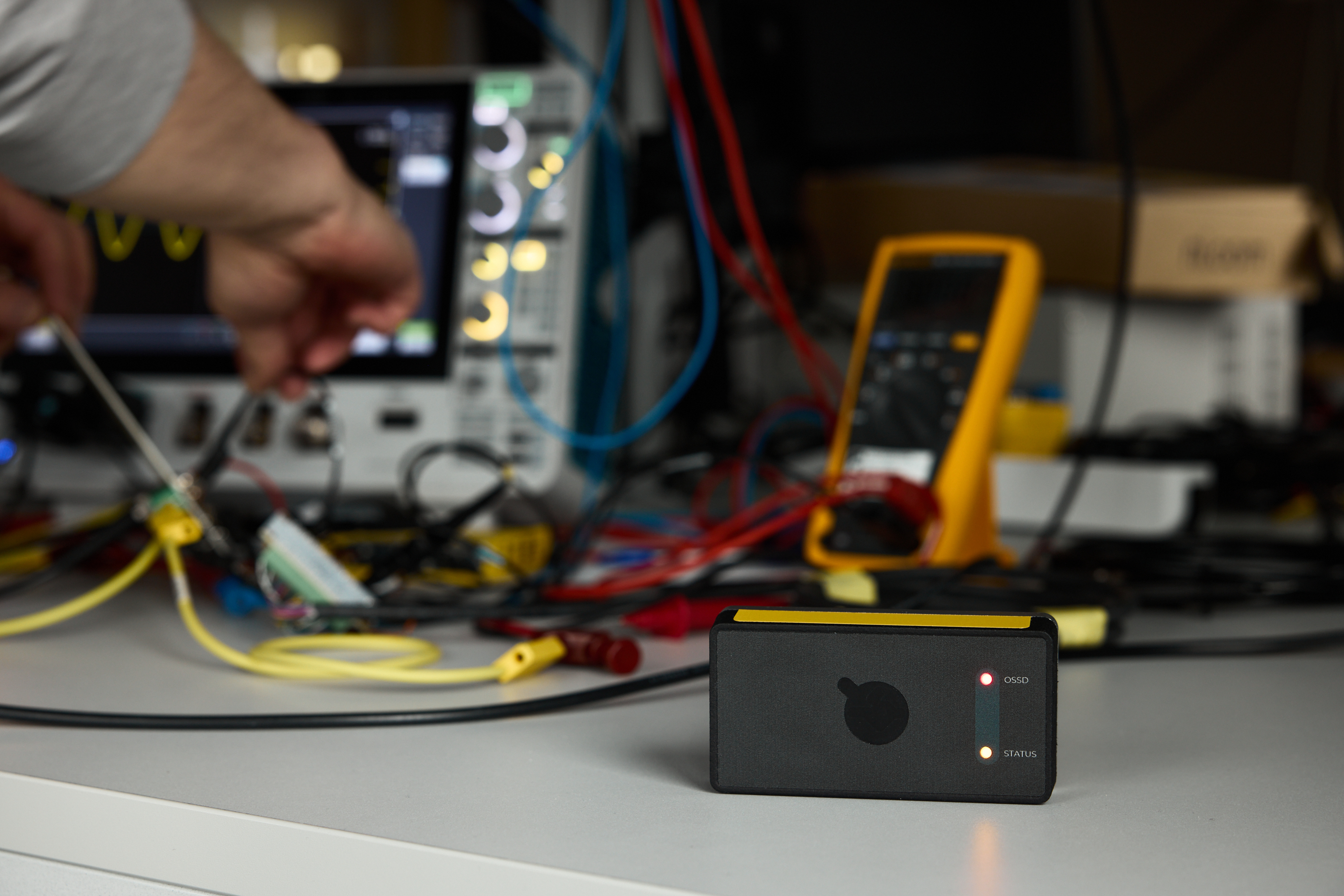
Designed for autonomous mobile robots and industrial automation, ADAR One delivers 180°×180° 3D spatial awareness, detecting people and obstacles at all heights, eliminating the limitations and blind spots that define today's 2D safety systems. Easy integration with a tiny footprint enables ADAR (acoustic detection and ranging) technology to be embedded flush into virtually any robot form factor, including humanoids.
“ADAR One does not merely replace a sensor. It introduces a new safety layer for robotics, a certified 3D perceptual foundation that sits beneath any camera, AI stack, or motion system, independently verifying that the space around a robot is safe,” said Knut Sandven.
ADAR One is already in series production and shipping on deployed industrial robots. Since the introduction of the beta version of ADAR one year ago, more than 80 global robotics companies have rigorously evaluated ADAR through Sonair's test program within. For many, safety certification is the moment they have been waiting for.
beRobox, a leader in plug-and-play palletizing and de-palletizing solutions, has entered into an agreement with Sonair to deploy the safety-certified ADAR One sensor in future solutions. The agreement marks certified 3D safety arriving in one of industrial automation's highest throughput use cases, where machines and people share the tightest spaces.
"At beRobox, innovation is not just about developing new products. It's about continuously integrating the best technologies available to simplify automation for our customers. Partnering with Sonair is another step in our mission to stay ahead through innovation and deliver the most advanced, user-friendly palletizing and de-palletizing solutions on the market,” said David Demers, CEO of beRobox
The certification
ADAR One was assessed as a human protection sensor according to the very demanding IEC 61496 standard for electrosensitive protection devices. In addition, the product meets two foundational standards: IEC 61508, the functional safety standard for electronic safety systems in high-risk industrial environments, and ISO 13849, the universal standard for safety-related parts of control systems.
The result: ADAR is rated SIL 2, (Safety Integrity Level 2) and PL d (Performance Level d) with a probability of dangerous failure (PFH) below 1.5 x 10⁻7 per hour.
ADAR has received an EC type-examination certificate from exida, a notified body under the Machinery Directive 2006/42/EC. In addition to the above-mentioned standards, exida has assessed ADAR’s conformity to the essential health and safety requirements from the European machine directive.
Furthermore, ADAR is the first safety-certified embedded system to be built in Rust, a programming language especially designed for performance, safety, and reliability.
What this means for robot manufacturers, system integrators, and end users
- Industrial autonomous robot OEMs: 2D LiDAR systems dominate the safety function, but at high cost and complexity. With ADAR One, robot manufacturers can bring certified safety to 3D and move quickly to market with a more effective, lower cost solution.
- Systems integrators: Can now deploy the plug-and-play ADAR One in AMRs (Autonomous Mobile Robots), AGVs (Automated Guided Vehicles), and collaborative robot architectures without seeking special exemptions.
- Humanoid OEMs: ADAR One's compact form factor means it can be embedded directly into a humanoid's body shell without significant redesign of the underlying structure. It provides the certified perception backstop that no camera-and-AI stack currently offers, in full 3D.
- End users: Warehouse and logistics providers can deploy robots in certified safety architectures that are recognized by insurance and liability frameworks. ADAR One means improved productivity, more uptime, fewer incidents, and greater trust.
“This is precisely the role ADAR One is designed to play as a drop-in, pre-certified safety layer,” said Sandven. “What used to be an engineering burden is now transformed into a commercial differentiator for all stakeholders.”
Availability
ADAR One, the safety-certified variant designed for autonomous robots and machine safety applications requiring SIL 2, PL d compliance, is available now. Get ADAR One.
Media resources (images, illustrations, and more): Here
Embed product video: Here
About Sonair
Sonair develops 3D ultrasonic sensing technology for robotics and autonomous machines. The company’s patented, award-winning ADAR (acoustic detection and ranging) technology uses MEMS-based ultrasonic transducer arrays to detect objects and people in true three-dimensional space. Sonair’s mission is to make robot safety simple, scalable, and reliable as automation expands into human environments. The company is headquartered in Oslo, Norway. www.sonair.com
Industry data:
- According to QNX’s 2026 benchmark report “Inside the Robot” surveying 1,000 robotics developers, 90% of robotics developers say physical AI is critical to their strategy, but only 29% feel very confident that physical AI systems can make safe, predictable decisions in real-world environments.
- As reported by the QNX survey, 66% of robotics developers experience project delays caused by industry-specific certification requirements. The report ’s recommended countermeasure is to use certified, safety-critical components to cut certification timelines and integration risks.
Contacts
Media contact:
Mette McCall, McCall Media
mette@mccallmedia.net