U.S. Bank Survey Finds Gen Z Small Business Owners Are Making Bigger Bets to Drive Growth
U.S. Bank Survey Finds Gen Z Small Business Owners Are Making Bigger Bets to Drive Growth
- Gen Z Momentum: Gen Z owners are nearly twice as likely as Gen X and Baby Boomer owners to make bigger bets on growth, while also reporting stronger business performance
- Growth Continues, But Less Widespread: Many small businesses are still expanding, though fewer are doing so as economic pressures persist
- AI Adoption Gap: Businesses adopting generative AI and digital tools are more likely to be in a growth phase
MINNEAPOLIS--(BUSINESS WIRE)--U.S. Bank released its fourth annual Small Business Perspective survey report today, highlighting how small business owners are navigating a more constrained environment, and how a new generation is building businesses differently. The nationwide survey of 1,000 small business owners, including an oversample of 200 Gen Z owners, shows that while many small businesses are still expanding, fewer are growing than a year ago amid ongoing economic pressures and rising costs.
“Growth may not be as widespread as it was a year ago, but small business owners are not pulling back,” said Shruti Patel, Chief Product Officer for Business Banking at U.S. Bank.
Share
“Growth may not be as widespread as it was a year ago, but small business owners are not pulling back. In fact, 91% of owners are planning at least one move to grow their business over the next year,” said Shruti Patel, Chief Product Officer for Business Banking, U.S. Bank. “That speaks to the resilience of this community and their determination to keep building for the future. In particular, Gen Z owners stand out as showing a greater willingness to invest in growth, even amid economic uncertainty.”
Gen Z Owners Take a More Ambitious Approach to Growth
With more than half of U.S. business owners over the age of 55, Gen Z owners are becoming an increasingly important part of the next generation of business ownership. In a more challenging economic environment, they are also approaching growth differently than past generations.
Compared to older generations, Gen Z owners are more willing to pursue calculated, bold opportunities to accelerate expansion (24% vs. 21% of Millennial owners and 13% of Gen X and Baby Boomer owners). Those efforts appear to be paying off, with nearly three-quarters (74%) reporting business growth over the past year, and almost half (47%) reporting significant growth, higher than all other generations.
That different approach to growth also shows up in how Gen Z owners are building their businesses. They are more likely to start businesses through passion projects (63%) or side hustles (49%), rather than acquiring existing companies.
However, this path often comes with tradeoffs. Gen Z owners are more likely to delay major life milestones, such as buying a home (30%), having children (25%) or getting married (21%), to focus on building their business.
It also comes with financial pressure. Roughly four in ten (38%) report annual revenue under $100K, and 87% say a three-month decline in revenue would impact their personal finances. This reflects both the opportunity and the pressure that come with building a business from the ground up.
Growth Continues, But Feels Harder Won
Small business owners are operating in a more challenging environment, as macroeconomic pressures, rising costs and shifting demand continue to impact day-to-day operations. Owners across generations report ongoing strain from the economic environment (90%), inflation and rising costs (88%), competition (82%), and access to capital (71%).
Despite these stressors, most owners still rate their businesses as successful, though success and growth have softened from last year:
- 87% of owners say their business is successful, down from 96% in 2025
- 68% report business growth, down from 88% last year
- 83% feel optimistic about the next 12 months, down from 93%
Even with this shift, most owners are not pulling back. Instead, they are continuing to invest in their businesses:
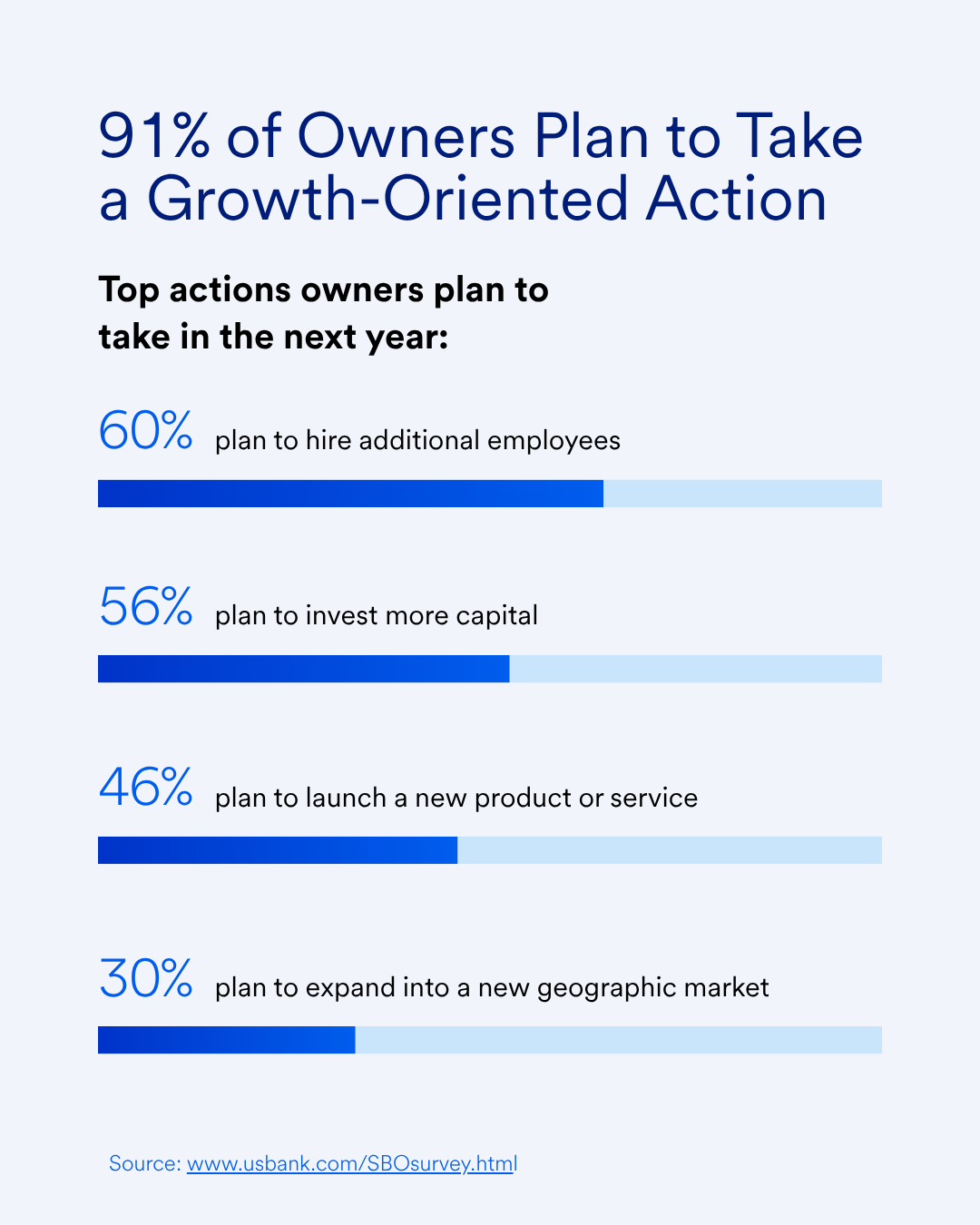
- 91% plan at least one growth-oriented action
- 60% plan to hire additional employees
- 56% plan to invest more capital
- 46% plan to launch new products or services
And few owners are stepping away from their businesses, with only 3% saying they plan to sell in the next year.
At the same time, this environment is not affecting all businesses equally. Businesses experiencing growth are less likely to report pressure related to the economic environment (88% vs. 94% among non-growing businesses), consumer spending (75% vs. 85%) and access to capital (67% vs. 80%), and are more likely to adopt generative AI (81% vs. 64% among non-growing businesses).
AI Adoption Continues to Rise
Generative AI adoption continues to grow, with 75% of owners now using it in their business. Owners most often apply AI to marketing and sales (56%), data analysis (51%), content creation (51%) and automation (44%).
For many, these tools are delivering real value:
- 98% say AI has had a positive impact
- 89% say it delivers measurable value
- 84% say it saves money
However, adoption is not universal, and experiences remain mixed. One in four owners (25%) are not using AI at all, citing lack of relevance, unclear return on investment and trust concerns. Even among users, 53% say AI has also had negative impacts, including added complexity and overstated benefits.
Owners Prioritize Predictability, Value and Simplicity
Beyond AI, small business owners are modernizing their operations with a focus on efficiency and reduction of day-to-day friction. Adoption of key tools is rising, including payment processing (60%), digital payments (53%) and accounts payable/receivable solutions (53%).
As they choose which tools to use, cost predictability plays a key role in decision-making:
- 92% prefer tools with consistent, predictable fees
- 78% say fees influence how they pay bills
- 65% say fees are a major frustration
Still, 83% say they are willing to pay fees in exchange for convenience and value.
Owners are also clear about what they expect from financial partners, prioritizing human support (91%), mobile access (90%), and fraud protection (88%) as essential rather than optional.
Looking ahead, many owners are also preparing for emerging forms of digital currency. Of those who do not currently accept digital currency, over half (53%) say they are likely to accept digital currency (e.g. cryptocurrency, stablecoins, tokenized deposits) in the next five years, though only 28% currently accept it as a form of online payment.
Methodology
20-minute survey among 1,000 U.S. small business Owners and an oversample of 200 Gen Z small business Owners, with an annual revenue of $25 Million or less and between two and ninety-nine employees.
Fielding for this study was conducted from February 27, 2026 – March 17, 2026, and the margin of error is ±3.1% for the U.S. SBOs.
2026 data were weighted to match the 2025 sample distribution for year-over-year comparisons. Results for the Gen Z oversample are shown unweighted.
About U.S. Bank
Headquartered in Minneapolis, U.S. Bancorp is the parent company of U.S. Bank National Association, the fifth-largest commercial bank in the United States. Our three major business lines serve 15 million clients globally, and our team of nearly 70,000 people invest our hearts and minds to power human potential every day. Ranked 110th on the Fortune 500, we are deeply respected for our culture and long-term stewardship and admired for our diversified business mix and product capabilities.
Contacts
Media Contacts:
Rick Rothacker, U.S. Bank Public Affairs & Communications
richard.rothacker@usbank.com
Erin Conroy, U.S. Bank Public Affairs & Communications
erin.conroy@usbank.com