Paul Smith’s College AWI Reaches New Milestones in Water Protection and Environmental Stewardship
Paul Smith’s College AWI Reaches New Milestones in Water Protection and Environmental Stewardship
The institute’s growing impact includes advancing long-term lake research and leading one of the region’s largest efforts to prevent the spread of invasive species.

PAUL SMITHS, N.Y.--(BUSINESS WIRE)--Paul Smith’s College today announced an expanded momentum and impact of its Adirondack Watershed Institute (AWI), celebrating its nearly 30 years of continuous lake monitoring and data collection, new grant awards, designation as one of the first in New York State to deliver Lake Wise, and a successful boat stewardship program to prevent the spread of invasive species.
As the only watershed organization covering the entire Adirondack Park and home of the only state-certified water quality lab in the park, AWI has a uniquely comprehensive perspective on these lands, communities, and waters. The Adirondacks sit at the center of the Great Lakes, St. Lawrence River, Lake Champlain, Mohawk River, and Hudson River watersheds, which provide drinking water for millions of people in New York and Canada. This connection of watershed protection in the Adirondacks to drinking water and public health downstream makes AWI’s work crucial.
“Protecting Adirondack waters ultimately protects water systems far beyond the Adirondacks, making our work relevant to communities across New York and beyond,” said Maureen Cunningham, Executive Director of AWI at Paul Smith's College.
The institute’s Adirondack Lake Assessment Program (ALAP) plays a key role in maintaining lake water quality in partnership with Protect the Adirondacks. ALAP’s continuous lake monitoring and environmental data collection have provided one of the region’s longest-running freshwater datasets and largest community science lake monitoring programs for 29 years. The data ALAP collects has become foundational for identifying how Adirondack lakes are responding to major stressors, including nutrient pollution, acid rain, road salt, and climate change.
“That data doesn’t just sit on a shelf; it directly helps lake associations and local communities address threats, secure grants, combat invasive species, and make informed decisions that protect Adirondack waters for future generations,” continued Cunningham. “The research AWI does in the Adirondacks on road salt, for example, can also help other areas of the state that are just beginning to see the impacts of road salt on drinking water sources and other critical waterbodies, including monitoring potential lake recovery once best practices are implemented.”
This impactful work has resulted in several recent funding wins for AWI, including recent grant awards from Overhills Foundation that support water quality research and monitoring and from the Lake Champlain Basin Program (LCBP)/NEIWPCC with funding from the Environmental Protection Agency that support building a durable framework for data growth and management and extending an LCBP program from Vermont called Lake Wise into New York State. AWI also has multiyear contracts with the New York State Department of Environmental Conservation (DEC) to run a boat stewardship program and the New York State Energy Research and Development Authority (NYSERDA) to collect data for the Adirondack Long Term Monitoring (ALTM) Program. AWI's research and monitoring also receives state support through the Environmental Protection Fund (EPF), including in the recently enacted FY26-27 budget.
Following its LCBP Lake Wise award earlier this year and building on its successful Stream Wise implementation in past years, AWI is one of the first to deliver Lake Wise in New York State — an initiative offering technical assistance to lakeshore property owners to establish a culture of lake-friendly land management practices that protect water quality, reduce erosion and flooding, and enhance wildlife habitat. This work builds on AWI’s strong partnerships with the Upper Saranac Foundation, Adirondack Lakes Alliance, and other lake associations across the region to better protect water health.
“Paul Smith's College AWI’s work will engage private land owners and support efforts to implement best practices that will reduce runoff, support native species, and protect lake and stream health," said Eric Howe, NEIWPCC/LCBP Director.
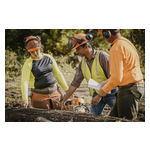
AWI’s boat stewardship program continued to expand its impact in recent years, serving as one of the frontlines of defense against aquatic invasive species. Through contracts with the DEC and the LCBP, the program works to protect the region’s lakes, ponds, and waterways by inspecting and decontaminating boats and preventing the spread of harmful invasive species before they enter Adirondack waters. During the 2025 season, AWI stewards inspected more than 83,300 boats, which is a 10% increase from 2024, and performed 3,820 decontaminations, stopping invasive species at the gate.
AWI’s work connects watershed protection to people, because long-term protection only works when more people are involved. AWI’s Research Director Dr. Michale Glennon leads a shoreline biodiversity research project, helping private landowners learn about the wildlife that share their shorelines and how best to protect wildlife habitat. She also leads Wool and Water, AWI’s collaborative data art project which uses fiber art to tell the stories of regional waterways and inspire their stewardship.
“Together, all of these efforts represent an important investment in the long-term protection of Adirondack waters,” Cunningham said. “AWI is uniquely positioned through Paul Smith's College and an on-site, state-certified water quality lab to combine scientific research, student engagement, community partnerships, and environmental stewardship in ways that strengthen the ecological health, resilience, and future of the Adirondacks and the communities that depend on these waters.”
Additional Resources
- Paul Smith’s College’s AWI Completes Successful Season Protecting Region’s Waters
- Maureen Cunningham New Executive Director of Paul Smith’s College AWI
- How’s my (Lake) Water? A New Report on the Adirondack Lake Assessment Program Helps Answer That Question
About Paul Smith’s College
At Paul Smith’s College, it’s about the experience. As the only four-year college located in the Adirondack Park in upstate New York, Paul Smith’s provides real-world, hands-on learning in fields such as business and hospitality, culinary management, forestry, environmental sciences and natural resources. We are able to draw on industries and resources available in our own backyard while preparing students for successful careers anywhere. Our community of resourceful, enterprising, supportive and adventurous individuals collectively provide experiential education, student support in the classroom and beyond and meaningful opportunities for our alumni. We pride ourselves on research and advocacy on issues that improve our planet and the lives of the people who inhabit it. Learn more at paulsmiths.edu
The mission of the Adirondack Watershed Institute is to protect clean water, conserve habitat, and support the health and well-being of the people in the Adirondacks through scientific inquiry, stewardship, and real-world experiences. Learn more at: www.adkwatershed.org
Contacts
Media Contact
Sara Delacruz
PRforPaulSmiths@bospar.com