PolyJoule unveils 3rd-generation, self-extinguishing, conductive polymer chemistry for battery energy storage systems
PolyJoule unveils 3rd-generation, self-extinguishing, conductive polymer chemistry for battery energy storage systems
New large-format prismatic cell introduces higher-density cathode chemistry and self-extinguishing electrolyte, purpose-built for environments where lithium-ion batteries cannot go.
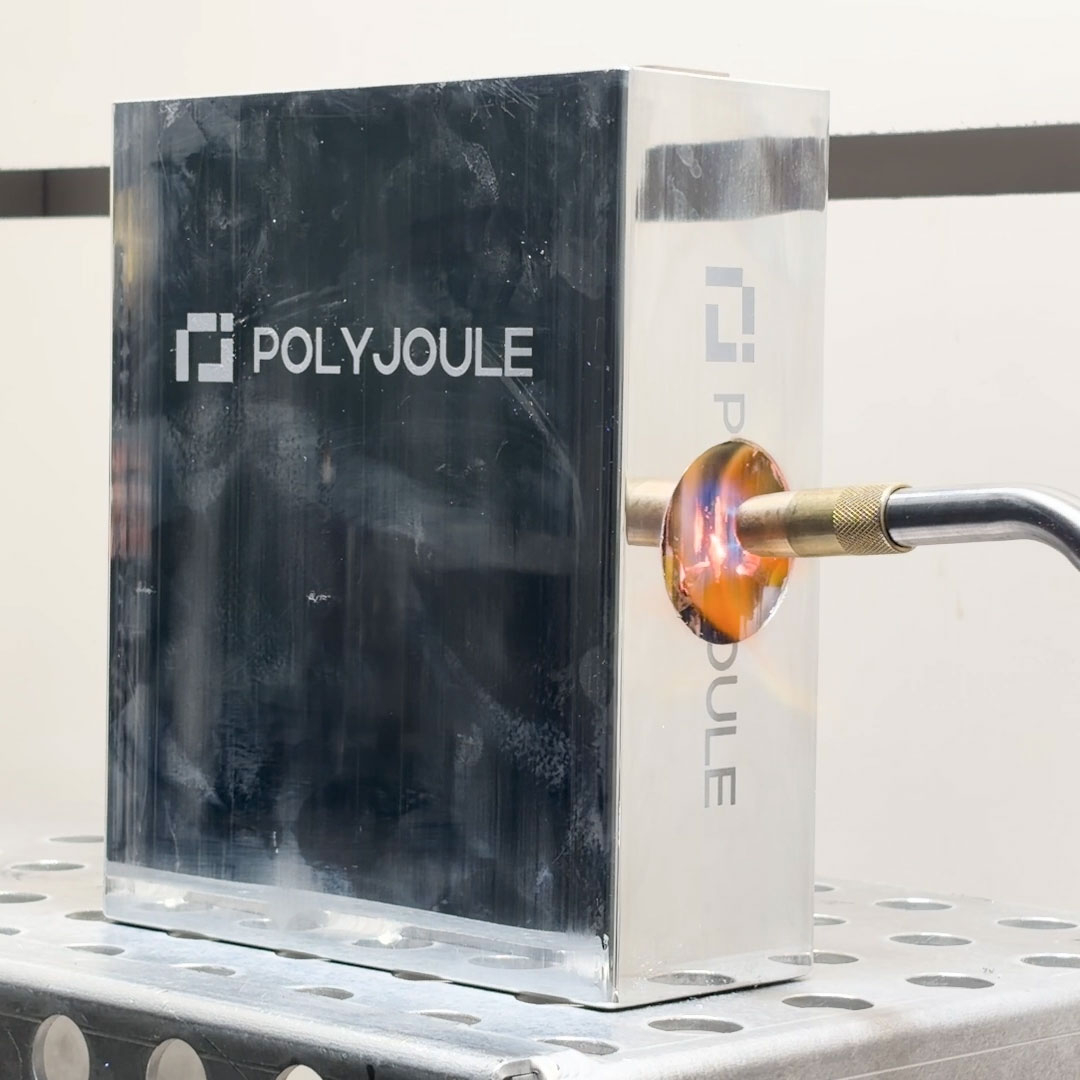
PolyJoule third-generation chemistry tested under extreme thermal conditions. DO NOT ATTEMPT TO REPLICATE, IMITATE, RECREATE, SIMULATE, OR OTHERWISE REPRODUCE ANY PORTION OF THIS VIDEO, IN WHOLE OR IN PART, BY ANY MEANS UNDER ANY CIRCUMSTANCES. The demonstration was conducted by qualified personnel using specialized equipment, protective measures, and safety protocols in a controlled laboratory environment. The cell tested is PolyJoule's proprietary, non-lithium third-generation conductive polymer cell chemistry, which differs materially from commercially available batteries. Applying an open flame, spark, electrical current, mechanical force, or any other heat or energy source to a battery—particularly, but not limited to, a lithium-ion or other commercially available battery—may cause thermal runaway, fire, explosion, rupture, projectile hazards, the release of toxic, corrosive, or flammable gases or substances, property damage, environmental harm, severe personal injury, or death.
BILLERICA, Mass.--(BUSINESS WIRE)--PolyJoule, Inc., a pioneer in conductive polymer batteries, today announced the release of its third-generation battery chemistry, designed to self-extinguish. The energy storage technology, spun out from MIT, is based on a new proprietary chemistry developed by PolyJoule that includes a new conductive polymer cathode and a liquid salt electrolyte.
The third-generation chemistry addresses the biggest problems that energy developers and buyers have with lithium-ion batteries: safety, complexity, and a foreign supply chain.
PolyJoule’s fire safety, ability to handle high temperatures without thermal management, and domestic supply chain all help unlock the transition to a more reliable energy supply and more flexible power grid. The energy storage industry needs to find simple solutions to these complex problems.
“PolyJoule has always been at the forefront of energy storage safety,” says Eli Paster, PolyJoule’s co-founder and CEO. “We were the first company in the world to prove through UL 9540A testing that our conductive polymer cells do not go into thermal runaway. We approached this next-gen chemistry with a very simple thesis: Batteries shouldn’t start fires. Batteries shouldn’t spread fires. Batteries shouldn’t catch on fire.”
Every commercial battery chemistry in use today, including lithium-ion, lead-acid, nickel, and emerging sodium-ion, relies on metals as the active charge-storing component. Conductive polymers store charge through a different mechanism, holding charge along an organic backbone rather than within a crystalline lattice. For PolyJoule, this translates directly into longer cycle life, no dendrite formation, and fundamentally safer operation.
The self-extinguishing capabilities of the third-generation chemistry are demonstrated in a new video provided by PolyJoule, using a full-size cell tested under extreme thermal conditions. A propane blowtorch delivered a nearly 3600°F (1982°C) flame for an extended period to the cell's internal components: anode, cathode, separator, and electrolyte. Heat and gas generated from the test are visible. The moment the blowtorch is turned off, the flames self-extinguish.
“Materials that have a propensity to catch fire often contain reactive metals that spontaneously react with air and volatile liquids,” says Timothy Swager, the John D. MacArthur Professor of Chemistry at the Massachusetts Institute of Technology and a co-founder of PolyJoule who serves as a technical advisor to the company.
“The advantage of PolyJoule’s batteries is that they have neither,” Swager said. “PolyJoule has created a product that can safely be put inside homes and businesses, using non-flammable conducting polymers and a liquid salt electrolyte that has a vapor pressure a billion times lower than that of the electrolytes used in Li-ion batteries.”
This third-generation chemistry is part of PolyJoule's push into markets where safety is a requirement, not a feature. It also unlocks a 10x improvement in energy density over the first generation, while still achieving more than 10,000 cycles. PolyJoule’s cells do not require any active thermal management, simplifying system design and operation. The company’s domestic supply chain streamlines the procurement process.
PolyJoule will begin accepting applications from qualified solar, battery, and generator installers in select markets later this year, offering energy storage systems for the commercial, industrial, and residential segments.
About PolyJoule
PolyJoule is a Boston-based, MIT spinoff pioneering conductive polymer battery technology built from non-metallic, rare-earth-free, domestic supply chains. The company develops ultra-safe, sustainable, long-life energy storage systems. PolyJoule’s polymer battery systems are designed and produced in the U.S. For more information, visit www.polyjoule.com and follow PolyJoule on LinkedIn.