A Quieter World for Quantum: Argonne Demonstrates Ultra-Low Noise Levels of an Innovative Qubit Platform
A Quieter World for Quantum: Argonne Demonstrates Ultra-Low Noise Levels of an Innovative Qubit Platform
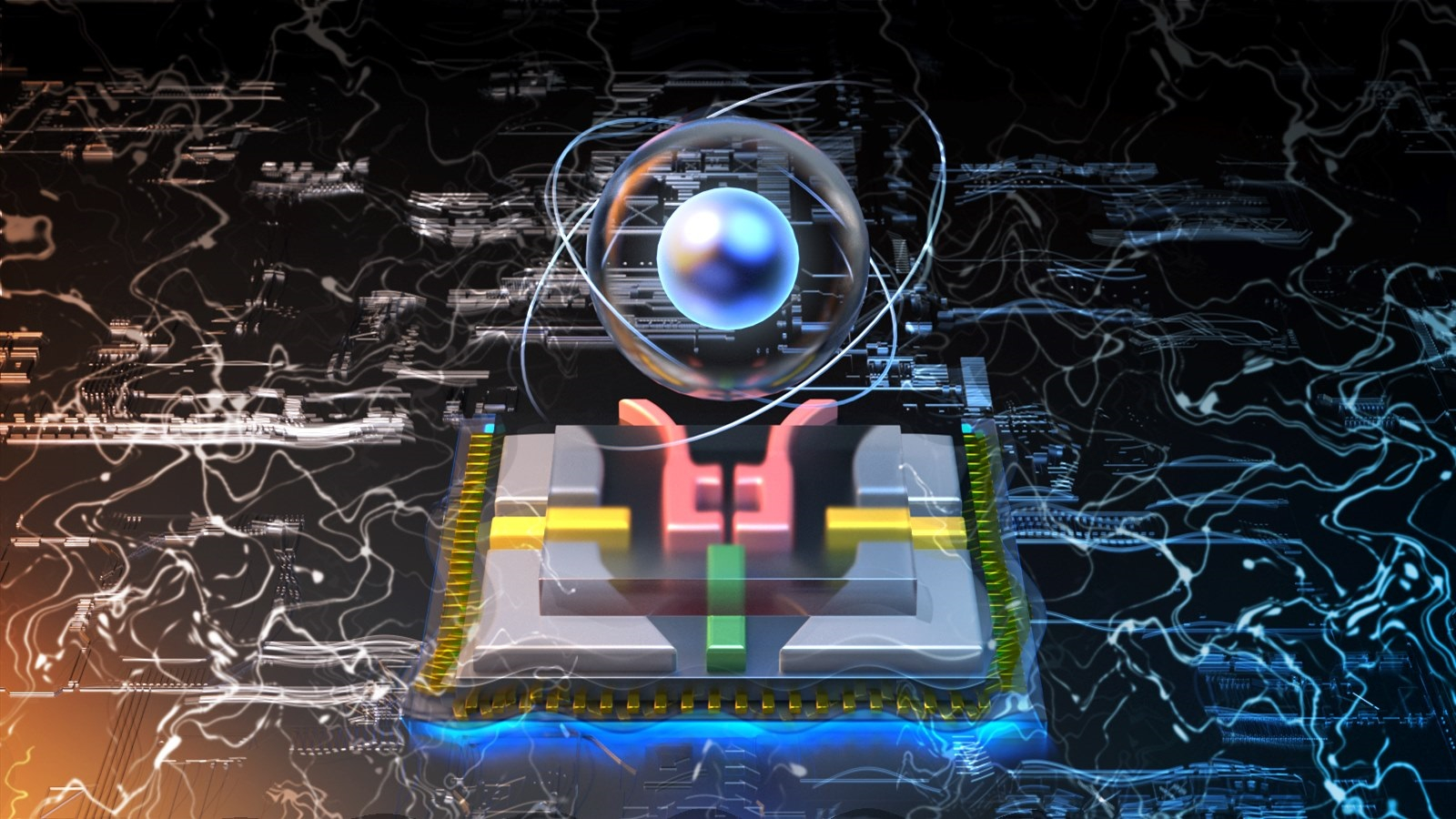
A quiet qubit: An electron (represented by the ball) is controlled by a resonator (red wires) above a solid neon surface (the transparent square piece under the ball). Noise (disturbances) in the environment (represented by the distortion) becomes quiet around the electron and neon (clear area). (Image by Xu Han/Argonne National Laboratory)
LEMONT, Ill.--(BUSINESS WIRE)--Quantum bits (qubits) are the fundamental building blocks of quantum information processing. A novel qubit platform invented at the U.S. Department of Energy’s (DOE) Argonne National Laboratory exhibits noise levels thousands of times lower than those of most traditional qubits. Noise refers to disturbances in the environment that diminish a qubit’s performance. The platform was built by trapping single electrons on the surface of frozen neon gas. The recent finding positions Argonne’s platform as a strong contender in the field of high-performance quantum technologies.
Quantum computing: Potentially transformative, but challenged by noise
Today’s computers and smartphones run on bits, which are tiny switches that can be either 0 or 1. Quantum computers use a special kind of bit known as qubits that can be 0 and 1 at the same time. What’s more, the state of one qubit can instantly affect another qubit’s state, even if they are on opposite sides of the planet. The remarkable properties of qubits can endow quantum computers with exponentially greater computational power than that of classical computers.
Yet, quantum computers are still an emerging technology. Qubits are extremely sensitive to noise — tiny disturbances in the environment such as electromagnetic fields, heat and particle vibrations. As a result, qubits tend to have short coherence times, meaning that they can only retain information for a fraction of a second. This makes quantum computers very error-prone.
Most of today’s chip-based qubits are made of semiconducting or superconducting materials. Semiconductors have controllable conductivity while superconductors have no electrical resistance. In experiments, industry-leading qubit platforms have performed reasonably well. However, qubits based on both semiconducting and superconducting materials are often challenged by noise from material defects, embedded charges and fabrication variability.
The electron-on-neon qubit has the potential to address these limitations. Because solid neon is chemically inert and free of impurities, it is inherently much quieter than semiconducting or superconducting materials.
A systematic noise characterization
The present study evaluated the platform’s quietness with a systematic noise characterization performed at the Center for Nanoscale Materials, a DOE Office of Science user facility. This involved directing carefully timed sequences of microwave pulses through the resonator at various frequencies. The sequences manipulate the qubit and probe noise in its local environment.
The study team found that the noise in the neon qubit platform is 10–10,000 times lower than that in most semiconducting qubits and rivals the lowest semiconductor noise records. In addition to its excellent noise properties, the neon qubit has a much simpler, lower-cost fabrication process relative to semiconducting and superconducting qubits.
The new study, jointly led by Argonne and the University of Notre Dame, was published in Nature Electronics.
Contacts
Christopher J. Kramer
Head of External Communications
Argonne National Laboratory
Office: 630.252.5580
Email: media@anl.gov