Teledyne Supports NASA’s Artemis II Mission with Critical Technologies Across Multiple Businesses
Teledyne Supports NASA’s Artemis II Mission with Critical Technologies Across Multiple Businesses
From launch hardware and deep-space communications to power and electronics, Teledyne technologies are enabling humanity’s next step beyond Earth orbit
THOUSAND OAKS, Calif.--(BUSINESS WIRE)--Teledyne Technologies Incorporated (NYSE:TDY) today announced its broad support of NASA’s Artemis II mission, with multiple Teledyne businesses delivering mission‑critical technologies that help power, protect, connect, and track America’s first crewed voyage around the Moon in more than 50 years.
Artemis II’s unprecedented demands for safety, reliability, and performance require best‑in‑class components capable of surviving the full spectrum of launch forces, deep‑space radiation, extreme thermal environments, and vast communication distances. From the Space Launch System (SLS) rocket to the Orion spacecraft and the global infrastructure that monitors it, Teledyne solutions are embedded throughout the mission’s lifecycle.
“Artemis II represents one of the most ambitious human space missions ever undertaken, and Teledyne is proud to support it at every level,” said George Bobb, President and Chief Executive Officer of Teledyne Technologies. “Across our businesses, we’re delivering the trusted technologies that enable launch, sustain power, maintain communications, and provide situational awareness as Orion travels farther from Earth than any crewed spacecraft before it.
“Teledyne has been supporting NASA’s space missions for more than 65 years, including the Apollo space program, and this latest mission highlights the breadth and strength of our space technology portfolio,” George Bobb added.
Engineering the Path to Lunar Orbit
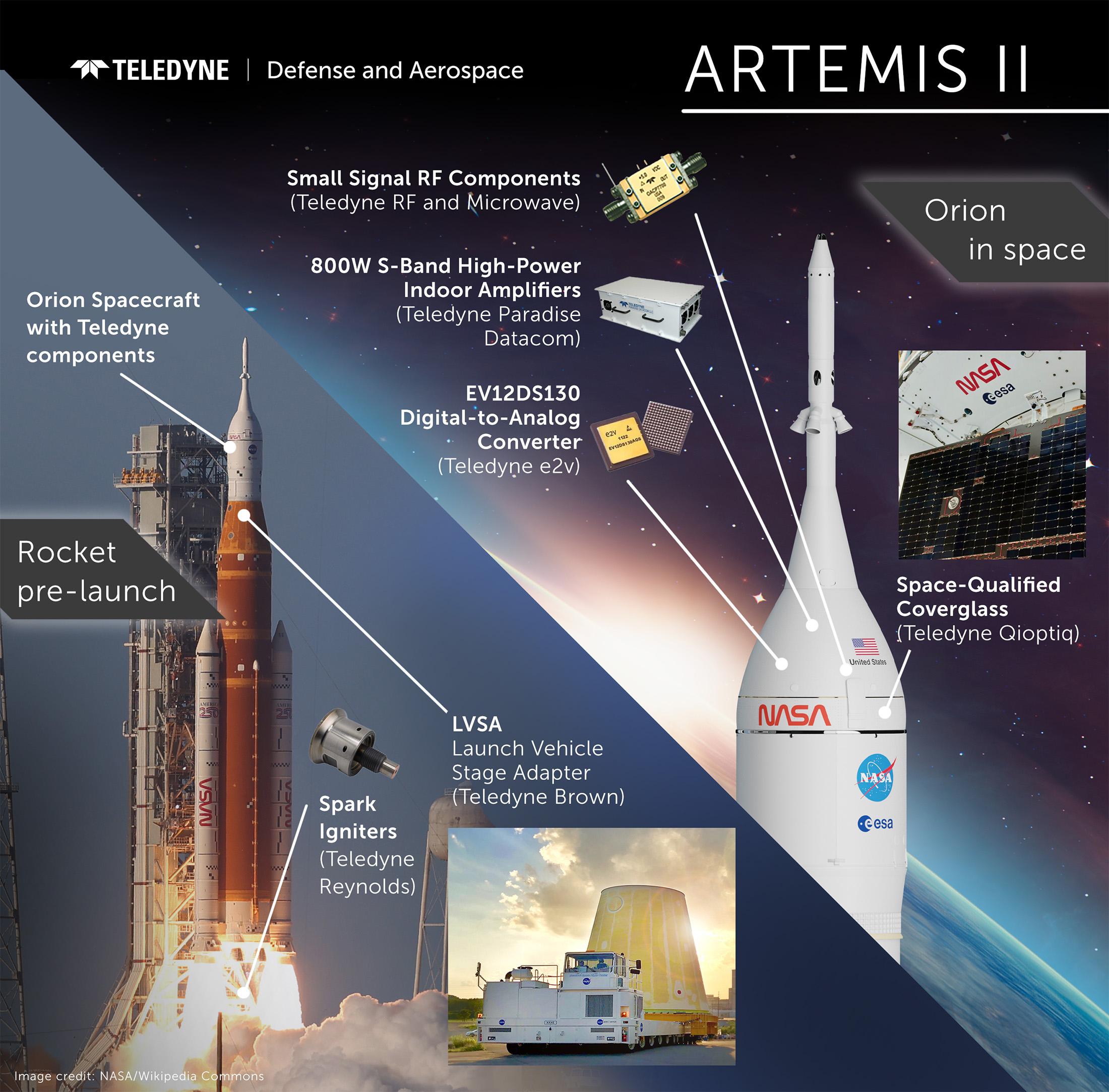
Teledyne Brown Engineering played a foundational role in Artemis II by designing and fabricating the 30-ft tall by 30-ft diameter Launch Vehicle Stage Adapter (LVSA). This zero‑margin‑for‑error structure connects the vehicle’s core stage to the Interim Cryogenic Propulsion Stage and provides the separation system. Designed in close collaboration with NASA’s Marshall Space Flight Center, the LVSA protected critical systems during launch and separated cleanly during ascent, enabling Orion to proceed on its lunar trajectory. Teledyne Reynolds builds the spark igniters for all four RS‑25 main stage engines. Each igniter provides the energy required to ignite the oxidizer and fuel pre‑burners, plus the main combustion chamber, while also serving as the primary pressure seal during engine start, with six igniters installed per engine.
Powering Exploration in a Hostile Environment
Reliable power is essential for crewed deep‑space missions. Teledyne Qioptiq supplied the space‑qualified coverglass protecting Orion’s solar arrays – critical to shielding solar cells from radiation, atomic oxygen, and severe thermal cycling while preserving optical performance. With more than five decades of heritage and over 30 million space‑qualified components delivered, Teledyne Qioptiq brings proven confidence to one of the mission’s most life‑critical subsystems.
Keeping Orion Connected Across the Void
Maintaining precise tracking and constant communications across hundreds of thousands of miles requires a robust global infrastructure. Teledyne Paradise Datacom supports Artemis II through its 800‑watt S‑band high‑power indoor amplifiers, installed at key tracking sites across the United States, Europe, and Australia. Teledyne e2v contributed its EV12DS130 digital-to-analog (DAC) converter, embedded in Orion’s data link. The high-speed, high-performance DAC plays a key role in ensuring reliable data transmission between the crewed capsule and ground systems. These systems provide primary and backup communications links, ensuring Orion’s position, trajectory, and health can be monitored continuously throughout the mission, now and across future Artemis flights.
High-Reliability Components with Mission‑Critical Impact
Throughout the Orion capsule, Teledyne RF & Microwave small‑signal radio frequency (RF) components quietly perform indispensable roles. These precision components enable communications, navigation, and electrical signal routing, ensuring data integrity across extreme distances and environments. While unseen by astronauts and ground crews, these technologies allow Orion to effectively “talk,” “listen,” and operate reliably far beyond Earth orbit.
Capturing History as It Happens
As Artemis II lifted off, Teledyne FLIR Defense captured high‑resolution electro‑optical and infrared imagery of the launch using its airborne Star SAFIRE® 380X imaging system during flight demonstrations near Kennedy Space Center. The imagery offers a unique perspective on a historic moment, showcasing Teledyne’s ability not only to enable exploration, but to help document it.
From mission control to deep space and back again, Teledyne is helping NASA extend humanity’s reach beyond Earth and lay the foundation for sustained lunar exploration and future missions to Mars.
About Teledyne Technologies
Teledyne Technologies is a leading provider of sophisticated digital imaging products and software, instrumentation, aerospace and defense electronics, and engineered systems. Teledyne's operations are primarily located in the United States, the United Kingdom, Canada, and Western and Northern Europe. For more information, visit Teledyne's website at www.teledyne.com.
Contacts
Media Contact:
Joe Ailinger, Jr.
Teledyne Defense & Aerospace
Email: joe.ailinger@teledyne.com