European defense sector faces a major digital execution gap as impact expectations surge, new BearingPoint study finds
European defense sector faces a major digital execution gap as impact expectations surge, new BearingPoint study finds
A new BearingPoint study highlights how digital technologies are reshaping Europe’s defense value chain and why accelerating digital transformation is essential to strengthen industrial resilience and operational readiness.
AMSTERDAM--(BUSINESS WIRE)--Europe’s defense sector is entering a new phase of transformation. Rising geopolitical tensions, evolving security threats, and increasing pressure to strengthen Europe’s strategic autonomy are forcing defense organizations to rethink how they design, produce, and sustain military capabilities. In this context, MSC 2026 signaled a new era of industrial scale, accelerated procurement, AI-enabled capabilities, and deeper industry-government cooperation.
In an increasingly uncertain geopolitical environment, digital transformation is becoming a central pillar of Europe’s defense resilience.
Share
According to a new study by management and technology consultancy BearingPoint, digital technologies are a critical enabler of this transformation. However, many defense organizations across Europe still face significant barriers in scaling digital capabilities across complex value chains driven by fragmented digital architectures, multi-stakeholder governance complexity, and constraints in execution capacity
The report, “Digital transformation in Europe’s defense value chain,” highlights the growing importance of digital technologies in improving industrial efficiency, operational readiness, and supply chain resilience across the defense ecosystem.
“To strengthen resilience and maintain technological sovereignty, defense organizations must accelerate digital adoption across the entire value chain, from design and manufacturing to maintenance and logistics,” said Manuel Schuler, global leader Automotive, Manufacturing, and Defense at BearingPoint.
Key findings:
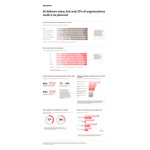
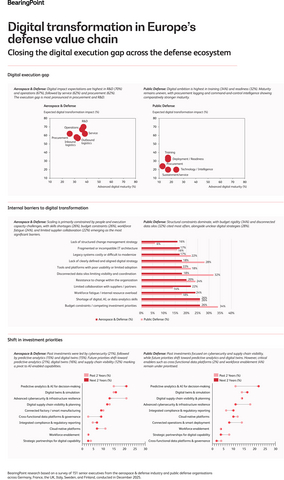
- 60–70% of aerospace and defense executives expect digital transformation to have a high or very high impact by 2028, yet only 20–30% report advanced levels of digital maturity today, highlighting a significant execution gap.
- In the public defense sector, the strongest digital transformation ambitions are in training and simulation (34%) and deployment readiness (32%), while advanced digital maturity in areas such as procurement and supplier ecosystem visibility remains limited.
- In the aerospace and defense industry, scaling digital transformation is primarily constrained by people and execution‑capacity challenges, with skills shortages (26%), budget constraints (26%), workforce fatigue (24%), and limited supplier collaboration (22%) emerging as the most significant barriers.
- In the public defense sector, structural constraints dominate, with budget rigidity (34%) and disconnected data silos (32%) cited most often, alongside unclear digital strategies (28%).
- Investment priorities across the defense ecosystem are increasingly shifting toward AI‑enabled decision support, predictive analytics, and digital twin environments, reflecting a growing focus on data‑driven optimization and lifecycle integration.
- At the same time, investment in supplier network visibility and supply chain orchestration is gaining importance, as defense organizations seek to mitigate geopolitical risks and improve coordination across complex, multi‑tier ecosystems.
The growing importance of digital technologies in defense
The study finds that digital transformation is reshaping all core stages of the defense value chain, from research and development to production, maintenance, and lifecycle management.
Technologies such as AI, advanced analytics, digital twins, and cloud platforms are enabling defense organizations to improve system design, accelerate production cycles, and enhance operational performance. These technologies also help defense organizations manage increasingly complex supply chains and improve collaboration between public and private stakeholders.
The study also highlights the growing shift toward software-defined defense, as defense systems are increasingly shaped by software, data, and continuous upgrades rather than fixed hardware. This shift places new demands on digital architectures, governance, and cybersecurity, making interoperable platforms, secure data foundations, and resilient software delivery capabilities critical to sustaining operational effectiveness. However, despite growing awareness of the importance of digital transformation, many defense organizations continue to operate with fragmented digital architectures and governance structures that limit data sharing and hinder the integration and scaling of new digital capabilities.
“Defense organizations must move beyond isolated digital initiatives and adopt a more integrated approach to transformation,” said Manuel Schuler. “By connecting data across the defense ecosystem and embedding digital technologies into core operations, organizations can significantly improve efficiency, resilience, and decision-making.”
Strengthening Europe’s defense value chain
The study emphasizes that accelerating digital transformation will be essential to strengthening Europe’s defense industrial base.
Improving data interoperability, modernizing digital infrastructure, and adopting advanced technologies can help defense organizations enhance collaboration across the value chain, reduce operational risks, and improve lifecycle management of complex defense systems.
“In an increasingly uncertain geopolitical environment, digital transformation is becoming a central pillar of Europe’s defense resilience. Closing the execution gap requires coordinated transformation across the entire defense ecosystem industry and government together,” concludes Reinhard Geigenfeind, global leader Public and Health at BearingPoint.
About the study
The “Digital transformation in Europe’s defense value chain” study explores how digital technologies are reshaping Europe’s defense ecosystem and examines the opportunities and challenges organizations face in accelerating digital transformation.
The research is based on a survey of 151 senior executives, including 101 aerospace and defense industry leaders and 50 public defense decision-makers, across Germany, France, the United Kingdom, Italy, Sweden, and Finland. Respondents include senior leaders responsible for digital transformation, technology, operations, and strategy.
The analysis is complemented by expert insights and BearingPoint’s experience working with defense organizations and industrial partners across Europe.
Download the full study here: https://www.bearingpoint.com/en/insights-events/insights/digital-transformation-in-europes-defence-value-chain/
About BearingPoint
BearingPoint is an independent management and technology consultancy with European roots and a global reach. We help businesses transform by combining deep industry expertise with strong capabilities in strategy, operations, and technology. Dedicated SAP and Microsoft transformation units, a strong focus on AI, and outcome-based products enable us to provide tailored, innovative solutions that create measurable and sustainable value.
In addition to our core consulting operations, we run two joint ventures. Arcwide, our joint venture with IFS, specializes in business transformation enabled by IFS technology. BearingPoint North America, our joint venture with ABeam Consulting, focuses on consulting excellence and business transformation built on SAP.
BearingPoint works with many of the world’s leading companies and public-sector organizations. Together with its strategic alliance partner ABeam Consulting, the firm brings together more than 15,000 professionals and serves clients in over 70 countries, delivering seamless business transformation, strengthening performance, and driving sustainable impact.
BearingPoint is recognized among TIME World’s Best Companies and Forbes World’s Best Employers. The firm is also a certified B Corporation, committed to responsible business and creating long-term value for organizations, people, and society.
For more information, please visit:
Homepage: www.bearingpoint.com
LinkedIn: www.linkedin.com/company/bearingpoint
Contacts
Press contact
Alexander Bock
Global Senior Manager Communications
Telephone: +49 89 540338029
Email: alexander.bock@bearingpoint.com