New Study Reveals 75% of Enterprises Report Double-Digit AI Failure Rates as Fragmented Observability Hits Its Breaking Point
New Study Reveals 75% of Enterprises Report Double-Digit AI Failure Rates as Fragmented Observability Hits Its Breaking Point
59% of Executives Say Organizations Are AI-ready, While 62% of Practitioners Report Fragmented Systems Unfit for Machine-Scale Operations
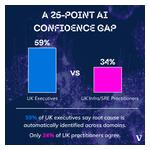
PALO ALTO, Calif.--(BUSINESS WIRE)--Enterprise IT is approaching a structural breaking point. New research released today by Virtana reveals a widening leadership disconnect as AI workloads scale beyond the limits of legacy observability. The “AI Is Breaking Human Managed Operations” report found that while 59% of executives believe their organizations are prepared for AI-scale operations, 62% of practitioners report fragmented systems and persistent visibility gaps. Three in four enterprises report AI job failure rates have already reached double digits, signaling measurable instability as adoption accelerates.
“The data is unambiguous. While executive confidence is rising, operational fragility is rising faster,” said Paul Appleby, CEO of Virtana. “When three-quarters of enterprises report double-digit AI job failure rates and one-third exceed 25%, the operating model is clearly outdated. At enterprise scale, these rates translate into thousands of failed executions per day, driving retries, wasted compute capacity, cascading delays, and escalating operational risk. As AI workloads expand and agentic systems begin operating autonomously, modest failure percentages compound into systemic volatility.”
Executive Confidence Masks Operational Reality for AI-Scale Operations
The research reveals a consistent and widening disconnect between executive confidence and practitioner reality. While 59% of executives believe their platforms are AI-ready, 62% of practitioners report fragmented systems and persistent visibility issues. Less than half are confident current observability tools can handle AI-scale workloads.
The divide is sharpest around cost governance, where a 16-point confidence split separates executives (67%) from the practitioners (47%) who experience the operational reality those investments are meant to address.
These forces converge to make even modest leadership-practitioner misalignment compound rapidly into systemic instability.
One in Four AI Jobs Fail, Exposing the Breaking Point of Human-Managed Operations
Organizations are experiencing AI failure rates that would be unacceptable in any mission-critical system, with 75% reporting AI job failure rates exceeding 10% and 33% experiencing failure rates above 25%, meaning one in four AI jobs fail.
These failure rates confirm that human-scale operations cannot sustain machine-scale systems. Practitioners recognize this reality: 45% fear they cannot meet AI workload demands with current systems, and 56% cite storage and networking bottlenecks as their top AI constraint.
The challenge extends to containerized environments, where 76% of practitioners experience multiple container-related failures, with more than half encountering three or more simultaneous failures. As applications decompose into distributed systems spanning services, clusters, nodes, storage systems, network paths, and AI services across hybrid and multi-cloud environments, operational models and observability architectures have not kept pace.
“Practitioners are confronting unprecedented complexity as the definition of ‘application’ has fundamentally shifted from discrete code to distributed delivery systems,” said Amitkumar Rathi, Chief Product Officer at Virtana. “Modern applications now span infrastructure, cloud platforms, Kubernetes, storage, networks, data pipelines, and AI workloads operating simultaneously. As organizations race toward AI adoption, these systems are scaling faster than operational models can support, exposing the limits of fragmented observability. At machine scale, teams cannot manage what they cannot see end-to-end, making continuous, real-time system context essential for reliable AI operations.”
This complexity manifests in GPU infrastructure challenges, with 41% of practitioners reporting GPU inefficiency and contention as AI workloads introduce nonlinear scaling, extreme burstiness, and deep cross-domain dependencies that exceed human cognitive capacity.
The Observability Investment Paradox and the Path Forward with Executive Alignment and Autonomous Operations
Gartner estimates the observability products market will reach approximately $14.2 billion by 2028. Yet despite this substantial investment wave, only 48% of practitioners, the engineers and operators working inside these platforms daily, are confident their current observability tools can handle AI-scale workloads. Enterprises are pouring billions into observability, while the people who must use those tools are sounding alarms. Investment decisions are being made at the executive level without adequate input from the practitioners who experience the operational reality those investments are meant to address.
“With budgets flat and teams not growing, organizations must scale IT through agentic AI, autonomous operations, and unified observability across the full system,” continued Appleby. “You cannot layer AI agents onto fragmented observability and expect reliability. These agents can only reason, decide, and act safely when they operate with full-stack operational context and continuous, real-time correlation across enterprise systems. Without unified observability functioning as an operational control plane, autonomous agents will inherit the same blind spots that plague legacy monitoring, then amplify those failures at machine speed and hyperscale.”
In direct response to these findings, Virtana today announced a new Application Observability offering, purpose-built to address the visibility crisis documented in the research. The new capability addresses the challenges of traditional application performance monitoring by automatically correlating application performance issues across the entire enterprise tech stack, from code and services to infrastructure, networks, and AI platforms, delivering the unified, full-stack context that practitioners report as missing.
Resources
- Download the “AI Is Breaking Human-Managed Operations” research report
- Learn more at virtana.com
- Follow Virtana on LinkedIn and X
Research Methodology
This report is based on an independent global survey of 351 senior IT and technology leaders responsible for enterprise infrastructure, operations, cloud platforms, Kubernetes environments, and AI workloads. Respondents came from organizations with 100 to 10,000+ employees, operating large-scale, business-critical digital environments spanning hybrid, multi-cloud, and on-prem infrastructure, Kubernetes platforms, GPU-accelerated AI workloads, and 24×7 production systems.
About Virtana
Virtana delivers the deepest and broadest observability platform for hybrid and multi-cloud, with full-stack AI observability spanning applications, services, data pipelines, GPUs, CPUs, networks, and storage. Powered by high-fidelity data and agentic AI, Virtana provides unmatched visibility across end-to-end IT services and AI workloads, correlating health, performance, cost, and user impact in real time. With advanced event intelligence and autonomous insight generation, Virtana delivers clarity no other provider can match. Trusted by Global 2000 enterprises and public sector organizations, Virtana helps IT operations and DevOps teams reduce risk, strengthen resilience, improve efficiency, and modernize with confidence across multi-cloud, on-premises, and edge environments. Learn more at virtana.com
Contacts
Media Contact
Stephanie Floyd
Bhava Communications for Virtana
virtana@bhavacom.com