Omdia: Hyperscaler Cloud Marketplace Sales to Hit $163 Billion by 2030
Omdia: Hyperscaler Cloud Marketplace Sales to Hit $163 Billion by 2030

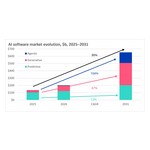
LONDON--(BUSINESS WIRE)--New research from Omdia has revealed that enterprise software sales through hyperscaler cloud marketplaces - led by AWS, Microsoft, and Google Cloud - are projected to surge from $30 billion in 2024 to $163 billion by 2030.
“Hyperscaler marketplaces continue to see rapid momentum as a route to market for vendors across the technology industry," said Alastair Edwards, Chief Analyst at Omdia.
Share
This growth reflects increasing enterprise adoption of marketplace procurement and a sharp rise in agentic AI sales. Omdia forecasts a five-year compound annual growth rate (CAGR) of 29.1% from 2025 to 2030, as vendors across the IT industry – from large global software vendors to ISV startups – increasingly embrace hyperscaler marketplaces as a primary route to market.
Strategic Cloud Spending Becomes Key Marketplace Driver
A key driver of this market is the continued growth of upfront multi-year cloud commitments by enterprise customers. Currently, there are estimated to be close to $470 billion in cloud commitments across AWS, Microsoft Azure, and Google Cloud, a proportion of which customers can spend on third-party marketplace purchases. The accelerating pace of this spend is demonstrated by the nearly $30 billion of new commitments added in Q2 2025 alone. Customers are moving from opportunistically using marketplace purchases to burn down unused commitments to more strategic marketplace procurement, negotiating cloud commitments to include budget for a broader set of vendor products that align with their cloud adoption strategies.
Notably, channel partners continue to adapt to this new procurement method rather than being displaced by it, supported by partner private offers and distributor models from all three of the major hyperscalers. By 2030, Omdia predicts that partners will facilitate nearly 60% of all marketplace transactions helping customers manage their commitments, purchase across multiple cloud marketplaces, and provide expertise and support across the full customer lifecycle. Beyond this, in the agentic age, partners are developing their own AI offerings and platforms, enabling them to capture a growing share of the billions of dollars transacted through these marketplaces.
Foundational Software Dominates as AI and Security Accelerate
Three technology categories will account for 63% of total spending via marketplaces: Infrastructure Software ($10.5 billion), DevOps ($9.1 billion), and Business Applications ($9.1 billion). These categories are the foundational tenets of customer environments, and power both the front end and back end of increasingly complex cloud environments.
As enterprises advance their cloud maturity, the AI marketplace presents tremendous opportunities, particularly through agentic AI. Microtransactions and the continued growth of multi-agent protocols will drive a total spend of $24.4 billion on the back of a 37% CAGR. Cybersecurity represents another high-growth area, projected to reach $31 billion by 2030 with a 31% CAGR, as integrated security platforms become essential, creating additional opportunities for cybersecurity vendors and their partner ecosystems.
“Hyperscaler marketplaces continue to see rapid momentum as a route to market for vendors across the technology industry. A small but growing number of ISVs are now reaching – and exceeding – $1 billion of annual sales through AWS, Google Cloud Marketplace and Microsoft Azure Marketplace, as they activate both partners and distributors to reach a broader set of cloud customers and drive an increasing share of sales. Agentic AI will be one of the fastest-growing categories through marketplaces in the next five years. The hyperscalers are competing hard to win the race as a channel for agentic AI through their agent marketplaces, because this accounts for an ever-greater proportion of cloud consumption,” said Alastair Edwards, Chief Analyst at Omdia.
ABOUT OMDIA
Omdia, part of Informa TechTarget, Inc. (Nasdaq: TTGT), is a technology research and advisory group. Our deep knowledge of tech markets grounded in real conversations with industry leaders and hundreds of thousands of data points, make our market intelligence our clients’ strategic advantage. From R&D to ROI, we identify the greatest opportunities and move the industry forward.
Contacts
Fasiha Khan: fasiha.khan@omdia.com